

In This State is a syndicated weekly column about Vermont’s innovators, people, ideas and places. Details are at http://www.maplecornermedia.com/inthisstate/. Dirk Van Susteren of Calais is a freelance reporter and editor.
Four thousand years ago, Egyptian fish farmers raised tilapia in ponds along the Nile as a protein accompaniment to the breads, lentils, dates, figs and other rustic foods that graced their tables.
Two thousand years ago, the fishermen of Galilee, including the apostles of Jesus Christ, sailed and rowed on the Sea of Galilee to cast their nets for tilapia to feed their families and sell in markets. The fish, a.k.a. musht, likely played a lead role in the New Testament story of the “Miracle of the Loaves and the Fishes.”
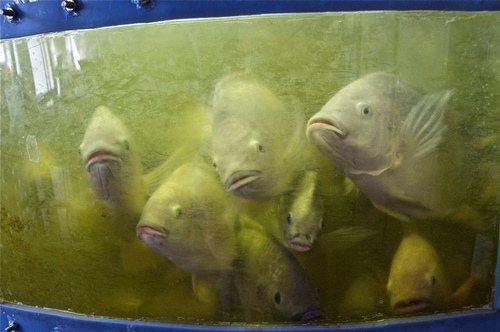
And 10 years ago, Tim Gustafson-Byrne, a horticulture teacher and food aficionado at the North Country Career Center, located next to the high school in Newport, Vt., found a 250-gallon tank, filled it with water at the school’s greenhouse and began raising this fish of ancient times.
That’s a lot of history swimming in a modest tank in an unlikely place.
The number he chose to farm, 150, were not of biblical proportions, but they were enough for his purpose.
“It’s all about sustainability,” says Gustafson-Byrne, who still farms the fish as both a healthy food product and a source of fertilized water for the vegetables and herbs that grow hydroponically at the school.
And for the record, Gustafson-Byrne likes his own food to be grown or produced, like the school veggies, unadulterated, at home or close to home.
He has no taste, he says, for: “tomatoes, irradiated so they turn red just when they arrive at the store; carrots chemically treated to bring out color, or milk from cows treated with bovine growth hormone.”
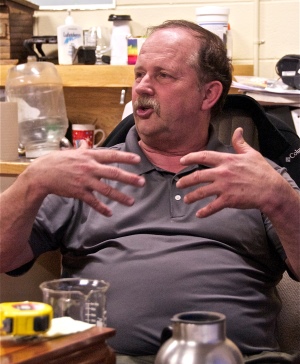
“We are trying to promote skills and a philosophy that will benefit students throughout their lives,” he adds during an informal tour of his classroom and the adjoining work area — which in late afternoon is empty of students but filled to the gills with manuals, books, assorted tools of the horticulture trade, a Shop-Vac, wheelbarrows, solar panels with attached batteries, plus a sink, hoses, pipes and buckets and seedlings popping from plastic seed pots.
If the fish and seedlings aren’t enough to promote the idea that resources are limited in a rapidly changing world, classroom posters help do the trick, among them one highlighting the causes of global warming and another celebrating Dr. Rudolf Diesel’s 1893 invention of the vegetable-oil engine.
With tilapia, Gustafson-Byrne picked a worthy fish. Next to carp, tilapia is said to be the world’s most farmed fish. While practically unknown in this country a decade ago, Americans now consume 475 million pounds of tilapia annually, most of it farmed in China and Latin America.
Tilapia provides valuable protein and contains heart-healthy omega-3 fatty acids, though not in the concentrations one finds in, say, salmon or mackerel.
In this era of diminishing cod, swordfish and other popular ocean stocks, the respected consumer-advisory organization, Seafood Watch, gives tilapia farmed in “a closed re-circulating system,” like Gustafson-Byrne’s operation, a “best choice” designation.
And that’s fine with him, because over the course of a year, as the fish grow to two or three pounds, he has to rid the school of several hundred of pounds of tilapia. So, he sells them whole for $5 or less a pound to teachers, staff, and students’ parents, or anyone who wants them, putting the fish proceeds into a kitty to help pay the fishes’ room and board.
For a while he was selling tilapia to the Highland Lodge on Caspian Lake in Greensboro, a well-known Vermont resort, until it closed a few years ago for reasons that had nothing to do with the seafood selections served in the dining room.
Gustafson-Byrne occasionally takes a fish home, cleans it, splashes it with olive oil, lemon juice and herbs and wraps in foil and puts it on the barbecue grill. Or, he makes tilapia sushi, with fine slices of raw fish, wasabi, avocado and toasted sesame seeds.
The tilapia arrive once a year as fry, barely an inch long. The teacher orders about 150 of them, now for about a half-buck each, from a Florida company that outfits fish farmers nationally with stock, feed and equipment. They arrive overnight by FedEx at the school in water filled plastic bags that are heavily oxygenated.
Gustafson-Byrne lists a few reasons why tilapia are easy to raise: they thrive in crowded conditions, can tolerate water without much oxygen, and, unlike many other farmed fish, they are easy and cheap to feed because they are vegetarians.
“It’s simple, you can toss in the feed while you are having your morning coffee,” says Gustafson-Byrne.
But one big reason they are hard to raise in Vermont is they require warm water, more than 50 degrees to survive, and near 80 to thrive. That means they are best kept in a tank in an unusually warm room or greenhouse, or tanks outfitted with heating units.
Gustafson-Byrne unfortunately knows this all too well.
Several years ago he lost the whole batch of fish, when on a winter night the heat went off in the school greenhouse.

They also, of course, need water. One morning he entered the greenhouse to find that all of the water had been drained from the tank and all the tilapia were in a stage of rigor mortis. There was no water on the floor, no evidence a valve had been left open, no evidence of mechanical failure. An unsolved mystery, says Gustafson-Byrne.
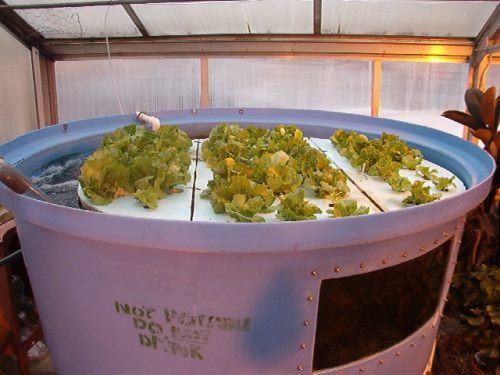
Outside of that, there have been no problems. And the vegetables could not be happier. For a few years water was piped directly to the rows of plants. “Fish poop is really good for them,” says Gustafson-Byrne.
These days, he and students are growing head lettuce in floating racks, the roots of the plants dipping just below the surface of the water, sucking up nutrients. The lettuce winds up in the high school cafeteria in sandwiches, salads, or as conduit for a more expensive fish: tuna.
Gustafson-Byrne’s schoolroom tilapia farm is one of only three licensed tilapia operations in the state, but based on experience he thinks raising the fish could make financial sense, “though one would probably have to become a fishmonger as well.”
Tilapia also is called “St. Peter’s fish,” thanks to another New Testament story, the one about the time Christ sent Peter out to find a silver coin in the fish’s mouth.
Maybe a church somewhere in Vermont could raise tilapia in the parish basement?
“Yes, with everyone trying to buy local, why not?” answers Gustafson-Byrne.


