


In This State is a syndicated weekly column about Vermont’s innovators, people, ideas and places. Details are at http://www.maplecornermedia.com/inthisstate/. This piece is by Nancy Price Graff of Montpelier, a freelance writer and editor.
Hardly anyone noticed when the solid red cow on Vermont’s coat of arms evolved over the years into a shaded red cow, then into a cow with spots. Finally last year someone noticed that one of the spots was unmistakably a pig. This last iteration, printed by inmates in a Vermont correctional facility who produce the decals for the sides of the state police cruisers, was a fiendish joke that was bound to catch someone’s eye. From there it was a short hop to several embarrassing national news stories.
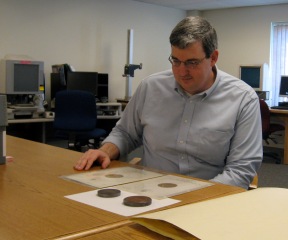
“That’s why you have standards; Vermont’s coat of arms is a brand that represents Vermont,” says Scott Reilly, an archivist at the Vermont State Archives in Middlesex, whose office normally protects the coat of arms and state seal from disparagement or commercial misuse. In this case, the archives had approved the decal designs before an inmate hacked a computer and pulled off his porcine prank.
It seems only fitting that a state conceived in a tavern can trace the origins of its state seal and coat of arms to an enormous drinking mug. At least that’s the legend. In 1778, during the Revolutionary War, an English lieutenant, perhaps a spy, visited Thomas Chittenden, president of the new Republic of Vermont, at Chittenden’s home in Arlington.
The English visitor was struck by the beautiful sight of fields ripe with grain, grazing cows, lush woodlands, including a towering pine, and in the distance the blue peaks of the Adirondacks. Inspired, he sketched the panorama on a drinking mug carved from an ox horn.
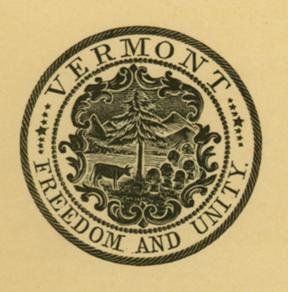
Ira Allen later saw the mug with its unique design and set out to rework the Englishman’s drawing. What came of his efforts was a stylized arrangement of the original features, a creation Allen brought to Reuben Dean, a silversmith in Windsor, to be engraved on a printing plate as the republic’s official seal.
The coat of arms came along approximately 30 years later. Featuring most of the same objects found on the seal, it presents them in a less stylized, more pictorial and painterly fashion.
Over the years, the seal and the coat of arms have come to reflect different uses. According to Reilly, “The purpose of any seal is (to serve as) a mark showing that the document is official. Its use is usually reserved for the governor.

“The coat of arms is probably more widely used than the seal,” he adds. It is a symbol that represents an official connection between something and the state of Vermont. For this reason it appears on state police cars, above the speakers’ podium in the well of the Statehouse, on the state flag, on state stationery, and anywhere else the state desires to make that official relationship clear.

To demonstrate one of the earliest uses of the state seal on a document, Reilly lays out on a table a yard-long, handwritten, framed document officially chartering the town of Barton in 1789. In the upper left-hand corner is a crudely hand-drawn and badly faded rendition of what then was Vermont’s new seal. Surrounding the circular medallion is a saw-tooth border, each tooth a small triangular piece of paper glued in place. The spindly pine tree, a focal point of the seal, is barely visible.
While the design of the state seal has changed little since 1779, the design of Vermont’s coat of arms has taken a wild ride over the years.
“The coat of arms is more like an emblem, and it comes out of heraldry,” says Reilly. This means it usually includes an escutcheon, a crest, and a motto. As such, a coat of arms can be freer in its design and yet is subject to formulaic arrangements that hark back to ancient times.
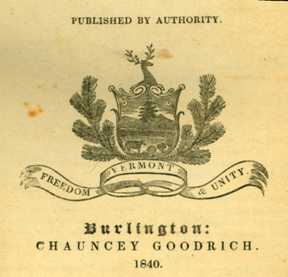
The first known Vermont coat of arms appears on an 1821 military commission. In 1840 it first appears on the title page of the annual official record of the Legislature’s activities, but someone has added a surround of pine branches, supposedly to commemorate the twigs carried by Vermont soldiers to remind them of their state as they entered into the Battle of Plattsburgh in 1814.
Over the years various printers in Vermont vying for state printing contracts had dies engraved reflecting their own versions of the coat of arms.
Finally, in 1862 Vermont codified a description of the state’s coat of arms: The fields and trees should be green, the sky yellow, the Green Mountains blue. A specimen pine dominates the center, flanked by three sheaves of wheat and a red cow. The crest is a buck’s head with antlers, and two crossed pine branches appear at the base and sides. A flowing banner bearing the motto “Freedom and Unity” floats across the base.
This description is contrary to what anyone looking at the coat of arms these days will see, but according to the protocols of heraldry, all descriptions are given from the point of view of the person bearing the shield.
The Legislature came up with that official description after it had commissioned prominent Vermont painter Charles Lewis Heyde to produce an official version in 1861 to hang in the House of Representatives. Heyde’s version on wood is lovely, richly colored, gleaming with gilt, and, perhaps most important, specific to Vermont.
In place of generic mountains rising to the west, he painted Camel’s Hump and Mount Mansfield, not from Vermont’s viewpoint but as seen from the shore of New York State, the way Samuel de Champlain would have seen them on his voyage of discovery in 1609. Unfortunately, Heyde’s painting was eventually lost, although there was a second, now belonging to the Shelburne Museum.
Codifying the design and having Heyde create a stunning model for the coat of arms still did nothing to stem creative interpretations by Vermont engravers in the years to come.
The buck might face left or right; the pine tree was once depicted as a maple tree. One version has a farmer scything a field and tiny buildings in the background. The cow and sheaves appear on the left side and the right side, then the reverse. A river runs through the foreground. A lake, presumably Lake Champlain, appears in the background. The pine twigs were briefly plumes. The cow is red in most versions, but a black and white Holstein appears in the late 1800s.
These days the Secretary of State’s office, which oversees the Vermont archives, receives all kinds of requests from organizations and companies to use either the seal or the coat of arms in their marketing.
The office politely says no. Today, Vermont is recognized the world over as a symbol of independence, integrity, and fortitude. To attach the state’s most important symbols to commercial products might be lucrative. However, the law is clear: As close to sacred as any symbols in Vermont’s culture, neither the seal nor the coat of arms are for sale.
Reilly enjoys imagining what a contemporary Vermont coat of arms might include as symbols of modern Vermont. “Kale for the sheaves of wheat,” he says. “Mountains with wind towers, a Subaru with a ski rack. And dogs.”
