

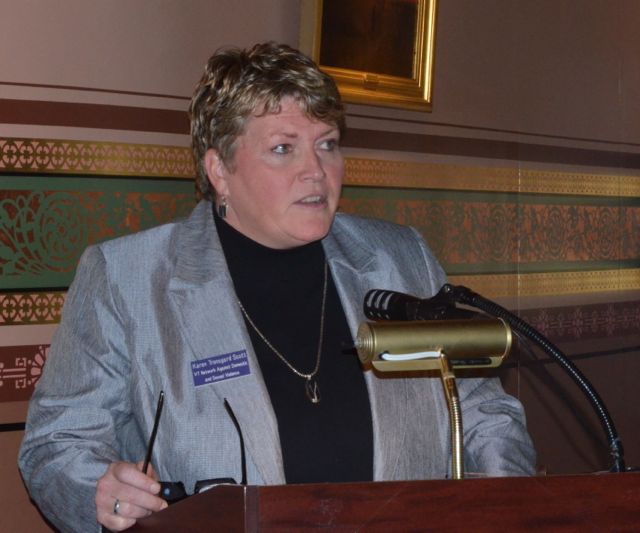
In the fall of 2012, the Prevention of Domestic and Sexual Violence Task Force commissioned the Castleton Polling Institute to carry out what they say is the state’s first poll on the topic. The results were released today to an audience of legislators and advocates at the Statehouse.
The poll surveyed 341 men from all 14 counties. Participants ranged in age from 18 to 90 years.
Task force members said they saw a surprising symmetry between the views of men under 24 and those over 55. Sixty percent of participants between the ages of 18 and 24 and above age 55 said that women who wear “tight or revealing clothing” are “always inviting sexual comments or other advances.”
Chris Dinnan, the member of the task force who oversaw the survey, said men between the ages of 30 and 55 demonstrated “more progressive views” than their younger and older counterparts. Only about 45 percent of men in this age group reported that women invite sexual advances when they wear provocative outfits.
Roughly half of the men surveyed indicated that they think rape accusations are “rarely” false. Dinnan said the task force was disheartened that this number wasn’t higher. Forty-eight percent of the men surveyed reported that they think accusations of rape are sometimes false (42 percent) or often false (6 percent).
“The fact that almost half of the respondents did not gravitate to the rarely false category is clearly concerning,” Dinnan said.
Dinnan says national research shows 2 percent to 8 percent of rape accusations are false.
The task force pointed out another troubling result: The men surveyed were more inclined to think sexual violence is a problem outside the state than in Vermont.
Some 88 percent of respondents indicated that violence against women is either “very” common or “somewhat” common across the country, while only 77 percent reported the same for Vermont.
“The fact that Vermont men assume, by a significant percentage, that the problem is less of problem here than elsewhere, is another problem,” Dinnan said.
Dinnan said the survey results clearly showed men have a solid and nuanced understanding of what constitutes an act of domestic and sexual violence, but most respondents reported that they would only intervene to stop this type of violence if they felt someone was about to be physically harmed.
The task force’s report concludes that, “A majority of respondents defined domestic and sexual violence broadly to include behaviors beyond physical violence. Yet when presented with a hypothetical situation asking them at which point they would intervene, their response rate was much lower than what might be expected… Respondents generally reported that the imminent threat of, or actual physical harm, would need to be present before they became engaged bystanders.”
Task force members want the survey to serve as a benchmark so they can gauge whether attitudes improve or deteriorate over time. Members said there haven’t been surveys of this kind conducted elsewhere in the nation, so it’s impossible to know how men’s attitudes in Vermont stack up against those in other states.
Bethany Pombar, who chairs the task force and is also a member of the VT Network Against Domestic and Sexual Violence, said the survey results will help the task force engage males in their efforts to prevent domestic violence.
Karen Tronsgard-Scott, the executive director for VT Network Against Domestic and Sexual Violence, said in the last three years, their member groups have seen a 17 percent increase in the number of sexual assault victims seeking their services.
Full survey results can be accessed here: http://www.vtnetwork.org/wp-content/uploads/Male-Attitudes-Survey-FINAL-REPORT-Color2012.pdf
