

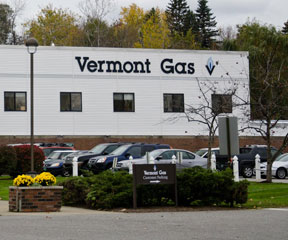
Last Friday, the Vermont Public Service Board told 33 organizations and residents that they could have a voice in the permit proceedings for Vermont Gas Systems’ proposed $86.6 million southern expansion.
What’s deemed the “Addison County Natural Gas Project” consists of a 41.2-mile transmission line from Colchester to Middlebury and 5.1 miles of distribution pipeline in Vergennes and Middlebury.
Entities that are allowed to participate in discovery and technical hearings for this project include, but are not limited to, governments of municipalities that the pipelines will pass through, state agencies, potential customers, landowners and companies that are concerned about the economics of the situation.
The board also gave the Vermont Fuel Dealers Association intervener status — much to the chagrin of VTGas.
Leading up to the order, VTGas reminded the board in a memo that the quasi-judicial body has “consistently ‘denied intervention to entities that have alleged nothing more than an interest as competitors.’”
Eileen Simollardes, vice president of supply and regulatory affairs at VTGas, took issue with the association’s tactics.
“I can’t think of another business model where you’re expected to invite your competitors to the table to lay out your strategies,” she said.
While the board wrote in its order that it shares VTGas’ concerns, the board said it would use its “discretion to admit VFDA as a party because the association is in a position to assist the Board in assessing the claims of VGS relative to the environmental benefits of replacing the consumption of heating oil with the consumption of natural gas.”
In essence, the fuel dealers are limited in their testimony to issues concerning “the environmental and practical implications of relying more on natural gas and less on fuel oil,” as the order states.
Matt Cota, who directs the fuel dealers association, said his group has every right to participate in these hearings.
“We have a very definite interest in presenting testimony because the filing and the public statements made by Gaz Metro’s natural gas subsidiary in Vermont have made statements purporting environmental and economic advantages over the products that our member companies sell,” he said. “Those claims are wildly exaggerated to the point of some not being true at all.”
Simollardes and company will contest Cota.
“I’m confident Vermont gas will be able to demonstrate that natural gas is cleaner than fuel oil on so many levels,” she said. “I can’t think of a place in the world where people say, ‘Let’s use more fuel oil because it’s clean.’ That’s just not happening … In my mind, it didn’t have a unique concern that wasn’t adequately addressed. The board saw it otherwise.”
VTGas and the fuel dealers association will bring in expert testimony to argue for and against the environmental advantages of natural gas.
According to the U.S. Energy Information Administration, fuel oil emits 161.3 pounds of CO2 per million Btu (British Thermal Units, a common measurement of thermal energy output), whereas natural gas emits 117 pounds of CO2 per million Btu.
Of the 35 applicants for intervener status, the Public Service Board denied two, but it will allow those applicants to make their case again with additional information.
The board denied a group called the Vermont Intergenerational Stewards at the request of VTGas because the board and VTGas did not feel they raised issues that would not already be addressed by other parties, and they did not make clear how their organization was structured.
“VIS has cited no statute that confers upon the organization an unconditional right to intervene,” the board wrote. “It is impossible for us to evaluate the VIS request without specific information about who comprises its members, what specific interests those members have as individuals in this proceeding, and how VIS is organized.”
The board also denied a landowner representing other landowners without their consent. Simollardes is under the impression that the other landowners will give their consent, but the board has not yet received that authorization.
The discovery process of the proceedings began on April 19, and technical hearings are slated for Sept. 16-20.
Simollardes said she is hopeful VTGas can move forward with this project by the end of the calendar year.
“We are responding to demands for natural gas in the southern part of the state,” she said. “Customers are asking for natural gas service. If there is a delay in this project, all that we are doing is denying those customers access to cheaper fuel.”
