

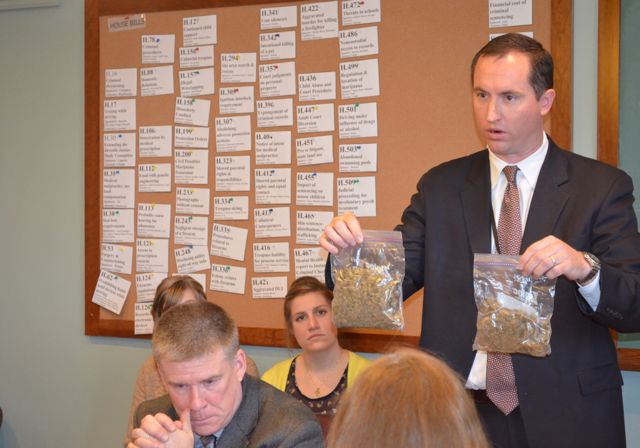
A bill to decriminalize small amounts of marijuana is spawning questions, from the legal to the agricultural.
The House Judiciary Committee plans to iron out the kinks rapidly — the committee chair, Rep. William Lippert, D-Hinesburg, hopes to vote on the bill, H.200, sometime next week.
The committee heard today from top state officials as well as law enforcement officers, state’s attorneys, and the court diversion director.
Law enforcement officers and some states attorneys rehashed longstanding philosophical objections — that decriminalization will encourage marijuana use and strip law enforcement of a tool. But the public safety commissioner, the defender general and the Chittenden County state’s attorney all support decriminalization, and most of the discussion in House Judiciary was spent on logistical details.
Supporters and opponents of decriminalization agree that H.200 would have little impact on freeing up law enforcement to pursue more serious crime or opening up bed space in the state’s prisons. As it is, people are rarely prosecuted solely for marijuana possession, Attorney General Bill Sorrell said.
T.J. Donovan, state’s attorney for Chittenden County, and Public Safety Commissioner Keith Flynn urged the committee to pass the bill to achieve consistency across the state. All 14 counties have distinct criminal justice policies, Donovan argued, and people charged with marijuana possession are “treated differently and unequally depending on the county they are charged in and the legal representation they can afford.” In Chittenden County, prosecutors rely heavily on diversion, and there has been a de-facto decriminalization of the drug.
Defender General Matthew Valerio told the committee that decriminalization will get rid of the “collateral consequences” — ineligibility for student loans or public housing, for example — that follow people charged with marijuana possession.
Lippert said his committee will have to wrestle with a clear conundrum — “Marijuana doesn’t fall from the sky.”
“How does one come into possession of this contraband or illegal substance without participating some larger illegal activity?” he asked.
H.200, which makes possession of two ounces or less a civil violation rather than a criminal one, would also decriminalize the possession of up to two mature plants and seven immature plants.
Flynn said he doesn’t think decriminalization should apply to cultivation. He told the committee that since a mature plant can produce between three-quarters and one pound of marijuana, the bill could effectively “lure” people into a felony charge.
Others, including Sorrell, cautioned that keeping cultivation illegal, while decriminalizing a small amount of marijuana, could simply push people into the black market, where unsavory marijuana dealers hold sway. Sorrell suggested there might be a middle ground — for instance, reducing the number of plants that would fall within the decriminalization threshold.
Winooski Police Chief Steve McQueen, who spoke on behalf of the Vermont Association of Chiefs of Police, opposes decriminalization, and he gave a starker assessment the impact it would have on drug trafficking.
“As much as you may believe that marijuana is this benign, no-big-deal drug,” McQueen said, “what I’d like to submit to you for consideration is that the vast, vast, vast majority, if not 99.99 percent, of the marijuana that these kids are buying and smoking is coming through the cartels in Mexico. … I will point out to you that the Mexican cartel will chop your head off to get their product to market and when someone buys that half an ounce of marijuana, they are supporting the Mexican cartels. Please do not lose sight of that.”
Both McQueen and Bram Kranichfeld, executive director of the Department of State’s Attorneys & Sheriffs, objected to the bill’s proposed $100 fine for a first-time violation. “The penalty for marijuana should be more than running a stop sign … 100 dollars is way too low,” McQueen said.
Flynn suggested an escalating fine that would rise to $400 if not paid within 90 days. According to Flynn, Massachusetts has struggled to collect fines for marijuana violations, and this fee scale would create a financial incentive to pay the fine promptly. Lippert said the Judicial Bureau in Vermont already has an adequate policy to prevent nonpayment of fines, and the committee has yet to finalize an appropriate amount for the fines.
There was also an across-the-board concern among law enforcement officials that marijuana remain a contraband substance, so decriminalization would not impede their ability to search for and seize the drug.
Another question the committee will grapple with is how to handle “infused products” like lollipops or brownies, where the amount of marijuana is less quantifiable.
Flynn told the lawmakers, “I don’t think we want to be in the business of sorting the marijuana out of the brownie — this would be very expensive.”
At Lippert’s insistence, the discussion did not fixate on the precise amount of marijuana that should be decriminalized, but the question still cropped up periodically. He said at the outset that he was leaning towards one ounce — the amount that Flynn is advocating for — but Sorrell argued for making it just a bit higher.
“I would also just caution that when you have that draconian a difference between an ounce and anything over an ounce, and to the extent that out in the marketplace an ounce is a typical amount of conveyance that, allowing for the vagaries of scales or maybe a dealer who is slightly more generous than the next dealer, you might want to put it slightly over an ounce,” Sorrell said.
At the end of the morning’s testimony, Lippert concluded, “We are in the middle of a shifting world on these issues, and I don’t think we will resolves all of the dilemmas with this bill, but it has the potential to at least move us to a more rational place.”
