


The Shumlin administration is defending its $8.6 million expenditure to renovate leased office space in the state capital, saying it was the most cost-effective way to relocate roughly 400 Agency of Natural Resource (ANR) employees displaced during Tropical Storm Irene.
The administration also denies having ever given a much more modest cost estimate to the House Institutions and Corrections Committee, which oversees state buildings.
The Associated Press reported that the Department of Building and General Services (BGS) originally gave the committee a “rough” quote of $2 million for the move.
National Life Insurance owns the Montpelier office complex where the state has undertaken the renovations. The space is already home to the Agency of Transportation and the Agency of Commerce & Community Development, whose employees were located at the site prior to Tropical Storm Irene.
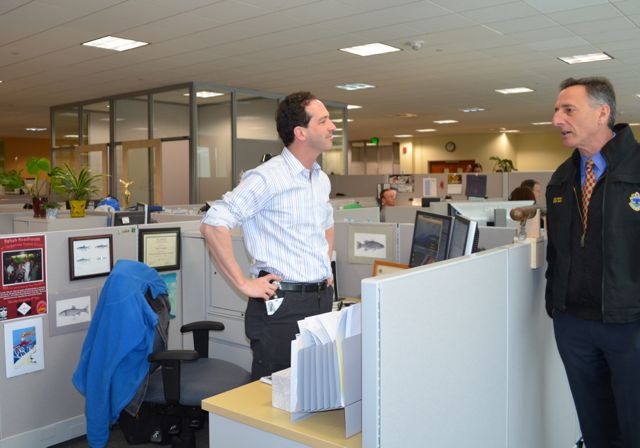
Last year, the state leased additional space, and began to reshuffle these workers and renovate all 180,000 square feet of leased space to accommodate the arrival of nearly 400 ANR employees. Those workers had been spread around the state because Irene flooded their work site at the Waterbury state office complex. The transition will be complete in April.
Gov. Peter Shumlin publicly condemned the AP story at an unrelated press conference on Wednesday. Paul Heintz of Seven Days reported that Shumlin broached the topic four times during the conference. “Let me just say every once in awhile there is something that is printed that isn’t true. And that story is not true,” Shumlin told reporters. “We never said that it would cost $2 million.” Secretary of Administration Jeb Spaulding added, “If there had been a cost overrun from $2 million to $8.6 million, people would have a right to be outraged, but that’s not what happened.”
According to administration officials, the “earliest internal rough estimates,” formulated in spring 2012, were between $6 million and $10 million, and costs inched up only slightly from summer to fall.
In July 2012, the administration issued its first formal estimate — $7.5 million — a number it shared with the House Institutions and Corrections Committee. By October, that number was adjusted upwards to $8.6 million — a revision that was again communicated to the committee.
“I don’t think there’s one piece of paper that said it was $2 million,” Spaulding told VTDigger. In reference to Wednesday’s press conference, Spaulding said the adminstration felt the need to combat the misperception that there had been a huge overrun in costs. “Our biggest concern was the way the public would internalize it [the alleged $2 million estimate the administration says was never put forth].”
Rep. Alice Emmons, D-Springfield, who chairs the Institution and Corrections Committee, said BGS first approached her committee last year with a “back of the envelope” request of $2 million to start construction at National Life. The committee gave the go-ahead for BGS to take $1 million from the $15 million in funds set aside for the Waterbury State Office Complex, and it also authorized the department to dip into the total $18 million allocated in the capital bill for the state office complex and a new state hospital in Berlin. The total costs for these project have been pegged at nearly $180 million.
Emmons said she knew the estimate was subject to change, but she was not alone in being taken aback by the final figure. “I don’t think anyone anticipated how much movement would have to occur with National Life.”
From the outset, the Institutions and Corrections Committee had envisioned a less cost-intensive transition, Emmons said.
“We were looking at the costs for ANR and thinking they could move into one floor and that would be it, but that’s not how it works in the real world. There were 640 [state] employees there before ANR. You move in almost 400 more ANR employees, and you’ve got to meld that.”
Emmons said that by June, the committee had been informed that renovations would cost about $6 million, and by October, the estimate stood at $8.6 million.
If the first “back of the envelope” estimate sent to the committee had been $8.6 million, Emmons says her committee would have had “more conversations” before making the decision. But, she added, they approved the project for philosophical reasons, which remain relevant despite the higher-than-expected costs.
“I saw it more as an evolving construction project, and it evolved more than anyone anticipated, but you know what, it was the right thing to do because we were looking at efficiency of state government.”
Emmons said her committee made the decision to back the move of ANR employees to National Life in the context of a much larger catastrophe. “Last year we got slammed by Irene. We lost a building that housed over 1,200 people. We lost, within that, a state hospital. We are human. You can only do so much when you’re under crisis.”
Both Emmons and the administration say the state will see long-term benefits from housing several state agencies in a single location. The committee heard testimony, according to Emmons, that “Those three agencies work together on a lot of permitting issues, and what we were hearing was it was making government more efficient and employees more efficient to be housed up there.”
Following reports about consternation among committee members, Spaulding released a fact sheet defending the construction project on behalf of the administration. The report states, “This return on investment will be compounded in the future when employees from ANR, VTrans, and ACCD cooperate and collaborate resulting in the increased productivity that was so evident in the aftermath of Tropical Storm Irene.”
The report also notes the following:
• It would have cost the state $31 million to build new offices rather than renovating and expanding at National Life.
• National Life is picking up $3.5 million of the $8.6 million tab.
• “This is not luxurious space … The average space per employee is decreasing by over 50 square feet.” Spaulding explains that the state had to make renovations on all seven floors, including the basement, in order to squeeze in the additional employees.
