

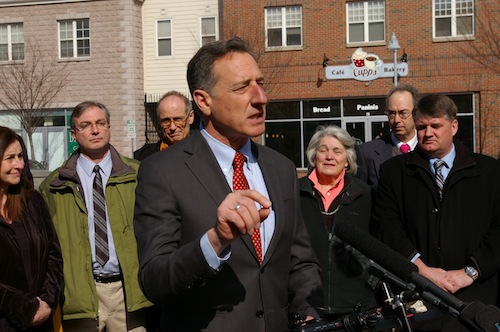
At a Winooski news conference, Gov. Peter Shumlin proposed that four Vermont municipalities be forgiven $6 million the state says they owe to the Education Fund.
The $6 million has been tied up in a dispute over the so-called tax increment financing (TIF) program.
Tax increment financing districts are state-approved zones where municipalities use statewide property taxes to pay for public infrastructure, geared to stimulate downtown developments. As downtown property values rise through redevelopment, the town or city keeps those extra tax dollars instead of remitting them back to the state.
Shumlin proposed legislation, which hasn’t yet been introduced, to clarify the complex laws concerning TIFs and create a way to resolve disputes between the state and municipalities. Former State Auditor Tom Salmon claimed the cities owed the additional $6 million under the TIF program.
Surrounded by legislators, city mayors, and town administrators, including Tax Commissioner Mary Peterson, Shumlin asked the Legislature to “wipe the slate clean” over past disputes with the auditor.
“Let bygones be bygones,” said Shumlin. “The first and original law wasn’t clear enough. Don’t require Winooski to pay back $1.5 million to the state; Milton, to pay back $3.4 million to the state; Burlington, to pay back $1 million, and Newport, several hundred thousand – because we weren’t clear.”
“Let’s clarify the future and wipe the slate clean for the past, so we can continue to grow jobs and economic opportunities in our downtowns,” said Shumlin.
Burlington Mayor Miro Weinberger and Winooski Mayor Mike O’Brien have welcomed more state oversight of TIFs, as VTDigger reported last month.
Though not present at the press conference, Weinberger issued a statement supporting Shumlin’s new proposal, arguing that TIF districts grow jobs and improve housing, and are in place in 49 states and thousands of American cities “because they work.”
State Auditor Doug Hoffer stands by the audit reports conducted by his predecessor. Hoffer says the reports “stand uncorrected.” Although towns have disputed the findings, he said, they haven’t provided evidence or detailed inaccuracies in the report.
Still, Hoffer backs Shumlin’s proposal, partly, he said, “because I don’t see the point at this stage, on engaging with that particular issue [of the $6 million].”
Hoffer pointed out that there isn’t a mechanism to collect that $6 million in statute, and that any retroactive legislation passed to collect the money could be unconstitutional.
Whichever state body eventually oversees TIFs, be it the Agency of Education, the Tax Department, or the Vermont Economic Progress Council, or others, said Hoffer, they must receive resources for that role.
“If we get serious about identifying the right entity to do monitoring or oversight … it will require some resources,” said Hoffer. “With six or seven TIFs, you can’t do oversight without having a body, but there’s a cost. … I think it’ll be a good investment, personally.”
House Ways and Means Chair Janet Ancel, D-Calais, didn’t return requests for comment on Shumlin’s proposal. Her committee has shouldered the task of rewriting the TIF statute in recent weeks.
The Ways and Means Committee has mused recently about creating alternative ways to fund TIF districts, without involving statewide funds, such as through local option or property taxes, or with shared state-local bonding. But so far alternatives to taking a slice of the statewide property tax appear largely undeveloped.
Shumlin also wants to allow a seventh TIF district in South Burlington, in a special exception made because Barre and South Burlington submitted applications to the state simultaneously. Under state statute, only six TIF districts are allowed, with lawmakers now pondering other ways to fund local public infrastructure.
Hoffer notes that those examining the history of TIF policy might conclude that the original legislation wasn’t “well thought-out” or “carefully crafted.” Legislators also may not have realized how burdensome mandatory TIF audits, required once every four years, would be, he said.
“The good news is that next time, we get to bill the towns,” for these time-consuming audits, quipped Hoffer.
A coalition of eight mayors, including Weinberger, O’Brien and newly re-elected Rutland Mayor Chris Louras, have advocated for TIF reform recently. House Republican Minority Leader Don Turner, who represents Milton, one of the towns which allegedly underpaid by $3.4 million, also backs Shumlin’s proposal, and appeared at the press conference.
Andrew Stein contributed reporting to this story.
