

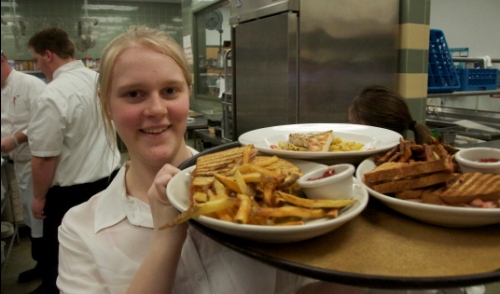
In This State is a syndicated weekly column about Vermont’s innovators, people, ideas and places. For details, click here.
A finger was cut and required a Band-Aid; a burn elicited an ”Owwww!”; and a plate of paella almost was served without the chorizo, the spicy sausage that gives zest.
Nothing unusual. No crisis. About as good as things go at any smartly run restaurant during noon rush.
What is unusual at this establishment is the menu and the fact it’s produced by teenagers. Consider today’s “tapas”: bruschetta with rabbit-liver pancetta; smoked salmon with pickled onions, capers and sour cream; and grilled asparagus with serrano ham.
Note the entrees: grilled beef tenderloin with pine nuts, raisins and tomatoes; osso bucco gremolata; harissa grilled shrimp with roasted cauliflower and preserved lemon … The list goes on.
Who’s cooking this?
Move over New England Culinary Institute (NECI) of Montpelier! It’s the students in the culinary arts program at St. Johnsbury Academy.
“I think the restaurant is just marvelous,” says Mary Ellen Reis, development coordinator at the St. Johnsbury Athenaeum, the library and art museum located across Main Street from the restaurant called The Hilltopper.
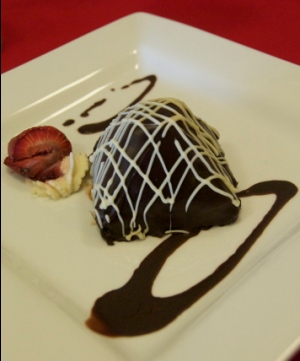
“The food is sophisticated, and the desserts are fantastic,” she says. “I send (museum visitors) there all the time.”
All the time, that is, when the restaurant is open. The Hilltopper is closed during vacation periods, like Christmas, and during the summer. Plus it serves only lunch.
But on Tuesdays, Wednesdays and Thursdays when it’s open for lunch, it’s often busy. And it offers take-out. And it draws crowds for special fundraisers, like the Laotian dinner last week to help raise money to help land-mine victims in Southeast Asia.
There’s no way to confirm this, but it’s a good bet there are few, if any, high school culinary program like this anywhere.
Culinary studies at St. Johnsbury Academy are not new. The 170-year-old private school has had such a culinary vocational program for some 40 years, but until a decade ago, it offered cooking opportunities only at facilities on campus. Food was served in modest dining areas that attracted faculty, staff and family of students, but usually not the general dining public.
But then the academy expanded its program to a section of a local restaurant, the Black Bear, and seven years ago the school began leasing The Hilltopper.
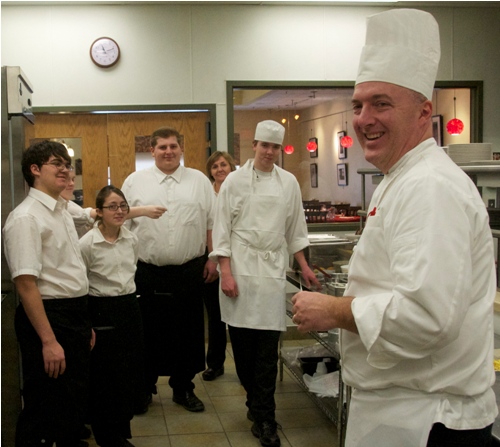
Making this work are teachers David Hale, a chef who taught for some 14 years at NECI, and Suzanne Libbey, whose professional experience has largely been front-of-the-house. Hale serves as kitchen traffic cop during lunch, and Libbey directs the service staff.
The kitchen begins popping at 8:15 a.m., when the first-year students arrive for prep work under Hale’s watchful eye. On a recent morning Abby Betts, a senior who wants to study fashion design in college, is carefully making julienne cuts on a red bell pepper.
“I’m taking this course for fun,” she says. “It’s harder than I (expected), but I like challenges.”
As she speaks, senior Tandra Colflesh of Concord is blanching pasta dough and senior Fawn Call, also of Concord, is preparing feta and spinach for the spanikopita. Both hope next year to enroll at NECI.
And near a sink is Kyle Gadapee, a junior from Danville. With a hand wrapped in a towel for protection, he’s shucking oysters.
“What kind of oysters are those?” another student asks loudly, and Hale, nearby, answers truthfully “’French Kiss Oysters,’ and they’re from New Brunswick.” He explains that they are similar in taste and texture to the popular malpeque oyster of Prince Edward Island. He got a deal on these.
This team, eight students in the beginning course, works until 10:45 a.m. at which time they leave for campus for courses in other subjects. Students in the advanced class begin arriving, and by 11 they are cooking.
Hale, watching over this scene, gives pats on the back and punctuates the organized mayhem with verbal praises like “Nice job!” and “Way to go!” But he’s not afraid to criticize. He was not happy when the paella was plated without the Portuguese sausage.
In addition to hands-on teaching, Hale gives classroom instruction on a broad range of culinary subjects from how restaurants run as a business to food safety. His goal, he says, is to instill in students a sense of “professionalism” and to help them develop personal standards they can apply to any walk of life.
While his cooking staff consists of teenagers displaying various levels of maturity, Hale says The Hilltopper, thankfully, has gone relatively major-crisis-free.
There have been goof-ups, as one would expect.
Once, a student using a hose was filling a bucket with water just off the kitchen, got distracted, the water kept running, overflowed onto the floor, and eventually reached the basement. Another time the fire department arrived when smoke poured from an oven door, triggering an alarm. And Hale recalls with a laugh the day one of his charges put a half-cup of cloves, instead of the specified half-teaspoon, in a molé sauce.
“Will it be really bad?” the student asked plaintively. Hale suggested she taste it.
But Hale stresses his goal is not so much to eliminate mistakes as it is to give kids confidence — so that when a challenge does arise, the student doesn’t buckle.
That approach seems to be working.
Mary-Em and her husband Fred Saar of Waterford, Hilltopper regulars, mentioned during an interview that one noon two years ago the couple was seated at the restaurant when they were suddenly jarred by a loud and inauspicious crash.
“It seems that one of the kids in the kitchen dropped our dishes, but they handled it beautifully,” she says. A young server soon arrived at their table to explain what happened, apologize and politely ask if they would have time for a new order.
“It’s a delightful place,” she says.
Dirk Van Susteren of Calais is a freelance writer and editor.

