

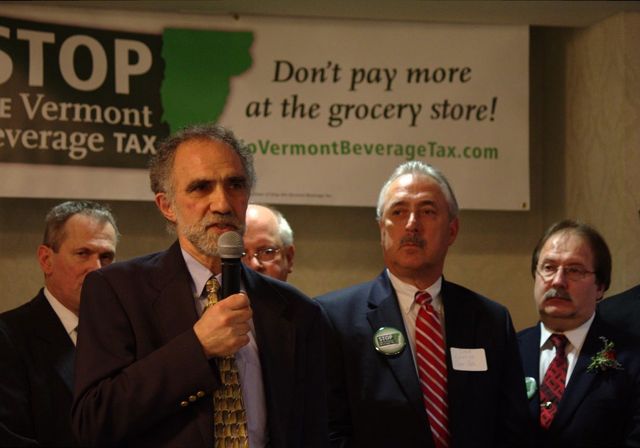
A coalition of small general stores and “kwik marts” says a proposed excise tax on sugary beverages will hurt their businesses.
At a press conference and in a media statement on Wednesday, representatives for the group, including Sen. Dick Mazza, D-Colchester, and Rep. Mike Marcotte, R-Newport, who both own stores, said the tax would drive customers and small businesses across the border to New Hampshire.
A proposed 1 cent per ounce tax on sugar-sweetened beverages, which was introduced last week, faces an uphill political battle, as key political leaders oppose the tax.
The coalition, billing itself as the “Stop the Vermont Beverage Tax” coalition, trotted out University of Vermont economics professor Art Woolf, who cited studies he’d done showing that new taxes, and Vermont’s sales tax historically, make the state’s border businesses seriously uncompetitive.
“The basic economics is quite simple,” said Woolf. “You make something more expensive, people are going to buy less of it. They’re going to buy less of it especially if it’s easy to avoid the high price.”
“In 2007, the latest data we have, the retail sales in the border counties of New Hampshire total about $19,000 per person. On the Vermont side of the border, it’s about $11,000 per person. There’s a huge gap,” said Woolf. “Every time we raise our taxes, we draw a bigger wedge: that gap got bigger and bigger. … Based on history, we know that there’s a behavioural response.”
Advocates for the tax had a ready response. In a statement, the American Heart Association cites a 2011 UVM survey in which Vermont respondents said they wouldn’t drive to New Hampshire to avoid a sugar-sweetened beverage tax.
However, the study also showed that 53 percent of border residents already shopped in New Hampshire. The author of the study, UVM applied economics professor Jane Kolodinsky, told VTDigger that the survey results surprised her, since she partly suspected a tax would drive business across borders.
“Small stores are not going to see decreased sales any more than any other kind of store, and shoppers said they will not cross the border to buy sugar-sweetened beverages,” said Kolodinsky. “That is the finding of our study.”
Kolodinsky also suggested that Woolf’s studies were merely “correlational.” She said his work didn’t draw a causal relationship between a sugar-sweetened beverage tax and actual buying habits, partly because such a tax hasn’t yet been implemented in the country.
Woolf’s November 2010 study, “The Unintended Consequences of Public Policy Choices: The Connecticut River Valley Economy as a Case Study” was funded by the Beverage Association of Vermont, the Vermont Grocers’ Association, the Vermont Wholesale Beverage Association, and the Vermont Retail Association.
The anti-tax coalition also said the tax wouldn’t change consumer behaviour, retailers would spread cost hikes across all beverages, and better education is the key to fighting obesity.
Asked whether the state spends enough to fight obesity, lead coalition organizer Jim Harrison, president of the Vermont Grocers’ Association, gave a vague response: “Education is very important. We need to do more with trying to get folks to look at the balance in their own lives.”
“In terms of funding those types of education … this is an important issue, we have to reprioritize. Maybe we spend less money somewhere else, and we spend more money on this.”
He also said: “Gaining weight is caused by a very simple equation. You consume more calories than you expend. If you don’t get up to turn the TV channel, and you have to sit down on the couch and use your remote, you’re not going to use as many calories.”
Other familiar arguments were also lobbied and rebutted: the anti-tax coalition described the proposed tax as “regressive”, because it would hit the poor hardest, since they purchase the most sugary beverages.
Supporters of the tax dismissed that argument. The Vermont Low-Income Advocacy Council backs the beverage tax because advocates say that obesity is a leading cause of medical problems among low-income Vermonters. The poor stand to gain the most from the proposed tax policy, they say, as the money would be used to fund health care subsidies.
All these intricate policy and economic arguments may come to naught in the face of politics.
Gov. Peter Shumlin, a Democrat, opposes the tax and Health Commissioner Harry Chen told VTDigger last week that research into the effectiveness of the tax isn’t persuasive or conclusive.
House Speaker Shap Smith isn’t “a huge fan.” “I think it has some merit from a health policy perspective, but I’m not sure it is a stable source of revenue,” he said.
Senate President Pro Tem John Campbell said a more comprehensive approach to obesity is needed, and he included junk food consumption among the causes of the growing health problem.
Shumlin, Smith and Campbell got cosy with the Vermont Grocers’ Association on Wednesday, at a legislative luncheon held by the group in Montpelier, just before the coalition press conference. Smith and Campbell competed with Shumlin’s chief-of-staff Liz Miller in a grocery bagging contest. Smith won the top bagger competition for the second year in a row.
The anti-tax coalition has collected over 6,000 petition signatures asking the Legislature to reject the tax. About 100 businesses and groups, mostly Vermont retailers, oppose the legislation.
Research from the state’s Joint Fiscal Office indicates the tax would raise $24.3 milliion in Vermont, down slightly from the $27 million backers of the tax initially estimated.
Below are some studies and testimony on the subject. Kolodinsky’s survey is a draft survey, currently under review for journal publication.

