

Editor’s note: Jon Margolis is VTDigger’s political columnist.
Bill Lippert is thinking about doing a little shooting.
Not that he’s making any pretense of being a gun guy.
“I do not have guns,” said the representative from Hinesburg. Since winning his marksmanship merit badge in the Boy Scouts, Lippert said, he has not fired a weapon. He didn’t say exactly when that was, but he just turned 62, so it was probably close to half a century ago.
But Lippert is the chair of the House Judiciary Committee, meaning he will preside over the early stages of the process of considering H.124, a bill that would strengthen some of Vermont’s gun laws. And he would have played a role in considering the much more far-reaching (and controversial, and quickly withdrawn) Senate bill that would have banned the sale of most semi-automatic weapons in the state. So he’s been getting emails and phone calls from some of his constituents.
It isn’t that all of them oppose the legislation, Lippert said. But they are “people who feel comfortable using firearms and want to continue using firearms,” he said, and they wanted him to understand why they feel as they do.
He agrees.
“I probably will take them up on that,” he said. “I don’t have a lot of personal experience with firearms, and one doesn’t want to distance oneself – oneself in this case being me – from my constituents.”
To some extent, Lippert’s statements and his possible future shooting sessions are just prudent politics. Any attempt to tighten gun regulations arouses passion – mostly from opponents – so it behooves a legislator to appear to be listening to those opponents, especially if he ends up voting for the stronger laws.
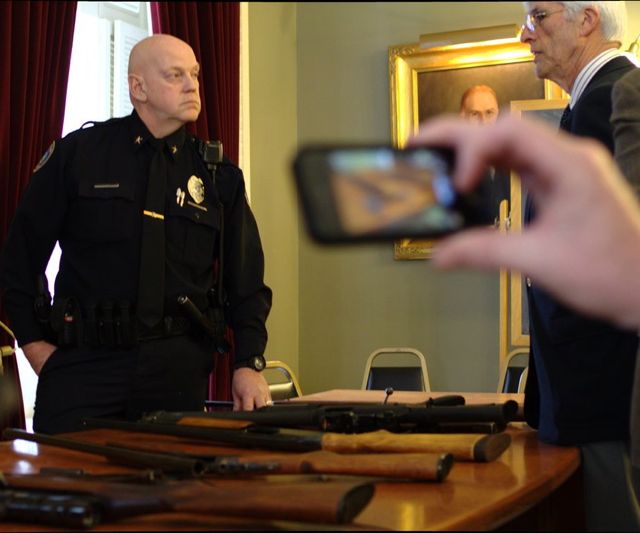
But the context of his remarks Friday was certainly unusual and possibly significant. He was standing in a first floor room of the Statehouse about to take a look at seven rifles and shotguns displayed on a table.
Firearms are forbidden in the building. But Rep. Linda Waite-Simpson, a Democrat from Essex Junction, had persuaded Capitol Police Chief Les Dimick to display some of his own (unloaded) weapons for the benefit of the many lawmakers who are not familiar with them.
Until three years ago, Waite-Simpson was one of those lawmakers. But then she sponsored a bill to require secure storage of guns in homes with children. The bill went nowhere, and she was bitterly criticized by many gun rights advocates.

She fought back. But she also decided to try to understand her critics, she said. She bought a revolver, and learned how to use it. And she arranged Friday’s weapons display for other lawmakers who are as unfamiliar with guns as she once was.
That’s probably most of them. In Vermont, as elsewhere, fewer people hunt. The state is not as rural as it used to be. The draft ended in 1972, meaning no man born much after 1950 has had to join the armed forces, where generations of American men learned about guns. Most don’t.
And most of them didn’t bother to see Chief Dimick’s display, which included a Colt AR-15, the kind of weapon that would have been banned by the bill Sen. Philip Baruth, D-Chittenden, filed and then withdrew (similar federal legislation has been backed by President Barack Obama).
Still, the fact that Waite-Simpson had arranged the display, considered in the context of her revolver and Lippert’s willingness to go shooting with his constituents, indicated that at least one side in this debate is trying to make it more a conversation about safety and less a cultural/tribal confrontation in which each side shouts insults at – and barely listens to – the other.
By no means is there any guarantee that they will succeed. But Lippert insisted there was reason to hope the debate could be civil.
“In Vermont, we have a personal connection with our neighbors,” he said. “If people are making actual, personal, contact with each other, they’re less likely to think their (political opponents) are foreign.”
Though acknowledging that the two cases were not exactly parallel. Lippert said the turmoil over the civil unions law in 2000 eventually calmed down after some people on each side of the dispute developed personal relationships. That helps explain, he said, why the reaction to the legalization of same-sex marriage in 2009 was so much calmer.
None of this indicates that Waite-Simpson’s bill is assured of passage. In fact, at the press conference announcing and promoting it, two of the speakers opposed two key provisions. Both representatives of the law enforcement community, Windham County Sheriff Keith Clark and Winooski Police Chief Steve McQueen, said they opposed banning magazines holding more than 10 rounds of ammunition and the requirement that no one be allowed to carry a concealed weapon who has not “completed (a) safe handling of firearms course.”
Along with the other speakers, they did endorse provisions requiring all gun owners to undergo background checks and giving state and local law enforcement authority to enforce violations of federal laws. As it is, a convicted felon can walk down the street with a loaded weapon. This violates federal law, but not Vermont law, so if police cannot find a federal agent to deal with the matter, the felon just keeps walking.
