

Advocates are taken aback by two proposals from the Shumlin administration that they say disproportionately hit the poor.
Gov. Peter Shumlin announced he wants to uproot an “insidious problem” in Vermont’s welfare system in his budget address on Thursday. His reform scheme centers on a $6 million cut to the Reach Up program, which provides assistance to people living at 50 percent of the federal poverty level.
The proposal comes on the heels of Shumlin’s announcement at his inaugural address that he plans to divert $16.7 million in monies from the state share of the Earned Income Tax Credit for low-income working Vermonters in order to increase childcare subsidies. The controversial plan was panned by a group of Democratic and Progressive lawmakers last week and was the subject of another press conference held by advocates for the poor on Friday.
Shumlin used his budget speech to staunchly defend his plan to scale back the state Earned Income Tax Credit by two-thirds. Shumlin emphasized that compared with most other states, Vermont’s EITC is unusually generous, and he said the state has other support systems in place to take care of low-income people.
Ironically, the state Tax Department and the IRS are trying to get more Vermonters to apply for the EITC because the agencies say the program is underutilized. State officials were on hand in Montpelier and Burlington to promote the program, which Mary Peterson, commissioner of the department, has said is the federal government’s most successful anti-poverty program.
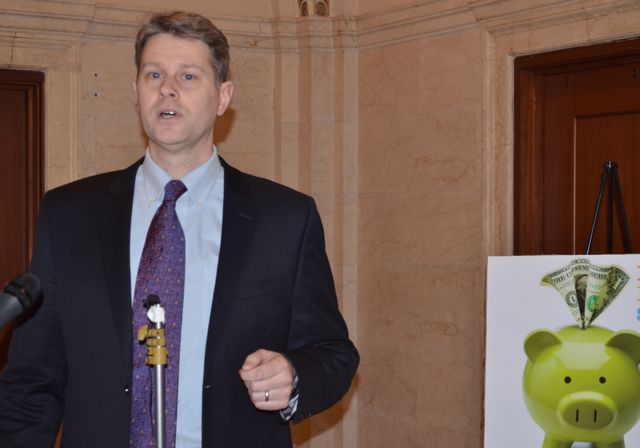
At the Montpelier event, advocates and lawmakers said the cuts would hit poor Vermonters hard and suggested that Shumlin consider other revenue sources to fund child care.
“It’s a false choice,” said Christopher Curtis, an attorney with Vermont Legal Aid. “We think the goal of greater access to affordable child care for all Vermont families who need it is a worthy goal but we don’t have to choose between EITC and more affordable child care. We can have both and that’s the discussion Vermont should be having.”
According to Curtis, five new states have established an EITC since 2006, and several others have expanded the credit in recent years.
“The trend seems to be more and more states recognizing EITC as an effective anti-poverty tool, and trying to do more. It’d be ironic if Vermont was taking a step back by reducing its EITC credit,” he said.
Curt McCormack, a Burlington representative and a former member of the Vermont Low Income Advocacy Council, reminisced about an earlier era, in 2000, when the council asked the Legislature for a 7 percent increase in the state portion of the EITC. The request, quickly granted, “was so popular and made so much sense to everybody,” including, McCormack added, the Senate President Pro Tem at the time — Peter Shumlin.
McCormack, a former beneficiary of EITC himself, also told the assembled group that he has a counter proposal to Shumlin’s. The state representative is drafting a bill that would increase the EITC on a tiered scale — the state would still pay 32 percent for the federal EITC for those at the higher end of the eligible income range, but it would pay a greater percentage for families at lower income levels.
The IRS estimates that 20 percent of eligible taxpayers nationwide don’t file for the credit. Peggy Riley, an IRS spokesperson, told VTDigger that “with recent unemployment statistics, and lower-paid jobs, there may be more and more people who may qualify now.”
“There will be many new people in Vermont who will qualify for the EITC for the first time due to the addition of children into the family or a cutback in their family wages due to the economy,” added Burlington-based IRS tax consultant Grant Peterson in a statement.
According to federal IRS data, Chittenden County received by far the most in federal EITC funds, with 8,649 returns in 2011, totaling $14.46 million and averaging at $1,672 per beneficiary.
According to state Tax Department data, the number of state EITC filers has risen slowly but steadily since 2007, at 38,943 claimants then, to about 44,500 claimants in 2012.
Plan to cap Reach Up
Reach Up provides support services and financial assistance to some of the state’s most vulnerable residents — those living at 50 percent or less of the federal poverty line. Shumlin wants to cut $6 million from the $38 million program by putting a cap on the period of time people can receive benefits.
Beneficiaries would be bumped from the program after three years; if they need assistance after that point they could come back into it for up to two additional non-consecutive years. After five years, they would be deemed permanently ineligible.
The cap would be retroactive, which means about 1,188 families and 2,100 children would immediately lose benefits. The total Reach Up caseload is 16,000 and “growing significantly,” according to Department of Children and Families (DCF) Commissioner David Yacavone. Children make up an increasing percentage of the caseload — there are about 10,000 children in the program currently. About 1,700 of Reach Up participants are employed.
Curtis said the program is “hugely successfully” and its burgeoning caseload points to the importance of keeping it intact. He pointed to a recent offshoot to the program, called Reach First, which, he said, has successfully diverted 48 percent of participants from the Reach Up program by providing them with immediate assistance.
“If we’re really interested in helping families avoid being on welfare as it’s called we need to invest more up front because that’s clearly a success,” Curtis said. “Investing more on the front end helps keep more people off of welfare and transition to full employment.”
The Shumlin administration is making the opposite argument — that the current level of benefits serves as a disincentive to getting a job, and less, not more, investment is the answer.
The governor took a more philosophical tone when making the case for shrinking the Reach Up program during his budget address. “It takes courage to say it, but say it we must: Benefits for Vermonters who are able to work must be temporary, not timeless,” he said.
“It is neither compassionate nor prudent to continue a system in which struggling Vermonters are financially punished for getting off government assistance, finding a job, and providing for their children,” Shumlin said.
Yacovone said he’s not sure Reach Up is helping people who have been on the program for five to 10 years. Twenty-one percent of people meet their work participation requirement, he said, and 25 percent of people return to the program within one year of leaving it.
“It feels like it’s too much of an income maintenance program,” Yacovone said.
Curtis said more, not less, government assistance would solve that problem. “Arguably it’s not enough to get by in the first place, which is part of the reason, frankly, that people have a hard time getting off,” he said.
Yacovone said it is difficult to quantify how many people are affected by the so-called “benefits cliff,” but his department “hears it all the time and we get phone calls all the time” from people reluctant to take jobs that will make them ineligible for benefits.
Some critics are worried that Shumlin’s welfare reform agenda will have an insidious outcome of its own — reinforcing negative stereotypes about welfare recipients.
“There’s also a misconception out there, frankly, that people on welfare don’t work. We know that over 1,700 families that receive Reach Up are working,” Curtis said.
Sen. David Zuckerman, P-Chittenden, holds a similar view. “To change a system based on rhetoric and stereotypes that are not the typical situation is very frustrating,” he said.
CORRECTION: We originally said 1,200 people would be immediately impacted by the cap; 1,188 households will be affected.
