


In testimony to lawmakers on Thursday, Vermont Attorney General Bill Sorrell delivered a spirited defense of keeping criminal investigation records largely closed to the public.
Sorrell said he’d support opening police case files, if the investigation examined alleged misconduct by an on-duty police officer.
Critics have questioned the impartiality of police investigations of colleagues and say subjecting those records to public scrutiny would go a long way toward enhancing public trust in law enforcement.
Sorrell agreed with that assessment, in part. “To try to reinforce public confidence in the integrity of law enforcement policing its own, open up those files,” the attorney general told members of the Senate Judiciary Committee. But Sorrell didn’t say whether details of disciplinary investigations of police officers, usually conducted by an internal affairs department, should be made public.
Currently, records on internal affairs investigations are kept secret. Even state prosecutors have only limited access to internal documents for criminal investigations, sometimes for constitutional reasons.
Allen Gilbert, executive director of ACLU-VT, says those internal investigations, as well as other criminal investigation records, should be open to scrutiny. Confidentiality harms the police by eroding the public trust, he said.
“The state that we’re in now, where it’s so difficult to get so many police records, really doesn’t benefit either the public or police,” said Gilbert. “It’s often the perception rather than the reality that rules how people view the police … [such as] the public’s feeling police have something to hide, otherwise they’d be turning over more records. I think we’ve got a systemic problem here.”
In a legislative proposal, Gilbert urged Vermont to move to a widely adopted federal standard for access to records, which allows access unless prosecutors can prove disclosure harms someone in specific ways.
The law enforcement community, which sometimes opposes opening public records, supports the Shumlin proposal. An attorney for the Department of Public Safety, which oversees the state police, said her department has supported a move to the federal standard since early 2011.
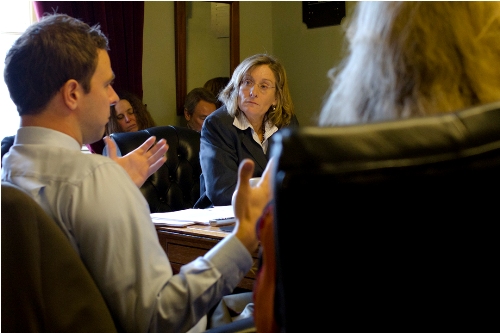
Rosemary Gretkowski, the department’s general counsel, said no specific incidents or criticisms of investigation procedures prompted the department’s internal decision to support the federal standard.
Sorrell, seemingly alone in defending the status quo on records for most criminal investigations, maintained that both the Shumlin administration’s and the ACLU’s proposals would expose irrelevant and embarrassing details about innocent citizens to public view. He also argued that it would stretch the state’s legal resources.
He cited the investigation into the 1991 rape and murder of Patricia Scoville. Eighty-two men gave DNA saliva samples in that investigation, which eventually produced about 50 boxes of records, said Sorrell.
“There was a huge amount of investigation into Patricia Scoville’s private life, and her history of relationships, the nature of those relationships … I could go on,” said Sorrell to lawmakers. “Does the public have a valid reason for knowing that? How about access to Patricia Scoville’s diaries and journals?”
Shumlin’s general counsel, Sarah London, said in an interview that a substantial body of federal case law supports the right of state prosecutors to reject records requests if they invade personal privacy, an exemption the federal standard permits.
Sen. Dick Sears, D-Bennington, who chairs the Senate Judiciary Committee, said he is leaning toward the Shumlin administration’s proposal, but has yet to decide definitively.
“I’m really interested to understand if some of the problems the attorney general described have been encountered in those states which have adopted the federal standard,” he said. “I’d like to continue to know why we shouldn’t just follow the federal standard.”
According to Gilbert, 21 other states, the District of Columbia, and all federal government agencies use the FOIA standard for access to criminal case files.
Sorrell said he’d decide whether to press criminal charges against the police officer responsible for that tasering within two or three weeks, concluding a seven-month investigation. His office has so far refused to relinquish records in the case.
[DISCLOSURE: VTDigger will testify in support of increased access to criminal records this legislative session. The president of the Vermont Journalism Trust board, Bill Schubart, is a member of the ACLU-VT board.]

