

Editor’s note: Jon Margolis is VTDigger’s political analyst.
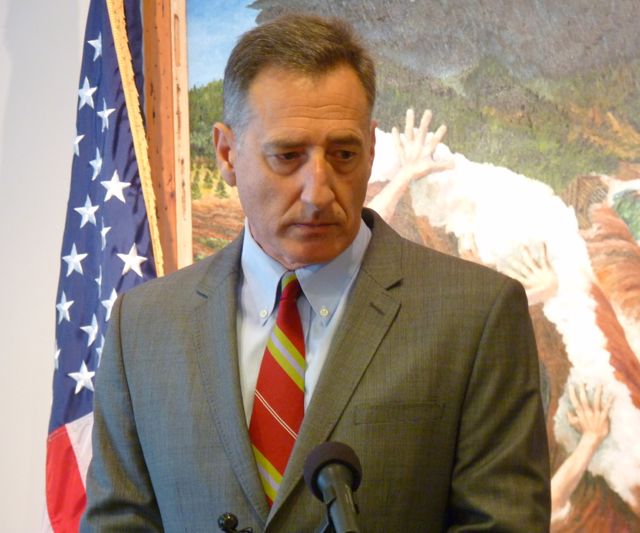
Gov. Peter Shumlin is a fan of public school choice, under which any high school student can go to (almost) any nearby school, even if it’s not in the student’s district.
Last year, Shumlin supported and signed a law expanding the program, and on Vermont Public Radio’s “Vermont Edition” program Friday, agreed with a caller who wanted the option extended downward at least to middle school pupils.
“Money should follow the student,” the governor said.
That could be good for the student, and no doubt it’s good for the school to which the student transfers. With that student comes money.
Not so good, though, for the school the student abandons. With that student, goes money.
In other words, whether expanded school choice would do more good than harm for the state, its schools, and its children is what a good teacher would call an interesting and complex question. There’s no doubt that some schools and some children would benefit. But in the process, other schools and other children would be harmed.
Not to mention that the air would be dirtier. Taking students to schools that are farther from their homes means somebody has to drive more miles.
Usually, that somebody is not a school bus driver. “School districts aren’t required to provide transportation,” for students choosing out-of-district schools, said Peter Thoms, the State Education Department official who coordinates the choice project.
No one has an exact count, but it seems clear that most “choice” students who attend a school outside their district are driven there by a parent or other adult, even if the bus going to the student’s in-district school drives right past the student’s house, even if the student could walk to his or her local school.
That means more driving, more gasoline consumption, more greenhouse gases warming up the world. It might not be very much more, perhaps not enough to offset the educational advantages of school choice. But there’s some irony in the support for more school choice by the governor who regularly says he supports more wind-powered electricity generation because Vermont should reduce its use of “foreign oil.”
Hardly a drop of oil, foreign or domestic, is used to generate electricity for Vermont. Almost all the cars schlepping kids to farther-away schools run on it.
There is broad agreement among educators that school choice clearly serves some young people. Stephen Dale, the executive director of the Vermont School Boards Association, said that “for academic or athletic reasons, or interest in the arts,” many students benefit from being able to choose a school outside their immediate areas.
A boy who wants to play football, for instance, but lives in a district where the high school has no team, might want to transfer to a nearby school which plays football. Or an aspiring actor who envies the superior theater facilities in a neighboring district. Or a student who wants to study a language not taught in his or her district’s high school.
In addition, he said, in some “severe bullying situations,” the best option is to have either the bullied student, or sometimes even the bully, transfer to another school.
Dale said his association is “strongly supportive of focusing on expanding opportunities for individual students,” and supported the bill passed last year that increases the number of high school students who can take advantage of school choice.
“But we’re not ready to say the solution is a huge expansion of school choice,” he said. What would be preferable, he said, would be for “the schools themselves to be offering a lot of different kinds of opportunities.”
Because most of these transfer students are driven to school, Dale said, “parents who have more flexibility would be more likely to exercise the option.”
Another way of saying that while choice may be theoretically open to all, it is more open to wealthier students and their families.
Which means that more school choice means more inequality in an already unequal society.
And extending choice to lower grades would exacerbate that inequality. Different high schools teach some different courses and emphasize different athletic and extra-curricular activities. Elementary and middle schools are far more alike. It’s understandable that parents might want to switch their students to a “better” middle school. But the evidence of the standardized test scores in the state is clear: a “better” elementary or middle school is one that has fewer low-income pupils.
Every affluent child who switches to one of those “better” schools makes it “better,” yet, but leaves the school left behind … well, this is impolitic, but the opposite of “better” is “worse.” One possible consequence of extending school choice to lower grades is an increasingly bifurcated system in which the affluent and the low-income are segregated. It isn’t that poor children can’t learn. But the evidence is persuasive that they learn better if they are not the only ones in the class.
On the evidence at hand, though, it is possible that the entire discussion is effectively moot. Of the 28,225 high school students in Vermont, Peter Thoms said, only 300 transferred outside their districts. That’s slightly more than 1 percent.
A few more may have wanted to transfer, but were blocked by the limits the law places on how many may transfer out of a school, and on the capacity of the school to which the students want to transfer. Those limits are being increased slightly by the new law, which goes into effect next September, which also removes the restriction that students can transfer only to another school within their “region.” Next year, students will be allowed to transfer to any public high school in the state.
It seems clear, though, that roughly 99 percent of Vermont’s high school students attend the school in their district because they want to. It’s their choice.

