

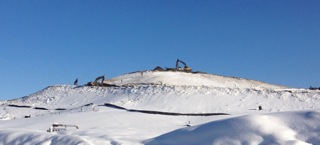
The state ordered Moretown Landfill to stop construction Thursday on a cap designed to control odors. The landfill has been working since mid-December to install gas wells and a temporary earthen and plastic cover to prevent odors from escaping.
The Act 250 District 5 Environmental Commission issued a decision Thursday stating that the work was not within the bounds of the landfill’s Act 250 permit. This is a reversal of a Dec. 17 decision stating that the work was permitted. The commission will hold a hearing near the end of the month to make a final decision regarding the landfill’s construction activities. In the meantime, it ordered the landfill to not only stop construction, but to undo all the work that’s been done in the last few weeks.
Susan Baird, assistant coordinator of the District 5 commission, said the commission’s most recent decision was influenced by an appeal of the earlier decision filed by neighbors of the landfill.
Jim Dumont, attorney for Lisa Ransom and Scott Baughman, who filed the appeal, said that the landfill’s construction activities were “blatantly illegal.”
The Moretown Landfill has been in operation for more than 30 years, but in the last 13 the Agency of Natural Resources (ANR) has accused it of dozens of environmental violations, the most consistent of which are off-site odors. Neighbors say the odors have gotten a lot worse this year, and the last three weeks have been the worst of all.
In November, ANR asked the landfill to prove it can control odors. The landfill submitted a proposal for a temporary cap and renovation of the landfill gas collection system, among other changes to its operations. Last month, ANR said it wasn’t satisfied with the proposal and intends to deny the landfill’s permit to operate in its active cell. In spite of this, the landfill has gone forward with construction.
“They come back and say ‘We’ve changed our ways, we’re good guys now,’ and the first thing they do is violate Act 250 and local zoning,” said Dumont.
Baird said Dumont’s arguments in the appeal were “persuasive.” She also said the commission’s decision to halt construction was influenced by ANR’s announcement on Dec. 20 that it intends to deny the landfill’s recertification application, which would effectively shut the landfill down. ANR will be receiving public comments until Jan. 21. It will make a final decision by Mar. 8.
The Moretown Landfill pays the town of Moretown more than $500,000 a year as a host fee. If it closes, trash haulers and solid waste districts throughout the state will have to reroute where they take trash, which will likely raise the cost of disposal. Trash may go to Coventry, the only other commercial, lined landfill in the state, or it could go to landfills in New Hampshire, Massachusetts or New York.
Neighbors say the construction work, which involved excavation of trash, produced “horrible” odors.
“It’s been much worse,” said Martha Douglass, who lives just over half a mile from the landfill. Douglass said she, her husband, and two other families had headaches and nausea from the smell. Two families left the area one day last week because the smell was so strong inside their homes.
Representatives of the landfill were unavailable for comment by press time.
As to the environmental commission’s decision, Dumont said he and his clients are “very pleased.”
CORRECTION: The last day for public comment is Jan. 21; the article originally stated that the comment period would end Jan. 20.
