

A pair of dark clouds will loom over any legislative discussion of human services this session— the $50 million to $70 million budget gap forecast for the General Fund and the prospect of cuts in federal funding. The Agency of Human Services is no stranger to budgetary woes, but the state’s shortfall together with uncertainty about federal funding, may cause a greater degree of discomfort for the agency.
The state’s mental health system will be at the fore of this year’s legislative agenda, as the state trudges onward toward a community-based model.
Leaders from both the Senate Committee on Health and Welfare and the House Committee on Human Services say they’ll take another stab at a bill Shumlin vetoed last session. The legislation — H.290 — would have required that the Adult Protective Service (APS) division report to the Legislature on elder abuse on a monthly rather than annual basis. It was introduced in response to a backlog in investigations of elder abuse that had bogged down the Adult Protective Services (APS) division and prompted a lawsuit filed by Vermont Legal Aid.
Doug Racine, the secretary of human services, said the law would impose an undue burden on the agency and create a “distraction” from its actual investigations. Gov. Peter Shumlin vetoed the bill.
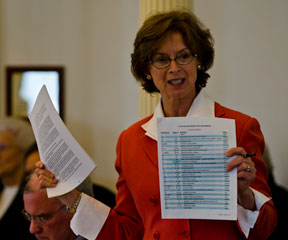
Sandy Haas, vice chair of the House Committee on Human Services, said she and other lawmakers who worked on the legislation were surprised by the governor’s veto. “We were amazed by that. Since they [members of the Shumlin administration] sat with us at the table and, item by item, said they could do it.”
Susan Wehry, commissioner of the Department of Aging and Independent Living, told the House Appropriations Committee on Thursday that APS has eliminated the backlog by hiring additional investigators and adapting to a more sophisticated data reporting system.
Sen. Claire Ayer, who hopes to head the Senate Committee on Health and Welfare again, and Haas both say they will still seek more timely reports of abuse. “Every single reporting requirement is an off–the-shelf standard requirement for that software,” Ayer said. The new bill will closely resemble the previous proposal.
H. 290 also called for an independent $75,000 study of how APS carries out its investigations. “All we are looking for is to get updated information on what is happening with reports of abuse and also to get information that would help us revisit the law,” Haas said.
Both the House and Senate committee will pay particular attention to the needs of the Department for Children and Family Services. The focus for the past two years on overhauling the state’s health care and mental health systems has meant this department “has gotten the short end of the stick,” according to Ayer. The Senate committee plans to take a broad look at the challenges the department has faced in addressing its caseload. Haas says her committee will look at how Act 168, which was passed in 2008 and enables the department to provide services prior to substantiation of abuse, has affected the caseload.
The Senate committee will devote a substantial chunk of time to examining Choices for Care, a program within DAIL’s division of Disability and Aging Services that provides support for senior citizens. The department reinvests savings that come from providing at-home programs instead of nursing home care into other community-based services. Ayer says current statute does not clearly define what these savings are or where they should be redirected. In fact, current law allows the savings to be reinvested in nursing home services. “We’re going to revisit that and try to give the department more clear directions,” Ayer said.
Haas said another of the House committee’s priorities is to improve coordination between family courts and probate courts in dealing with issues like divorce and child abuse. The system has not been comprehensively evaluated in decades. Haas says they will look to improved coordination between these courts based on the recommendations of a working group report on the issue.
