

Campaign for Vermont, a conservative advocacy group based in Montpelier, has set a high-minded goal — to make Vermont’s education system among the top five in the world.
That objective, however, hinges on freeing up $160 million in the system. In a 16-page white paper authored by former tax commissioner Tom Pelham, the organization makes the case that consolidating school districts, cutting back on administrative costs, and increasing school choice can save enough money to fund programs such as universal preschool and raises in teachers’ salaries.
Campaign for Vermont, which describes itself as a nonpartisan 501(c)4 organization advocating for “pragmatic” ways to strengthening the state’s economy, released its education policy proposal on Monday.
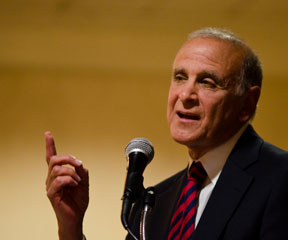
Bruce Lisman, co-founder of Campaign for Vermont, said much of the plan relies on ideas that have been around for a while, but he thinks the state is at a point where they are “ready to be activated.”
The report can be found here: http://www.campaignforvermont.org/pdfs/12.08.12-PUTTING-CHILDREN-FIRST.pdf
The proposal calls for doing away with most of Vermont’s 64 supervisory unions and replacing them with 15 “Education Districts,” an idea that was first proposed in 2006 by Richard Cate, the former education commissioner who served during Republican Gov. Jim Douglas’ tenure in office.
In this scenario, the current level of local control and the state’s role would both diminish. Instead, the new education districts would be responsible for setting budgets and collecting the statewide property tax, for example.
Pelham, co-founder of Campaign for Vermont, said the state would be more of a “cheerleader for excellence, but not driving that excellence through mandates.”
Each of the 15 districts would be overseen by a board made up of local school board members, whose representation would be proportional to the population of the local districts. These district boards would take over many functions that currently fall within the domain of either local school boards or the state — budget proposals and union negotiations would all be in their purview.
The group envisions stripping the state of its role as primary distributor of property tax revenue to schools. Instead, each “Education District” would be charged with this task, and the statewide property tax would be used only to even out any imbalances that emerge across districts. Campaign for Vermont says their plan stays true to the spirit of the Vermont Supreme Court’s Brigham decision, mandating equal access to education for students, but it relegates this responsibility to the district level.
The proposal’s other recommendations include expanding school choice within districts and de-linking the state’s income sensitivity program— which gives Vermonters the option of paying education taxes on income rather than property — from property tax rates to “enhance transparency” about the program’s expenditures. The plan also calls for a teacher and principal evaluation system and recommends raising teacher salaries by an average of 20 percent for those who make the grade.
Lisman said that while Campaign for Vermont isn’t explicitly advocating for increasing the student-teacher ratio and forcing smaller schools into extinction, this “may result as a natural consequence” of the consolidation of supervisory unions.
The $160 million figure is based on the difference in spending per pupil between Vermont and Massachusetts. Lisman and Pelham say they selected Massachusetts as the benchmark for comparison because it has one of the highest-ranked education systems in the nation. The proposal does not provide specific estimates on how much each of the initiatives would contribute to realizing the $160 million in savings.
In 2010, a task force called the “Education Challenge Design Team,” created by Education Commissioner Armando Vilaseca to identify costs-saving opportunities, examined the savings potential of reducing the number of school districts from 289 to 49 while maintaining the same supervisory union structure. The department’s chief financial officer, Bill Talbott, said transitioning to this model would save the state $13 million to $17 million a year.
Campaign for Vermont said they are prepared to do what it takes to make sure their ideas gain traction and their efforts may include advertising and marketing. The Campaign is a 501(c)4 organization, and it is not required under the law to reveal how much money it raises or spends on advocacy campaigns.
