

Editor’s note: In This State is a syndicated weekly column about Vermont’s innovators, people, ideas and places. Details are at http://www.maplecornermedia.com/inthisstate/. Andrew Nemethy is a veteran journalist and editor who lives in Calais.
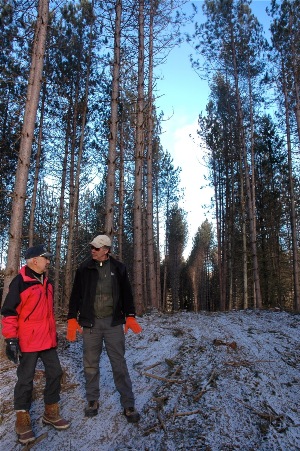
This is the tale of a success story – mostly.
It’s a scruffy, sometimes spindly success story, to be sure, not always judged aesthetically pleasing, and sometimes considered problematic. But when it comes to trees, which is what our story is about, appearance isn’t everything, and therein lies an object lesson with roots in Vermont history, ecology and the landscape that surrounds us.
Our tree is Pinus resinosa, or red pine, also known sometimes as Norway pine. The red pine’s tall presence throughout the state is a reminder of the historic downshift from agriculture throughout the past century, when Vermont went from being mostly open hillsides grazed by animals to being around 80 percent forested.
The ubiquitous planting of red pine during that transformation has largely been forgotten, much like the former hayfields the red pine reclaimed. This is ironic considering how distinctive and uncharacteristic these plantations are, maturing in rows in thousands of places around the state. Compared to the snaggly, windthrown random hardwood and softwood mix of trees that are the archetypal Vermont forest view, they are regimented outliers whose linear stands never fail to present a sort of visual surprise.
Michael Snyder knows the red pine well. Now Vermont’s commissioner of Forests, Parks and Recreation, he spent more than a decade as Chittenden County forester before he took the top forestry job. Many a landowner turned to him for advice on their plantations, noting “there were so many I couldn’t even count them.” Often in decline because they were never thinned as intended, occasionally criticized for being an ecological desert, advising what to do with red pine gave him “a lot of headaches.”
But that doesn’t change the fact that red pine served “a massive and unheralded ecological function,” he says. He is unequivocal about their benefit: “I think it was a smashing success,” though he admits, “I have a love-hate relationship with them.”
Red pine is a native tree ranging from southern Canada down to the mid-Atlantic states that can live as long as 250 years in some locales. In Vermont, it’s a small part of the natural forest mix, usually growing in warmer pockets. Starting in the 1920s and running through the 1960s, red pine was promoted and planted all over Vermont, first by Civilian Conservation Corps crews and then later under a state “soil bank” program. Distinctive for its flakey reddish bark, sparse tops and pom-pom clusters of needles, red pines now rise in maturing stands on sites both prominent and secluded.
They tower in a green swath on the hillside behind Vermont’s Statehouse in Hubbard Park. They rise in high rows in plots on Mount Tom in the Marsh Billings Rockefeller National Historical Park in Woodstock. Poet Robert Frost planted 1,000 red pine seedlings near his house in Shaftsbury in 1921, inspired by a planting of red pine his friend and author Dorothy Canfield Fisher had done in Arlington. It turns out Frost, our unruly New England poet, not only loved something about walls but loved pines in rows. Who knew?

Vermont’s half-century of red pine passion has withstood the test of time, in the knowledgeable eyes of Waitsfield forester Leo Laferriere, who held the same post as Snyder from 1979 to 1985. He continues to work part-time as a consulting forester at the age of 78. On a cold weekday morning last week, Laferriere was surveying fragrant proof in bunched stacks of felled red pine being stripped and sawn and stacked as sawlogs awaiting shipment to Canada from the town of Orange.
The red pine is being culled on four parcels comprising 41 acres on a 1,200 acre property owned by the city of Barre. The land protects the watershed for the scenic Thurman Dix reservoir, the source of Barre’s drinking water. The timber cut is expected to produce 350,000 board feet of lumber, a significant haul, he says.
Red pine, Laferriere explains, was seen as the ideal tree to reclaim the depleted soils of old farm fields, stabilize eroded hillsides, and provide farmers and landowners a cash crop down the road, though the road is measured in decades, not years. Red pine was also susceptible to relatively few diseases or insects, unlike the more common white pine.
Snyder adds another salient virtue: Red pine grows very fast its first 60 or 70 years, and as it grows it provides habitat for species from birds to squirrels and salamanders and constantly adds to the soil.
“Green side up, brown side down, and away they go,” says Snyder. “You put these plants out there and against all odds they grow pretty quickly, they absorb rainfall and dump organic matter, their roots aerate the soil … these are lots of small things that have profound effects,” he says.
In other words, it pays to take a holistic view and look beyond their plantation rows, so uncharacteristic for Vermont, and the fact many landowners are asking what to do with them.
Showing a visitor the logging operation, Laferriere displays several answers. At one small four-acre site, he recommended a clear cut because the pines, never thinned, have produced spindly trees with little upside that are leaning or being knocked down by winds, creating an unsightly and unmarketable tangle.
At a healthier plantation just up the road, he called for thinning by taking out every other row, which will “release” the remaining trees, in forester speak, providing more light and less competition that will allow them to thrive.
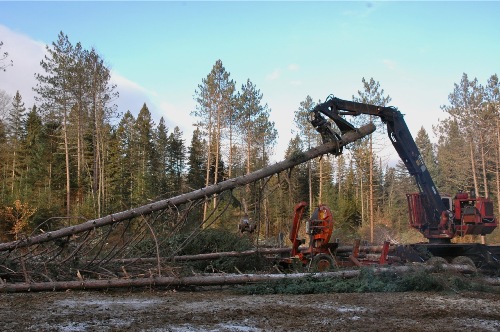
“The goals are to harvest and start the process to regeneration of native species,” he explains.
“There’s a strong market for red pine now,” Laferriere adds, noting the entire tree gets used. The tops are turned into wood chips for biomass production, the straightest trees – those over 50 to 70 feet – are valuable as telephone poles, and the sawlogs can end up as framing lumber, boards or used in building log structures.
As longtime Washington County forester, Russ Barrett has observed many interesting slices of red pine history. He notes many maturing stands now reside deep in town forests grown up from old fields, or along lakes and ponds, where they were planted to protect the watershed. At one time, Vermont had a program to treat red pine with creosote at Windsor Prison for use as telephone poles or guardrails, he notes.
Bill Baron, now a district forestry manager, has a different, younger perspective: He once oversaw the state’s tree nursery, which was closed in 1995. He says as many as seven million seedlings were produced each year at the peak in the 1950s and 1960s, red pine prominent among them.
Love or dislike the cathedrals of tall red pine, the tree is a reminder of both an era and how taking the long view can reap benefits. It also illustrates that it’s hard to predict the future. In the case of Pinus resinosa, that includes our more complicated aesthetic views on tree harvesting today, and the dramatic changes in timber markets. But all that doesn’t detract from a job essentially well done, argues Laferriere.
“It served to regenerate the open fields. Absent some kind of organized planting like this, the old fields would have taken much longer to regenerate to woodlands and would not have produced timber of this quality for an extended time,” he says.
