


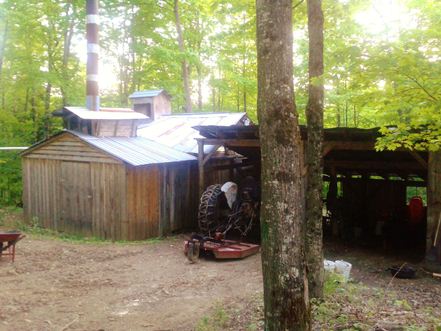
There is a forest in Barton that may keep a culture alive, educate children and nourish the hungry. It could be a place where a people who lost nearly everything, and who have struggled long and hard for their rights, will feel a sense of ownership.
The owner of the land will, through a conservation easement, sell the development rights to the Vermont Land Trust so that it is never developed. Anyone, from any community, will be able to visit and enjoy the forest.
But this place is different in one profound way: it would be the first communal land of the Nulhegan Abenaki in 200 years.
The property, 68 acres off May Farm Road, visible from Interstate 91, is a mature and functioning sugarbush. Aside from two small clearings, the land is forested. Hiking trails loop through its sloping terrain, and wildlife, including grouse, deer, bear and moose, abound.
Abenaki Helping Abenaki Inc., a nonprofit organization of the Nulhegan Abenaki Tribe, is hoping to buy the parcel with the support of the Vermont Land Trust, the Vermont Housing and Conservation Board, and the Vermont chapter of the Sierra Club. They’ve currently raised more than 85 percent of the funds needed and hope to close on the deal in November or December.
“It’s Nulhegan’s way of saying that we are conserving land for us, for everybody, for the people that we neighbor,” said Luke Willard, trustee and former chief of the Nulhegan Abenaki Tribe.
The Nulhegan Abenaki Tribe was formally recognized by the state last year, after pushing for recognition for decades. Currently the tribe has no communal meeting place and no income. Its 1,000 members are among the most economically depressed of Vermont residents in the most economically depressed region of Vermont, the Northeast Kingdom.
The tribe envisions the forest as a sort of outdoor community center.
“We have a handful of elders who still gather wild medicines. Living in unit C3 of the local trailer park doesn’t necessarily provide you with a forest to be able to gather those medicines from,” said Willard.

For years, two Nulhegan Abenaki women, Billie Largy and Lucy Neel, have taught local schoolchildren how to gather medicinal plants. As the number of children has grown to 60 or more at a time, they’ve struggled to find outdoor classrooms. With the purchase of the tribal forest, they’ll have one.
For the past two years, Willard has offered a portion of his land for a community garden, where families can grow food they otherwise wouldn’t be able to afford, using traditional Abenaki agricultural methods. Without the garden, Willard said, “these practices could be extinct in as little as a few years.”
The garden has been a success, but participants still feel that they are imposing on Willard’s land. Now, the tribe plans to garden in an existing clearing in the tribal forest.
“With a tribal forest, with a forest that is owned by the community, it’s owned by everybody, so that you have a sense of ownership, you don’t feel like you’re borrowing from somebody,” said Willard.
Harvesting maple sap from the forest could bring in up to $30,000 a year for the tribe, which could pay the costs of owning and managing the property as well as expanding programs for those in need, like the food shelf. This, in turn, would lighten the load on Vermont taxpayers.
Don Stevens, the chief of the Nulhegan Abenaki tribe, sees more than a forest.
“If you look at it from a native perspective, it’s a place where our ancestors have walked, and held the dirt in their hands, and fed their families from it,” he said. “Technically, would we own it, yes, but you know we’re stewards, we only take care of it for future generations. It means a lot, it makes us grounded, rooted, it gives people a sense of home.”
Winning state recognition was a long fight, said Willard, because some people were afraid that the tribe would make land claims or build casinos. Willard wants people to see that the Nulhegan Abenaki have no interest in those things.
“There is a little bit of Abenaki people wanting to prove to a culture that has made a lot of assumptions and accusations, I’ll admit that this is an Abenaki community wanting to prove those assumptions wrong,” said Willard. “Come up here and plant a garden, come up here and walk the trails, come up here and learn that that flower will take care of your headache and it’s a lot cheaper than a bottle of ibuprofen, come up here and learn about your neighbors that you may have been reluctant to learn about.”
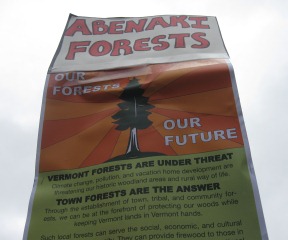
The land is part of the Vermont Sierra Club’s Our Forests, Our Future campaign to conserve wildlife corridors by supporting the establishment and growth of town and tribal forests. The Barton property is within a zone identified by conservation groups as essential to regional wildlife habitat connectivity.
David van Deusen, a conservation organizer with the Vermont Sierra Club, sees this tribal forest as a model. “In the years to come we hope to use this first modest tribal forest as a model to point to and say this is a way to move forward in tribal conservation in the state of Vermont.”
While traditional conservation often focuses on protecting endangered species, van Deusen and others say this forest will help protect an endangered culture, too.
Tracy Zschau, Northeast Kingdom regional director for the Vermont Land Trust, said the purchase of the property is “not a done deal.” The Vermont Housing and Conservation Board, which will co-hold the conservation easement with the Vermont Land Trust, agreed to contribute $112,000. Another grant has yielded $40,000. The remaining $20,000 will come from grants or private sources.
Willard, citing an Abenaki ideal of making decisions that benefit seven generations, from one’s great-grandparents to one’s great-grandchildren, is satisfied that even though “it’s just a drop in the bucket,” the tribal forest will have long-term effects.
“You can see that a project such as this, the act that this current generation has taken to procure a small piece of land that will be here forever, that will be a resource not only to the tribe but will be an asset shared with all people — native, non-native, doesn’t matter — this will be a huge impact on seven generations, and seven more, and seven more, and seven more.”
Those seeking to support the purchase of this tribal forest can contact Tracy Zschau, of the Vermont Land Trust, at tracy@vlt.org.
