


Vermonters are certainly generous in food drives. But that won’t be enough to compensate for a 1.2 million pound drop in food donations statewide, warned Vermont Foodbank Director John Sayles at a press conference headlined by U.S. Sen. Bernie Sanders on Tuesday.
“I’m becoming intolerant of hunger and how we can let it happen,” Sayles said.
The main cause of the drop is a 50 percent reduction in Vermont’s allotment from the federal Emergency Food Assistance Program (TEFAP), which provides food at no cost through groups like the Foodbank. Sanders called it “simply unacceptable” that Vermont children go to bed hungry, and “unconscionable that the federal government would cut back on food and nutrition assistance to states as our nation struggles to recover from the worst recession since the Great Depression.”
The media briefing on hunger programs was held at the Chittenden Emergency Food Shelf in Burlington’s Old North End, and attended by around a dozen local residents.
The county’s food shelf relies on TEFAP to meet the needs of more than 12,000 people.
“We are seeing more working families in need at a time when our food donations this past year were down 500,000 pounds from the previous year,” according to director Rob Meehan, who suggested holding the press conference.
Food shelves, and other programs are seeing a record demand, but the “charitable food system is working with fewer and fewer resources,” according to a press release issued by the Vermont Foodbank. Part of the reason for the reduction in TEFAP is that the U.S. Department of Agriculture has not needed to purchase as much food to support various markets.
More cuts may be on the way, added Sanders. The Senate has voted to increase TEFAP spending by $50 million, but House Republicans are blocking extension of the Farm Bill, Sanders said. The 2008 legislation funds TEFAP and other food assistance programs, including Food Stamps, the Commodity Supplement Food Program, the School Lunch Program and Summer Food Service Program. The House version of the bill includes deep cuts to food stamps.
The Vermont Foodbank works with 280 food shelves, meal sites, shelters, senior centers and after-school programs across the state. Donations allow them to purchase food by the truckload at wholesale prices. “Purchased food allows the charitable food network to replace the lost USDA foods with what the network needs, when they need it,” Sayles explained.
More than 8 million pounds of “quality food” is distributed by the Foodbank annually. But at least a quarter of that comes from TEFAP.
The TEFAP reduction is having a ripple effect. “Many of our partners are struggling to keep food on their shelves while providing for those in need walking through their doors,” Sayles said. “While grocers, food manufacturers and financial donors have been generous, the Foodbank still struggles to fill the void of the 1.2 million pounds of food that we were counting on.”
Due to the “awful recession we are dealing with, millions of Americans have slipped out of the middle class and into poverty,” Sanders said. “Many of them, including seniors and children, struggle daily to put food on their table.” He pointed to a recent AARP study that says about nine million Americans 50 or older risk going to bed hungry, a 79 percent increase in the last decade.
“We have a tendency to forget this is a huge economic downturn,” Sanders said.
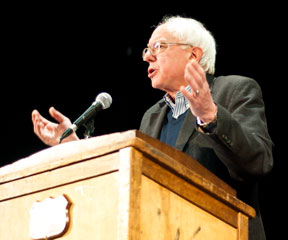
Asked why the emergency food problem is getting worse even though the economy appears to be improving overall, Sayles replied that food banks cannot solve the problem of hunger on their own.
“They’re not magicians,” added Sanders. “As a nation we may be making a slow recovery but millions remain at the bottom of the economic ladder and are really hurting.”
Hunger is at an all-time high in the U.S., Sanders said. One out of seven people – almost 45 million – receive food stamps. In Vermont, more than one in eight households do not have enough money to fully meet their food needs at all times, according to Hunger Free Vermont.
It’s not just seniors and children, Sanders added. “What emergency food shelves around the state tell me is that people who are working full time, but who earn low wages, are simply having a difficult time paying their rent, putting $4 a gallon gas into their car, heating their homes, paying their light bills, paying for health care – and then having enough money left over to pay for food,” Sanders said in a prepared statement.
The ultimate solution is, “at all levels, we’ve all got to say, nobody goes hungry,” Sanders concluded. For five years he and other senators have urged the U.S. Department of Agriculture to increase TEFAP funding. But while mandatory spending for Farm Bill programs has risen as needs have grown, discretionary funding has been reduced.
Congress has agreed to maintain $3.47 billion in funding for the Low Income Home Energy Assistance Program (LIHEAP), which helps eligible households pay for winter energy service. Although the same amount as last year, the amount is a decline from the $4.7 billion approved for FY 2011. Sanders warned that some GOP leaders want to cut back further.
“At a time when the gap between the very rich and everybody else is growing wider, we cannot turn our backs on those Vermonters and Americans most in need,” Sanders argued. He pledged to “do my best in the lame duck” congressional session after the November elections to reverse the trend and adequately fund nutrition programs.
“Most people believe that we don’t want to see our neighbors go hungry,” he said.
Asked by a local activist what individuals can do, Sayles advised people to stand up and talk openly about the problem. “Let people know you will not tolerate hunger in Vermont.”

