

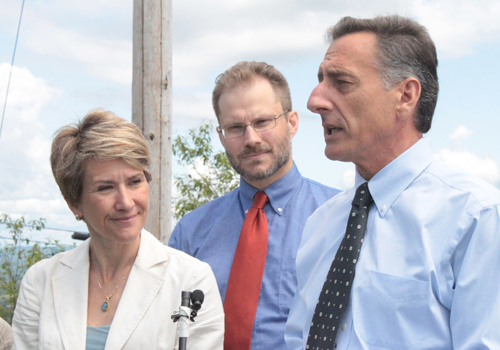
Vermont will receive $2 million from the federal government for cell service infrastructure in Orange and Caledonia counties.
The Shumlin administration and the state’s congressional delegation announced the award from the Federal Communications Commission last week. The funding will be used to create 4G/LTE 700 MHz infrastructure for mobile voice and data service on 941 miles of Vermont roads in the two rural counties.
The FCC received 900 bids from 38 carriers for wireless projects in unserved areas. The federal agency awarded bids to large carriers, like T-Mobile, and small ones, like VTel, that offered the lowest cost-per-mile bids. The VTEL bid was $2,184 mile. The project must be completed in three years.
VTel will use the money to build cell towers in towns that are now dead spots for cell service in Orange and Caledonia, and parts of Orleans and Washington. Michel Guite, CEO of VTel, said the award will extend 4G 700 Mhz Wireless Open World network to cellular corridors on Route 125 and other important roadways.
Only VTel customers would have access to the network. The Springfield-based rural cell and broadband service company will have roaming agreements with a large carrier.
The company could erect a single $150,000 tower in Canaan, for example, to provide cell services for about 400 homes, Guite said. The company would conduct a radio frequency analysis to site the tower, which could be on an electric transmission tower, a church steeple or a 50 foot telephone pole, he said. It would be connected to the cell system via fiber or microwave technology.
“This $2 million grant is a huge lift to Orange County and Caledonia County,” Gov. Peter Shumlin said last week. “We hope to put together more packages like this with all of our partners but it’s going to be a slower crawl with cell than it is with broadband.”
While the governor has often repeated his promise to ensure that “every last mile” of Vermont will have access to high-speed Internet service, he has made no such pledge for cell service. He said Vermont’s geography makes it “one of the most challenging areas in the world to bring cell service.” Universal service in Vermont is decades away.
Karen Marshall, who is the broadband and cell service project liaison for the Shumlin administration, said trying to get perfect cell service in Vermont is like “chasing a rabbit” because demand for data usage has exploded.
“The average person walks around with 2.6 devices with them,” Marshall said. “A couple of years ago maybe you had one — and it wasn’t a smart phone.”
Data usage over cell, she said, will grow 66 fold between now and the end of 2016 nationally. The large carriers are, at the same time, are enhancing their networks from 3G to 4G.
It would cost $50 million to $70 million to fully build out cell service in Vermont, she said. The state has been making investments to expand through rural carrier networks, she said, and is working cooperatively with carriers to build towers.
The 700 megahertz 3G LTE network under way in Vermont, she said, “does trifecta triple time.” “It delivers fixed broadband, it supports our smart grid, and we also know it can support mobility,” Marshall said.
Guite says it could be 15 to 30 years before there is perfect cell coverage everywhere in the United States. He imagines at some point it will be possible to get 100 million to 1 billion bits per second wireless anywhere in the United States and throughout the world. That level of coverage, he said, would cost billions of dollars in investments.
“As we sometimes wonder why there isn’t service on this model or that model, I sometimes like to remind myself that some of the worst service in the world is in downtown New York City,” Guite said. “There’s a place … 15 miles outside of New York going through New Rochelle where AT&T has been losing cell calls for 15 years.”
The way forward, however, at least for the voice network isn’t all that clear, he said. The system now in use is 3G. Once 4G broadband is available, Guite said, it’s likely consumers will have to use a Skype like voice system, but the way the new system would work is unknown. “They don’t have a clear mechanism for how to introduce voice on this fully data only integrated type network,” Guite said. “That’s being untangled now and will we invite others to share it with us, of course but the mechanics of it are unknown.”
“It’s not the way we’re used to making calls, it’s not the old-fashioned circuit switch network,” Guite said. “How you roam in a Skype type world isn’t yet known. We happen to have roaming agreements with one of the largest carriers. We haven’t announced it yet. We’re pleased we’re one of the only small rural carriers that has 3G roaming agreements with one of the giants.”
To see a map of the Vermont areas that will be impacted by the award, visit http://apps.fcc.gov/auction901/map/auction_result_ext.html, and click on the Vermont icon on the right.
For a full list of winning companies, visit http://transition.fcc.gov/Daily_Releases/Daily_Business/2012/db1003/DA-12-1566A2.pdf
