

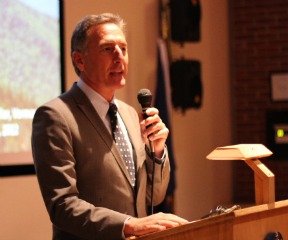
Don’t tell anyone (no need to rile up the troops), but so far most advocates of one cause or another have taken in stride Gov. Peter Shumlin’s announcement that he would take part only in campaign debates sponsored by news organizations, leaving those advocates out in the political/metaphorical cold.
According to the governor’s de facto fiat, there will be five or perhaps six candidate debates over the next two months rather than the 13 Shumlin had with Republican Brian Dubie two years ago, when neither one was the incumbent governor.
It may not be immaterial that Shumlin’s campaign made the announcement late on the Friday afternoon of Labor Day weekend, a perfect time for attracting minimal attention.
Still, the “losers” here – advocacy groups such as AARP, the Vermont Natural Resources Council, the Vermont Chamber of Commerce and others which had hosted debates in the past – were not all that upset. At least not as judged by their websites, which ignored the debate flappette.
Sure, Republican candidate Randy Brock was unhappy, as he had a right to be. The more debates, the better for a lesser-known candidate trailing in the polls. He gets better known, and every additional minute of debate is a minute in which the front-running incumbent might say something really stupid, giving the challenger a boost. (Yes, it’s just as likely that Brock would say something really stupid, falling farther behind. For him, though, that’s an acceptable risk. Losing by three touchdowns, you put the ball in the air, the risk of interception notwithstanding).
The lack of outrage from potential debate sponsors does not mean that one has to take without a helping of sodium chloride Shumlin campaign manager Alex MacLean’s insistence that “the decision is based solely on scheduling reasons and the fact that governor still needs to do the job he was elected to do… If we were to accept every debate invitation, he would be spending all of his time debating.”
He does have that job, and it is time-consuming. It’s also true that fewer debates are as good for the better-known incumbent as more debates are good for the lesser-known challenger. It is clearly better for the candidate with a 30-point lead to have as few debates as possible. Shumlin is that candidate. Or to put it another way, Shumlin’s decision was at least as much political strategy as it was governmental devotion, though the two are not incompatible.
Perhaps the frozen-out interest groups are containing their ire because they understand that there is only one sensible judgment to be rendered about the current state of affairs: five is enough; six would be … well, perhaps one more than enough. The two presidential candidates, after all, will debate each other three times. Nobody seems to think that’s not enough, and those guys have at least as much to talk about as Vermont’s candidates for governor.
None of which means that the slimmed-down debate schedule will have no impact on the campaign. And it could be an undesirable impact unless the people who do end up moderating the debates and questioning the candidates – presumably that would be journalists – take up the slack left by the absence of the advocates.
No, journalists are not supposed to be advocates. But in candidate debates, they are supposed to ask some of the questions – albeit usually in a less adversarial manner – that the advocates would ask.
For instance, had the Vermont AARP sponsored a debate, no doubt one of the questions would have concerned that $21 million rebate that AARP thought should be returned to some of Central Vermont Public Service’s customers. Instead, with Shumlin’s backing, it was earmarked to finance improving the energy efficiency of some customers following Green Mountain Power’s takeover of CVPS.
That was a big enough controversy that reporters are likely to ask about it, too. But Greg Marchildon, Vermont AARP’s executive director, said that at an AARP debate, Shumlin and Brock would probably have been asked about public transportation services for rural elderly Vermonters.
The fastest-growing segment of Vermont’s population, Marchildon said, is over 82, many of them live in small towns. As more of them can’t drive – or are told they should not drive – more are in danger of becoming isolated and depressed. How might candidates address that problem?
An interesting question. Will it be asked? Perhaps, if the debate questioners take the time (and they don’t have a lot of time) before the debates to talk to the people at the AARP, the business community, the environmental organizations, labor unions, farm groups, and others with an interest in how the state is governed.
And why would they not have those conversations? Well, perhaps because reporters covering a campaign are often tempted to ask about … the campaign.
That’s understandable. The campaign is what they are covering. They are not covering health care, taxes, schools, water quality, or jobs; only how discussion of such subjects influences the electorate.
Understandable, in this case, does not equal defensible. The responsibility here is precisely to that electorate, which gives not a hoot which candidate has raised more money, which one is ahead in the polls, what each man’s campaign strategy is. The electorate does want to know about how the candidates would deal with health care, taxes, schools, water quality, jobs, and the like.
Besides, it’s always a mistake to ask a candidate to analyze his own campaign. They’re no good at it. Take, for instance, one Barack Obama, who when asked four years ago why he seemed to have trouble connecting with working-class white voters blurted out that in hard times such voters “cling to guns and religion.”
Wrong answer. The right answer would have been: “You’re the analyst. I’m the candidate. I can’t be a good candidate and a good analyst at the same time.”
Neither can Peter Shumlin or Randy Brock. And the vast majority of the voters don’t care what they have to say about the campaign. Those voters want to hear what the candidates would do in office. There are enough questions there to take up all five debates. Even all six.

