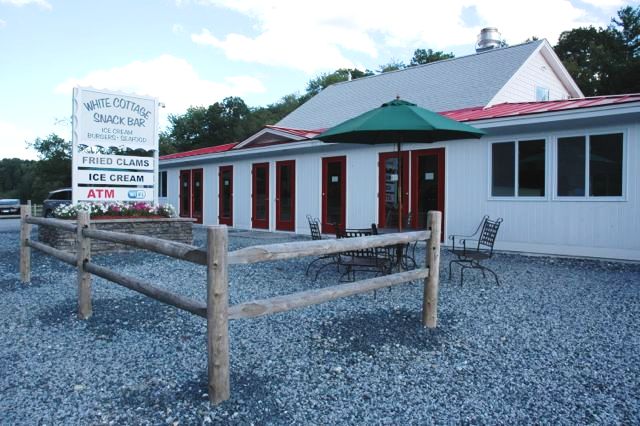
Driving along Route 4 from Bridgewater through Woodstock to Quechee and Hartford a year after Tropical Storm Irene, a tourist could easily miss that this river valley was hammered by the flooding Ottauquechee River.
Last week, the river was bony and low after a dry summer, the Woodstock town green was thronged with locals and visitors at the weekly farmers market and Simon Pearce’s Quechee restaurant was drawing hungry diners and shoppers looking at the elegant glassware.
But look closer and it’s clear the impact of Irene’s raging floodwaters has yet to recede from the region, evident in missing bridges, fresh riprap and eroded river banks, occasional rubble fields and new patches of pavement – and new, or vanished, buildings.

Stop and talk to business owners and you’ll find the damage goes beyond the physical to the mental landscape, and bank accounts, of those whose livelihood was thrown into disarray by Irene’s devastation. It’s not in any list, but in Vermont, Post-Irene Traumatic Disorder or PITD clearly is a syndrome some are still suffering.
Along with the scenic Route 100 corridor from Rochester to Wilmington and the Route 9 east-west corridor in southern Vermont, Route 4 was one of the hardest hit areas of Vermont. Along the Ottaquechee River, the scars remain prominent today.
Take the covered bridge in picturesque Quechee that connects the town. The span, a replica that was four decades old, remains missing, with a temporary scaffolding carrying water and sewer lines across the river over a gaping eroded bank, past a tilting real estate office and heavy construction equipment surrounded by concrete barriers. That unsightly view now dominates the center of the picturesque waterfall in the village. Repairs on a $2 million replacement are expected to go into 2013.
Further up Route 4, the iconic red Taftsville covered bridge, built in 1836, is half stripped and closed after damage to the footings, piers and long structure itself. It is being refurbished and isn’t expected to open until 2013.
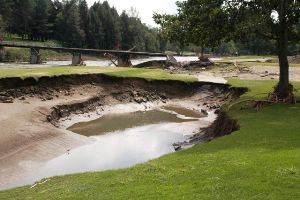
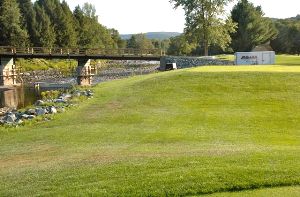
Tucked away on a side road in Quechee, one of the two 18-hole golf courses at the Quechee Club is finally expected to reopen on Labor Day weekend, a year after it was turned into a muck-covered rubble and debris field by the Ottauquechee. A staffer said the repairs there have cost more than $2 million.
Then there’s the loss of business that followed Irene, to landmarks like the tony Woodstock Inn, whose 142 rooms bring visitors to town and employs well over 200 people. The inn was closed for nearly two months after Irene and a year later, the flooded downstairs is still not in full use.
Less obvious is the changed character of the river, whose banks were dramatically widened in places as the water swept away grass, shrubs, tree and soil. That reminder of the power of a swollen river has left some along the river with an uneasy feeling about the potential for future flooding in storms.
“I try not to go to that place. Nothing’s changed,” says Patrick Crowl, speaking at the rejuvenated Woodstock Farmers Market, a bustling natural foods, wine and cheese, flowers and fruits emporium right on the riverbanks not far from Woodstock village.

When Irene hit, more than five feet of muddy water came through his store, ruining all his refrigeration and computer equipment and causing damage that he estimates topped out at $750,000. FEMA funding and loans covered about half of his rebuilding costs, and he recouped the rest by selling pre-paid Irene shopping cards to a supportive community.
Today, the only sign of the damage is new riprap and crushed stone fill along the river and the former offices of the Vermont Standard weekly newspaper next door, which stands empty with only the steel frame of the building remaining. The newspaper lost everything in the flood and is now in new rented space a mile west on Route 4.
While his store is restored, Crowl says he still feels the damage that happened in a deeply personal way, in the stress of having to rebuild his business, which hasn’t yet recovered to its pre-Irene levels, and of finding himself financially set back.
He compares it to losing a decade and suddenly being a teen again instead of an adult.
“Imagine just pulling the plug on a $5 million business,” he says, noting Irene wiped out everything he’d built, from all the equipment to the staffing and organization and leadership. He reopened in a limited way on Nov. 19, almost three months after Irene hit, and didn’t finally reopen fully until just after Christmas.
Crowl says it’s been a tough time, and he even went to talk with a consultant to try and grapple with his feelings of loss and frustration.
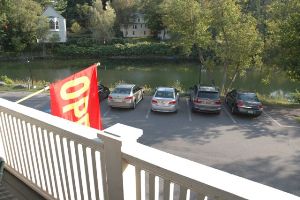
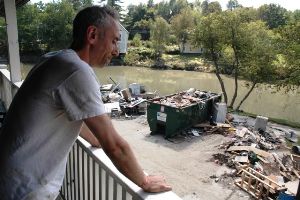
At the Parker House Inn in Quechee, co-owner Alexandra Adler knows exactly what Crowl is talking about. On a warm day with diners sitting on the shaded outside porch and a sparkling river down below, everything looks sunny and normal. But turn the conversation to Irene and she quickly becomes emotional.
She admits she’s “exhausted” from their continuing struggles, which now include a battle with the town of Hartford over use of the seven guest rooms that have always been part of the inn. In inspections after Irene, she says the town decided the inn can only use four without additional safety renovations.
“I want it all to be over,” she says. Later she adds, “we’ve killed ourselves.” Using $300,000 in loans, the couple used Irene as an opportunity to “reinvent our business” and upgrade the handsome red-brick inn, which sits in the village next to Simon Pearce. Irene flooded the basement and trashed all the mechanical equipment and refrigeration stored there.

But with the covered bridge out, traffic is down and she’s worried about winter business and paying off their loans.
To add to her and her husband Adam’s financial pain and stress, their house across the missing bridge was condemned after the flooding and they and their two children had to move to Hartland.
“It’s been hard on our family. We’ve had to relocate a couple of times,” she says.
The most heartwarming part was all the people who showed up to help clean up and how grateful they were when the inn reopened three weeks later.
“People were just happy to see something open,” she says.
But like Crowl, a year later she’s still dealing with the emotional scars that Irene left behind. She says she has virtually no memory of the hectic difficult days after Irene hit on Aug. 28 and they had to evacuate the inn.
“I don’t remember any of September. People say, ‘I helped move you out of your house’,” but she can only thank them and reply that it’s gone from her memory.
Watch the WPTZ story about Woodstock residents coming together to remember Irene.