

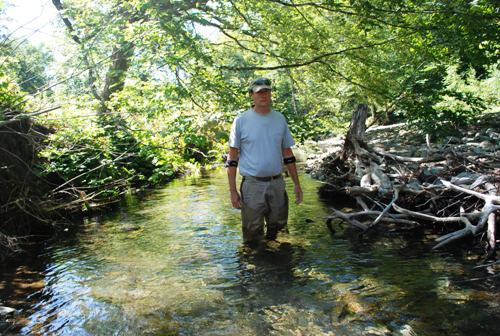
Rich Kirn stood thigh-deep in a cool pool overhung with gnarled tree roots on one side and lush vegetation on the other.
“This is it,” he said. “This is what we’re missing downstream.”
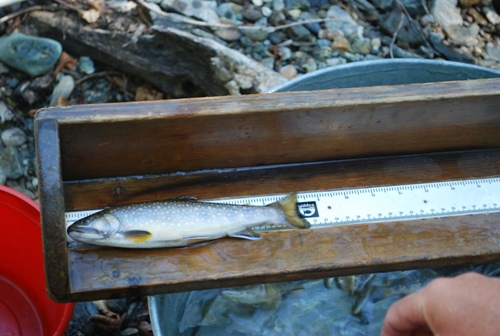
Just a few minutes earlier, Kirn had swung an electrified loop on a stick like a metal detector through the water downstream. The loop stunned fish with 500 volts of direct current so that Kirn, a fish biologist with the Agency of Natural Resources (ANR) and his assistant, fisheries technician Dylan Smith, could net them into a five-gallon bucket.
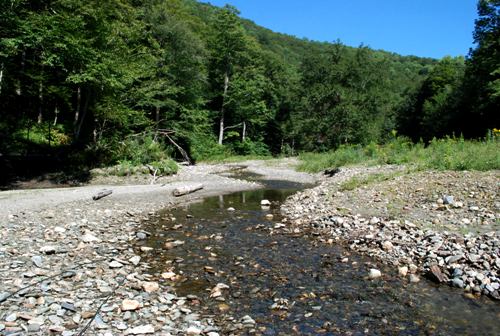
After Kirn and Smith waded through about 200 feet of Alder Meadow Brook in Granville, shocking fish, they measured and weighed them before releasing them — alive — back into the brook. In the section they surveyed, downstream of the pool, the streambed is broad, flat and homogenous.
There, Kirn and Smith found some small trout, two to four inches long, and no adults. In the sections of their survey route where branches or rocks created some refuge from the current and the sun, they found adults as well as young.
Electro-fishing is part of the annual fish surveys that ANR conducts along streams and rivers all over the state to assess the health of Vermont’s fish populations. This year, the data have not yet been analyzed, and in fact are still being collected, but the results are already clear.
In areas where the 2011 floods were severe, fish populations are down. Given that Irene seriously affected 10 out of the 17 major river basins in Vermont, this is a sobering realization.
Kirn has surveyed Vermont’s fish for 26 years and he has seen fish populations return to normal just two to three years after a major flood. He expects that to happen in many places.
But the survey route at Alder Meadow Brook was excavated by heavy machinery following Tropical Storm Irene, and woody debris removed.
“In the past, this had a lot of habitat,” said Kirn. There was “a series of shallow pools, a lot more dominated by wood. … It created a lot of good cover for older fish, larger fish.”
Now, however, the shallow, sunny, straight areas are capable of supporting only small fry.
In last year’s survey before Irene, Kirn guesses (without consulting survey records) that he found more than 20 brook trout adults on Alder Meadow Brook. This year he found seven.
Kirn’s report states that at least 86 miles of stream channels were altered by the use of heavy machinery following Tropical Storm Irene. The vast majority of those involved major channel excavation. These excavations ranged from less than 100 feet to several miles long. The regions with the most stream miles excavated were the White, West, Ottauquechee, Saxtons, and Hoosic watersheds. Along Alder Meadow Brook, about three miles were dredged, channelized, bermed, straightened or otherwise altered.
In some places, towns went back into rivers and restored some of what river engineers call “roughness” to the streambed. This was not meant to provide fish habitat, but rather to slow floodwaters. Indeed, Kirn’s report says, “these efforts largely fell short of restoring aquatic habitat complexity.”
Nonetheless, they did make a difference.
“In those cases, we saw better populations because they created a little more diversity with that [restored] habitat,” said Kirn.
Kirn has seen these patterns throughout his district, which includes the White, Ompompanoosuc, Ottauquechee, Waits and Upper Winooski watersheds.
What happens to a fish during a flood, and why does it take so long for populations to recover?
Ellen Marsden, a fish biologist at the University of Vermont, pointed out that fish expend much less energy than you might think by taking advantage of refuges in the current. This is why rocks and logs, which create eddies where the current slows, are so important. Big, dominant fish take over these spots and wait for dinner to drift by. This means most of the time they aren’t putting forth much effort to stay in place. During many floods they find a spot to wait out the drama, or else they get washed downstream and slowly make their way back. If the habitat is still there, they stay.
Kirn said that during a really big flood, like Irene, some fish are killed by the blunt trauma of boulders rolling downstream. Others get stranded on the floodplain. Still others die from breathing in the sediment suspended in the water and from secondary infections related to that. Surveys soon after Irene revealed that fish populations had plummeted by 40 to 70 percent. The young fish were the hardest hit, and it seems that is reflected in the current lack of older fish — the young ones just weren’t around to grow up into bigger fish.
The Federal Emergency Management Agency, along with numerous state and nonprofit partners, is helping fish swim back upstream by funding special culverts. These culverts will be larger and stronger so that they can allow floodwaters and debris through without being washed away. They will also provide rocky, complex habitats inside the culverts themselves.
“It’s not just the pipe we’re looking at, we are looking at the stream itself and restoring that so that the whole thing has ecologically integrity,” said Mary Russ, executive director of the White River Partnership, one of the partner organizations. Seven culverts are slated to be replaced in areas where fish passage is deemed highly important.
But if the fish that were washed away don’t find habitat to thrive in when they return, there’s no use in staying. Kirn said that there are enough adults to repopulate the survey area of Alder Meadow Brook, but if the young of the year and juveniles don’t have refuges to rest and hunt from, they won’t grow into adults and the population won’t rebound as quickly.
At Alder Meadow Brook, the next flood will wash new debris into the excavated stretch, and the next flood, and so on, until the habitat has returned. And because the stretch is not very long, fish can move up or downstream in their search for habitat.
“This will heal itself over time,” said Kirn.
Kirn is more concerned about some rivers, like Gilead Brook in Bethel and Pinney Hollow in Plymouth, that were dredged and straightened for miles. In those cases, said Kirn, the rocks and logs that create habitat will have to fall in from the banks, and that will take much longer. Kirn’s 2011 report on pre- and post-Irene trout surveys says recovery could take decades. Gilead Brook, at least, had some restoration work done to re-create roughness on the streambed.
Not just the fish
The ANR also monitored macroinvertebrates — the insects and crustaceans that fish eat — before and after Irene. They found that in remote, undisturbed streams, the number of macroinvertebrates dropped by 80 percent following Irene, but the number of species was hardly affected.
The number of species in a place is partly a result of the diversity of habitats available. Steve Fiske, an aquatic biologist with ANR, said that because Irene floods didn’t reduce habitat diversity, the core population of macroinvertebrates was able to return quickly to the number and diversity present before Irene. Theoretically, in areas with less habitat diversity, the populations should take longer to rebound because species diversity would be lost.
Fiske and his team did not sample in streams that were dredged following Irene last year, mainly because there was so much other activity going on in those areas. They will be sampling for macroinvertebrates in those stretches this year.
Fiske and his team have not begun their sampling season yet — it runs September to October — but Fiske said that based on his personal observation from turning over rocks and logs in streams, “it looks like things are going to bounce back pretty well.”
Stream salamanders were also affected by the flooding, said Middlebury College professor and herpetologist Jim Andrews.
Stream salamanders tend to spend their days nestled under moist logs and rocks along the edges of streams, escaping the heat. Andrews said he has looked for stream salamanders since Irene and in the areas that were scoured by the flood, there are none. He said it will take some time for them to come back because they prefer areas where there are moist dead leaves and twigs, which feed the macroinvertebrates that these salamanders eat.
“As a group, the stream salamanders will do fine, it will just take a while to recolonize some of the portions that got scoured out and exposed,” said Andrews. “Overall, I think our amphibians won’t feel a major impact as a result of that one storm outside of those specific areas that got heavily scoured.”
Andrews is more concerned that increasingly frequent summer floods in general will harm the stream salamanders. He cited a study by a former student, Winsor Lowe, published in the journal Biological Conservation, that found declines in stream salamander populations were associated with increases in precipitation.
Stream salamanders lay their eggs alongside or in streams. The eggs hatch and gilled salamander larvae spend part of the summer eating macroinvertebrates and swimming around in streams. The larvae can’t leave the water if there is some disturbance because they won’t be able to breathe.
“When we have flood events in the summer, these larvae can get washed downstream and get killed,” said Andrews. “It’s really like a big blender, all the rocks pounding down the streams and if they don’t find a big rock that doesn’t move, many of them will get killed.”
What Kirn, Fiske and Andrews seem to be saying is that, in general, our streams and the creatures that inhabit them have a natural resilience. It may take some time, but they’ll be back — as long as we do more to help than hinder that resilience.
