


The proposed master plan for Burlington’s urban core sounds and looks like a new airport designation: planBTV. The logo-style name, like other decisions made since the project began in early 2011, points to an emphasis on image and messaging that runs through the “discussion draft.”
The current draft is as much a persuasive prospectus as a planning document. PlanBTV’s long-term blueprint for downtown Burlington and the waterfront attempts to balance concerns about sustainability with continued growth and pressing Burlington’s competitive edge. Once adopted, it will become the basis for a variety of ordinance and zoning changes for implementing an overarching vision for the city. It will also smooth the path for projects that survive public scrutiny.
The plan itself is more like a PowerPoint presentation than a traditional plan, full of intriguing statistics and perceptions and frequently reinforced themes and arguments. In the 114-page print version, specific recommendations don’t appear until page 90. The rest of the elaborately-designed glossy magazine-type publication covers local history, how the plan was developed, a set of “values we celebrate,” and nine “themes” that combine to create the rationale for various proposals.
Dozens of diagrams, illustrations and charts create a seductive vision of Vermont’s largest city in the not-too-distant future. The plan design is the work of the consulting firm Town Planning and Urban Design Collaborative and is funded by HUD’s Office of Sustainable Housing and Communities.
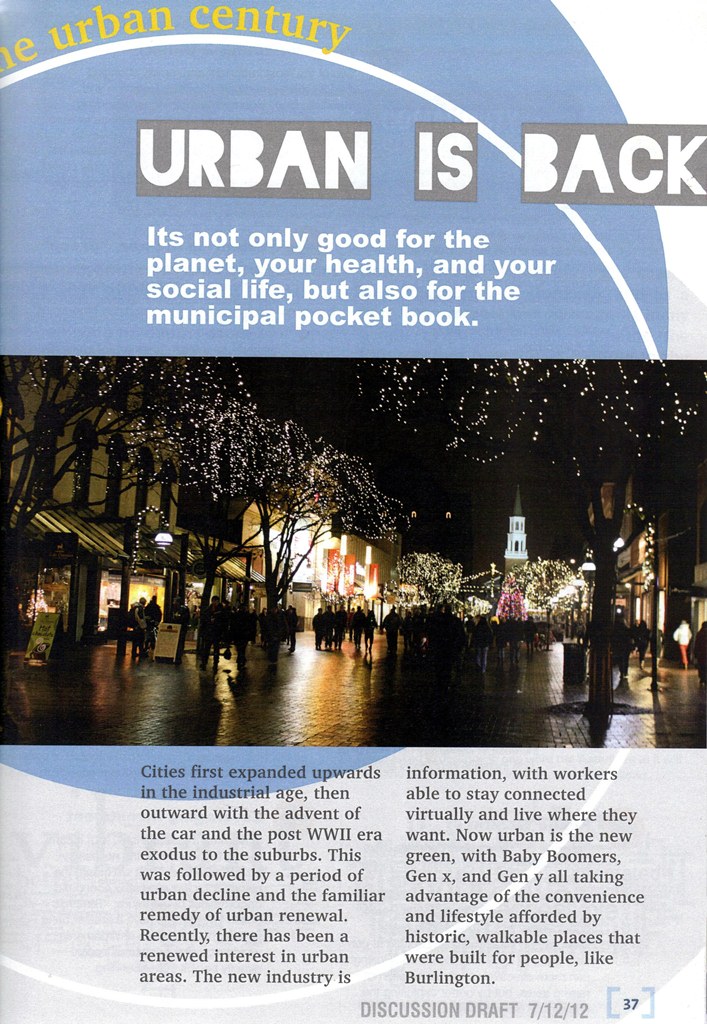
The draft is now available online and – if you make the effort, or work for the city – in printed form. An initial 100 copies of the magazine version were printed at a cost of $1,800 and a second edition will be available after the public comment period. Some pages and recommended ordinance changes in the print edition are not featured on the interactve website (viewers can leave comments), but the entire magazine is available in PDF form. The City Council is expected to take public comments on the plan at its meeting on Aug. 13 and in future meetings before the Sept. 30 comment deadline.
Burlington’s comprehensive planner Sandrine Thibault recommends adoption of the plan, which she says “represents a social contract bringing citizens together around common goals for their future.” An orientation section follows under the headline “How to love the plan.” Step one, it suggests, is to support it “even if you don’t like all the ideas.”
The objective is to focus residents on the big picture rather than on controversial details like a new waterfront hotel or more parking structures, and ultimately to consider whether the overall plan takes the city in the right direction. Readers are encouraged to become part of the planning team and to recognize that some ideas likely to “bring about transformative change” could take years to implement.
A highlight of the public process was the series of community meetings held in January. These design “charettes” — a planning term from the French words for cart — were attended by about 500 people who looked over various proposals.
The writers of planBTV explain: “Feeding off this buzz of activity, the team entered production mode, synthesizing ideas, collaborating over design challenges, preparing renderings, compiling precedent images, and drawing up the final master plan.”
A survey conducted from October 2011 to January 2012 yielded 250 responses that were used to define a set of “Burlington values.” When asked about their impressions of downtown Burlington and the waterfront, the word residents used most often was “vibrant.” Survey respondents gave the city high marks for special features, namely: downtown shopping and dining, Church Street Marketplace maintenance, amenities for pedestrians and cyclists, and the scale of buildings.
Respondents’ No. 1 priority? Promotion of a local economy sustained by a diverse mixture of business. Other items that topped the list included: creating new urban development, strengthening the city’s role as an economic center, and developing an integrated transportation system and a wide range of housing options.
The planners generated another list of “values we celebrate” (based on surveys and other sources), including: respect and tolerance, diversity, access, localism, creativity, ability to walk and bike, social interaction and civic engagement, a sense of place, conserving energy, self-sufficiency, and lifelong learning.
Making the case for change
The desire to keep Burlington a vital and desirable place to live is linked to competition for “market share” with surrounding communities and the suburbs.
“For years the City has struggled to agree on how to move forward with the development of the waterfront and the core has struggled to match the vitality seen on Church Street,” according to the authors of planBTV. “While the city is a desirable place to live, a lack of high quality affordable housing limits the number of people who can find housing downtown. This deficiency of downtown housing also potentially deters businesses who fear they cannot find a needed employee base. Traffic, challenges with parking, and shortfalls in the quality of the public realm further deter potential residents and visits. Complex and unpredictable regulatory framework also suppress the potential for investment by the private sector.”
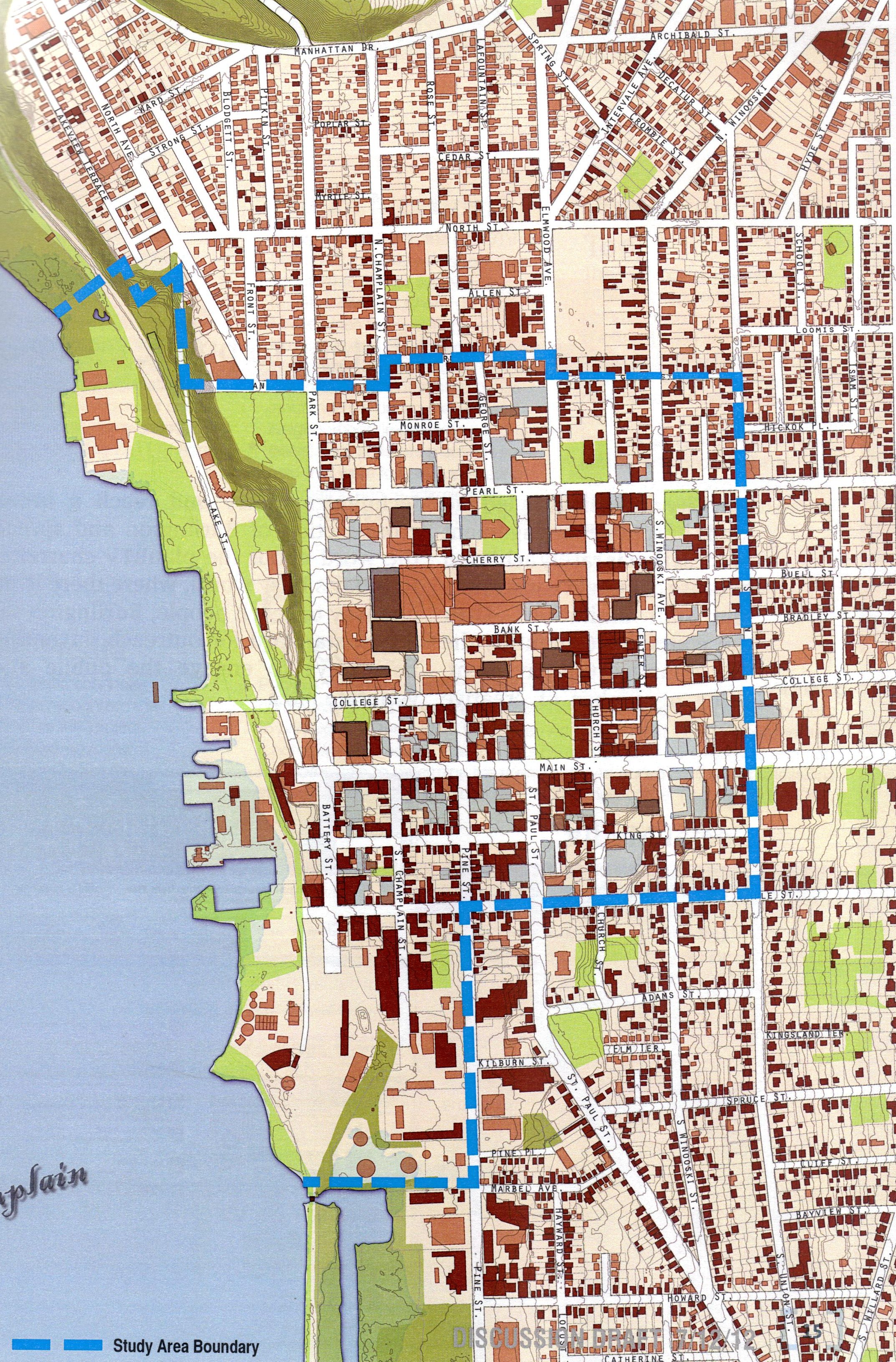
PlanBTV recommends that neighborhoods combine commercial, residential, recreational and civic uses.
The plan concludes that downtown could handle an additional 18.2 million square feet of mixed-use development and more than 500 residential units.
“The creative class, entrepreneurs, and baby boomers are moving into cities, sacrificing privacy, personal space, and their automobiles, in exchange for convenience, entertainment and social interaction,” the plan states.
Single-person households account for 55 percent of the total population in the downtown and waterfront area, the plan reports, while 88 percent are renters and 63 percent are under 35 year old. The average rental rate for an apartment is $1,250. According to the plan, only 12 percent of homes in Burlington’s downtown are owner occupied.
The report says that rental properties are often “unkempt” — “especially when there is a high concentration of transient residents such as students – compared to homeowners who put down roots and make a long-term investment in their home and neighborhood.”
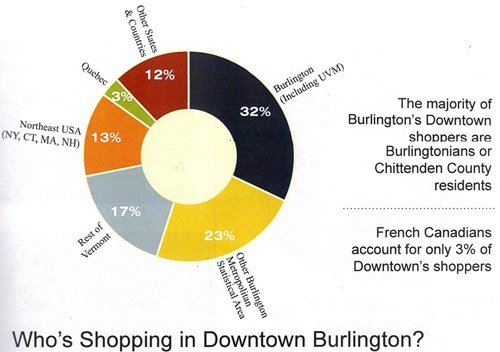
Among the economic “insights” that emerged from the report is that downtown Burlington, which currently has nearly 1 million square feet of retail space, could accommodate up to 200,000 more. Another is the assertion that French Canadians account for only 3 percent of downtown shoppers. Some officials have questioned the facts cited in the report. No documentation is provided for much of the data presented in the plan, and some statistics are based on short-term or limited samples.
A transportation analysis shows that 74 percent of Burlingtonians drive to work regularly, but the majority of residents “would like to be less auto dependent” and 20 percent walk to work. The plan asserts that the city does not have a shortage of parking spaces, since at peak times 35 percent of the spaces are empty. A third of the parking, however, is private.
Although the impact of the proposed Champlain Parkway is not discussed – in part because it extends beyond the downtown area – four high-relief aerial maps show the potential for more park and civic space beyond the core. These opportunities include extending the street grid in the south end. According to PlanBTV there is “a lack of buildings to enclose and activate the parkspace” on the waterfront. In other words, more development is needed to draw additional visitors to the area.
Implementing the vision
PlanBTV eventually gets around to specifics, beginning with the need to expand the retail market share. A major proposal in this area is expansion of the current four-block business improvement district (BID) downtown, currently known as the Church Street Marketplace.
In future the BID’s role could include unified management of public infrastructure, advocating for redevelopment incentives, retail recruitment services handled by a specialist, and creation of a waterfront enhancement and redevelopment program. Setting up a downtown development revolving fund – a potential source of loans for promising projects – is mentioned as “a means to leverage private investment” and to ensure that design and material standards are met.
Subsequent sections cover the need to reduce barriers to housing development and open up more units downtown. One recommendation is to improve vacant upper floors along Church Street for use as student housing. Another is to develop an underutilized parcel at the corner of Main and South Winooski, ironically known as the Superblock, to create a high density project that attracts “several demographic groups interested in urban living who may want an alternative to fatigued single-family homes.”
Absent from the website is a related section in the magazine listing the specific zoning changes that will be needed. They include dropping a 50 percent limit on residential use in downtown projects, eliminating off-street parking requirements, simplifying the public approvals process, increasing the threshold that triggers the need for inclusionary units, and revising the size limits to allow for smaller units.
Another section deals with the innovative potential of Burlington’s creative class, described as “anyone willing to think like an artist” or who is striving to “create a window to view the world in an altogether different way.” This element of the plan is a departure from the past: It explicitly acknowledges that arts and culture have become key factors in Burlington’s identity and economy that need to be nurtured.
Recommendations for fostering innovation include combined public and private funding for non-for-profit enterprises, a commitment to development that “actively enables” creative endeavors, and “incentivizing” the use of upper story properties.
Among the most detailed sections in planBTV are proposals for streets, transportation, pedestrians, cycling, and parking. These plans are numerous and ambitious, including a downtown transit mall; a passenger train station that would be part of a new waterfront civic square; and enhancing Burlington’s reputation as a bike-friendly destination through functional parking, end-of-trip facilities, secure storage, bike sharing and a variety of bikeway types.
The section titled “Park It! Burlington” provides a granular look at demand, the rationale to change some parking requirements, a tiered time limit approach, use of smart technology, and pricing proposals. “We already know that there is a surplus of parking that should be filled before new parking infrastructure is constructed,” according to the plan. “Building additional parking facilities will be the last step for Burlington to grow in a smart and efficient way.”
Reimagining the waterfront
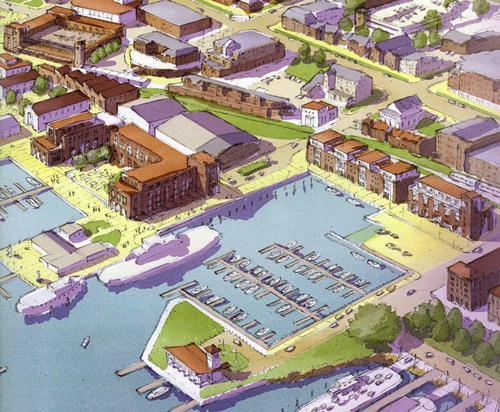
PlanBTV sees the waterfront’s potential “to be a year-round activity center that attracts both city residents and visitors.” Future possibilities include an ice skating facility and a sled run down Depot Street when the area is “less than ideal” for typical warm weather options. The waterfront area would also be physically linked with the downtown at several points.
The text often mentions minimizing the use of automobiles. But in the section on parking it also recommends eliminating parking requirements for future development. “Each new development can determine exactly how much parking is needed without wasting land and resources on parking spaces that will not be utilized.”
Thirty pages later, among the many proposals in a key section under the jaunty title, “Around the Burlington Plan,” it discusses two possible new parking structures on the waterfront. The idea is to keep most of the additional parking hidden from view, preferably in buildings with other retail, housing or office uses.
One possibility is a parking garage with a “green” roof with a commanding waterfront view below Battery Street, potentially with a connection to Pearl Street via elevator. Another option is below the southern end of Lake Street, with access to College or Main. Building them “would allow nearby surface parking lots to be redeveloped into civic spaces and mixed-used buildings to further activate the waterfront,” the plan says.
The most informative sections come in the final 25 pages, which physically pinpoints and describes specific elements of the plan. At the north end of the waterfront, for example, it calls for a redesign of Overlook Park; stairs or even a mechanical conveyance down the escarpment; a new multi-purpose building at the midpoint of Waterfront Park, with an entrance to the event area where access can be controlled; a “creativity village” of new and existing buildings along Lake Street; a seasonal skating rink; and a large new civic pavilion that could become the site for future crafts and farmers markets, indoor concerts, and exhibits.
Moving south, the plan describes an “active mixed-use area” with retail space, restaurants and a new inn or hotel on land owned by the Pecor family. In planning speak, this is called “adaptive reuse and infill,” an opportunity for development that extends the four-season tourism concept, with uses that reinforce “a vibrant pedestrian environment.” To accomplish this, the city’s ferry terminal would be moved south to make room for new projects.
Last June Mayor Miro Weinberger said that he sees the process under way as the city’s best chance to reach “a meaningful consensus” about what Burlington’s downtown and waterfront should look like. The approach could work, he told VTDigger.org, because it is visual and combines talented designers with modern technology.
The plan does not incorporate some other relevant planning that is also under way, notably the update of Burlington’s Climate Action Plan that will become part of a revised Municipal Development Plan. Future city projects and programs affecting transportation and development will have to conform to the standards in the plan. That includes zoning, subdivision regulation, impact fees and capital improvements.
To order a free digitaldownload or a print copy of the magazine go to www.burlingtonvt.gov/planbtv.


