

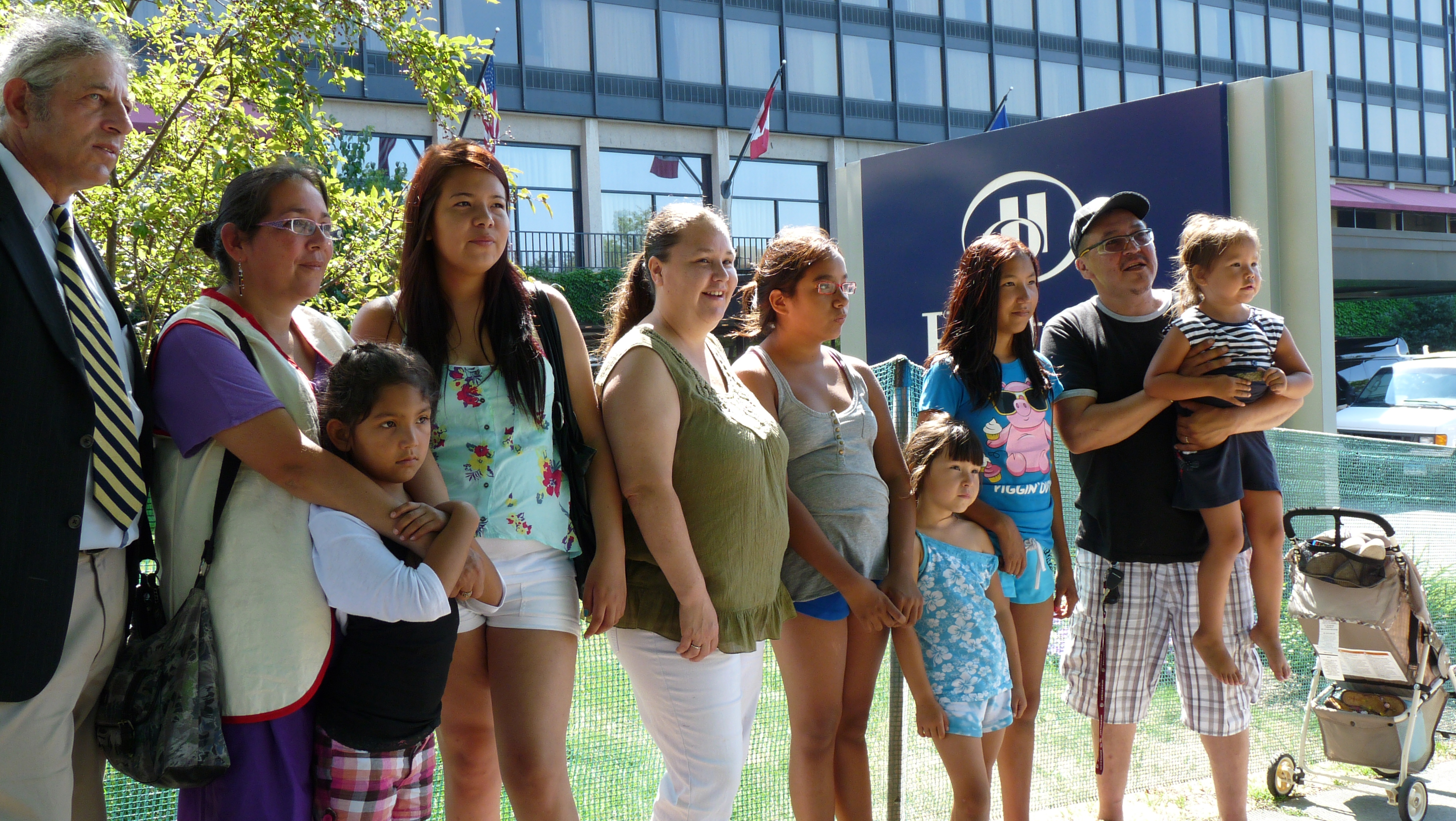
While officials from New England states and Canada’s eastern provinces worked on regional cooperation on renewable energy inside Burlington’s Hilton Hotel, activists outside criticized the officials’ approach as too corporate-friendly.
The 36th annual New England Governors and Eastern Canadian Premiers Conference is focusing on how to develop and expand markets, coordinate government responses and work collaboratively with private sector innovators.
The leaders discussed the potential for regional cooperation on renewable energy and policies that will promote electric vehicle development in the opening hours of the one-day conference.
Outside the conference site, activists heard from Inni representatives about the destruction of native land to make way for tar sand oil development, a major focus of protest activities designed to influence the agenda of officials and business leaders.
Charles Megeso of the Nulhegan Abenaki and Elyse Vollant, from the Innu community of Uashat-Maniutenam entered the hotel and asked to speak with governors, according to Megeso. They were reportedly told by conference director John Shea, “We just don’t have enough room for you here. There’s not enough breakfast,” said Megeso.
Vollant, who traveled 12 hours from northern Quebec with three of her children and one other family member, opposes Hydro Quebec development on the La Romaine River and Plan Nord, an $80 billion energy development project.
A small group of activists gathered just beyond the Hilton driveway, but the number was much smaller than Sunday’s turnout.
After a first wave of peaceful Sunday protests by about 500 people, an attempt by about 40 activists to block a bus bringing conference participants to the hotel in late afternoon led to a standoff with riot-clad police. Ellen Kief, an immigration attorney from Massachusetts who arrived on that bus, said that she and others were surprised by the protests and the police response.
“A lot of people attending are on their side,” Keif said of the activists. She showed snapshots that showed a gradual buildup of tensions that eventually led to use of pepper spray and rubber bullets by the police.
After opening remarks from representatives of state and provincial governments on both sides of the border, several resolutions were adopted. They include pledges to develop a “coordinated competitive regional procurement program,” create a “new regional process to identify longer-term opportunities in electricity markets,” and develop policies accelerating the deployment of alternative vehicles that “facilitate a lower carbon and more sustainable transportation future.”
More than 50 representatives from state agencies and the private sector in Vermont were joined by delegations from the other five New England states and five Canadian provinces as well as from China, including several representing the Chinese People’s Association for Friendship with Foreign Countries. The Vermonters included leaders of energy, conservation and environmental businesses and organizations.
During the first conference session, Vermont Public Service Department Commissioner Elizabeth Miller moderated a roundtable discussion on regional procurement of renewable resources and models for small-scale energy.
Gov. Peter Shumlin touted a “long and productive relationship with Hydro-Quebec,” calling it a crucial asset that provides the region with a competitive advantage. The next challenge, added Quebec Premier Jean Charest, is to look at regulations and barriers to development of small-scale resources. “Our view of pricing is long-term,” he added. “Hydro-Quebec has been built for a hundred years.”
Canada is also encouraging development of bio-fuels, Charest said, and “the private sector thinks there will be a price on carbon at some point. We want to get ahead of that.”
The coordinated procurement resolution mentions promising results of more than 50 renewable generation projects in the region that account for 4,700 megawatts of power, along with seven transmission projects. Such developments indicates that “sufficient resources exist to enable New England to develop or import renewable energy to meet Renewable Portfolio Standards or goals,” the resolution states.
In a statement about the procurement initiative, Conservation Law Foundation President John Kassel said that New England has “once again set a national example by acting boldly.” In the absence of a national policy, states are providing leadership by “shaping and building new markets,” he said.
After a series of presentations on the potential of electric cars, the officials also adopted a resolution on transportation. Noting that this sector contributes more than 30 percent of all greenhouse gas emissions in the region, the resolution expresses government support for development of infrastructure and policies that promote alternative fuel vehicles. A conference on the topic will be held Sept. 27 in Montreal.
Although tar sand oil development and shipment is not a focus of the conference, most participants are aware of the protests and the Sunday confrontation with police.
A number of people commented that the activists should know that they have allies at the conference. Others felt the protests were misdirected.
Some conferees don’t see the connection between what is being discussed at the conference and the issues that sparked the protests. One Vermont participant suggested that the activists develop a statement that can be circulated to those attending.
