

Editor’s Note: This essay is part of a series excerpted from Maverick Chronicles, a memoir-in-progress by Greg Guma, a longtime Vermont journalist.

Bennington was not only the scene of revolutionary-era resistance. Two centuries later it also became home to a revolution in the arts when Martha Graham and others turned Bennington College into the epicenter of the modern dance world in the 1930s.
The Bennington School of Dance, precursor of the American Dance Festival, was an innovative laboratory where pioneers experimented, trained students and created early works that defined modern dance. A generation after Graham, the area evolved into a nexus for modernist art activity. As the story goes, art critic Clement Greenberg met painter Helen Frankenthaler, then a Bennington College student.They were soon joined by painters like Paul Feeley and helped connect the emerging avant-garde movement based at the college with the New York art scene.
By the early 1960s, the community was hosting a veritable artists’ colony. An article in Vogue updated Vermont history by calling painters like Anthony Caro, Kenneth Noland, Vincent Longo and Jules Olitski the new “Green Mountain Boys.” The college had assimilated a small yet energetic community of idealists, intellectuals and artists.
Greenberg’s idea was that art should be disciplined without sacrificing aesthetic vitality, a concept that combined distance with enjoyment and freedom. Not far from urban centers and yet sufficiently removed, Bennington felt like an ideal place to play out this artistic vision.
The “Golden Age” on campus was over by the late ’60s and a conservative political storm was brewing not far away. A new public high school had been built in the blush of a progressive educational era. But after several Bennington leaders died in a plane crash and the school superintendent resigned in 1968, a dispute developed over who would replace him and where education was going.
Watching a culture war begin
Lack of experience and limited knowledge of the local dynamics made my first education stories for the Bennington Banner less informative than they might have been. But after some tense schoo lboard sessions, plus getting the back story from off-the-record sources, I developed a sense of the situation. At the center of it were the Sleemans, the most influential family in the village of Bennington.

Assistant School Superintendent George Sleeman had a brother, Richard, a leading local conservative who chaired the elementary school board, held an administrative job at a local college, and supervised the local property assessments. The family, which owned more rental property than anyone else in the area, had strong support among the local working class. But the village was literally surrounded by another legal entity, the Town of Bennington, a growing suburbia populated by more liberal professional types.
I was witnessing a struggle for power between two factions – working class traditionalists and middle-class modernists.
Openmindedness meets the ‘moral majority’
Beyond their resentment of Bennington College, the traditionalists disliked the modernists because of the “progressive” agenda they had imposed in the construction and curriculum of the new high school. Still, their deepest antipathy was reserved for the state’s bureaucratic establishment, particularly the commissioner of education, Harvey Scribner.
A no-nonsense teacher from Maine, Scribner had come to Vermont after presiding over the integration of black children into white schools as Teaneck, New Jersey’s school superintendent. In the 1970s, he went on to become chancellor of New York City’s school system during its turbulent shift toward local control. But to local Vermont conservatives in the late ’60s, Scribner represented the heavy hand of the state. During my second week on the job, he made a fateful decision that turned the traditionalists’ simmering hatred into an open feud with bitter long-term consequences.
To break the stalemate, Scribner — usually a proponent of local control – exercised his authority to merge Bennington’s Supervisory Union with an adjacent board and appoint its superintendent as head of a new “super district.” George Sleeman could keep his job, but his promotion had been blocked by a state dictate. His allies were stunned and his brother was hopping mad.
For Richard Sleeman, the decision was not merely a slap in the face but a sign of things to come. With a superintendent selected by Scribner, the next step would be “open classrooms” and other “dangerous” reforms proposed in the commissioner’s Vermont Design for Education.
At an elementary school board meeting held after the announcement, Richard puffed furiously on his pipe as he complained about the decision. “Didn’t Dr. Scribner write a letter to us a few weeks ago and say our situation hasn’t changed? And haven’t we now got this man telling us local puckerbrushers what to do? Ordering us? Chaos! I see chaos,” he said.
Turning to his real target, Scribner’s Vermont Design, he proclaimed it “an affliction being imposed upon the education system of our fair state. Read it and decide for yourselves. The format could be titled ‘Harvey Scribner meets Matty Mouse.’ But since use of the design is voluntary, we can save ourselves and our teachers a lot of spare time by burning the Design for Education on the front lawn of the elementary school.Then we can begin the great work of drawing up our own design forthwith.”
He never got around to the public burning. But Sleeman’s cadre of “concerned citizens” did proceed to organize a crusade that put progressive education on trial. As the reporter covering school affairs, it reminded me at times of Inherit the Wind, the classic dramatic reworking of the Scopes Monkey Trial. But Bennington had no Clarence Darrow to defend it against this assault on reason.
The first flashpoint was a musical production at the high school, an experimental adaptation of “Brecht on Brecht,” George Tabori’s innovative sampler of the German artist’s plays, essays, poems, aphorisms and struggles. Students and teachers were attempting to challenge the limits of what high school drama could be, just as Brecht had challenged Broadway’s theatrical conventions. They were doomed before the curtain went up.
I explained the situation in a front page report on Feb. 1, 1969:
A poster advertising Mt. Anthony Union High School’s upcoming production of Brecht on Brecht has become the center of a controversy involving the U.S. flag, Nazism, advertising and censorship.
That considerable accomplishment was the result of the sign’s use of a swastika juxtaposed with sections of Old Glory, symbolizing America’s victory over fascism to some — and U.S.police-state inclinations to others.
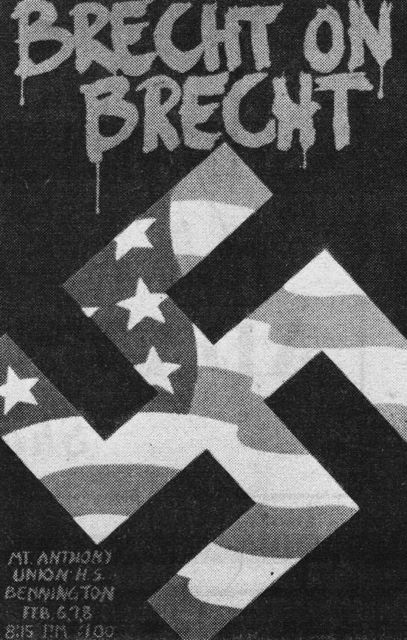
Shortly after the show’s poster appeared, complaints were lodged with the state police. According to the cops, it was illegal under the “uniform flag code” to use the flag or any part of it for advertising. The posters had to come down. Aside from a few that became collector’s items, they were never seen again.
When the show finally opened, the house was half-full and the audience reaction ranged from nervous laughter to stunned silence. An attempt to dramatize concerns about the state of society had instead exposed the gap between the school’s avant-garde leanings and the community’s growing discomfort.
Not long after that, two English teachers made the mistake of teaching a lesson about language with examples that included a few sexual phrases. The outcry was immediate and overwhelming, further deepening the rift. This time “concerned citizens” packed the high school cafeteria, heckled the school board and demanded action. At one point, a parent sitting next to Richard Sleeman actually argued that Broadway plays shouldn’t be performed in small towns.
“If we censor what students do, we are in a sensitive area,” a board member replied. Once the booing died down, someone shouted, “Why? What about parents who have kids in this school? What about poor people? Rich people make all the decisions.”
Feeding the resentment, another ally of Richard’s pointed to the row of board members facing them and charged, “This is merely a group of merchants and business people. It isn’t representative.”
The opening shots of a “moral majority” curriculum war had been fired. What I saw over the next months was depressing but instructive. Unwilling to directly challenge the assault, the area’s spinally challenged liberals capitulated, which left Richard Sleeman’s lieutenants free to wrest control of the high school from the “open education” crowd. Once brother George became superintendent, the Sleemans and their crew re-staffed the public school system.
By the early 1970s, the football coach had taken command as high school principal. Outside, a fence went up to discourage “loitering,” and MS Magazine was banned.
Inside, a hard-fisted crackdown was under way. It was back to the basics and goodbye to “the Bennington College influence.”
Next: Living with polarities
