

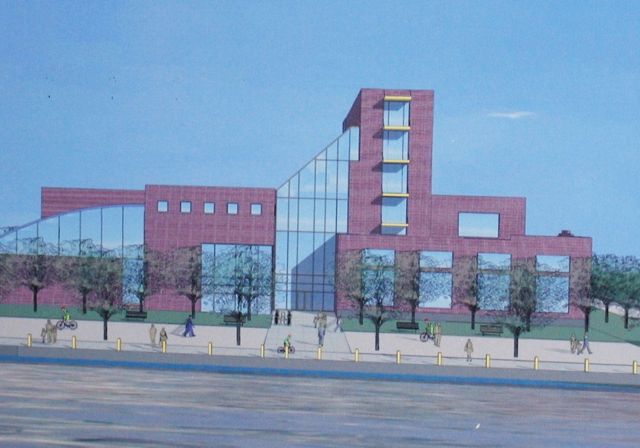
The recent decision by Mayor Miro Weinberger about the future of the Moran plant on Burlington’s waterfront answers one question but leaves others hanging.
The city will not continue to act as developer of an ambitious plan to turn the hulking, 90-foot high former coal plant into a recreational space with ice climbing, a sailing center, restaurant, and other facilities, Weinberger announced. But the ultimate fate of the structure remains uncertain and will depend to a large extent on proposals submitted by private developers in a competitive process slated to begin by the end of September.
Four years ago, Burlington voters approved a $21 million renovation plan for the Moran site by 700 votes. The city was going to put up $7 million, with tenants expected to provide the rest.
Some residents thought the building should be torn down instead using “smart demolition,” which involves salvage and recycling, for a projected $2.5 million. The idea was to create a public park with community gardens and sailing center. But a separate advisory question asking whether residents wanted to go in that direction went down by 874 votes.
The redevelopment deal that emerged was complex and progress was slow, compounded by the most serious U.S. economic crisis since the Great Depression.
“My goal is an efficient process created in partnership with the City Council that allows the City to commit to a new direction no later than April 2013,” explains a description of the new “Five-Point Action Plan” prepared for Weinberger’s announcement. The argument is that having an “environmentally clean site,” a plan for the area surrounding the building, and tax incremental financing (TIF) for improvement of adjacent areas will attract new players with ideas for the structure itself or the valuable waterfront property on which it sits. Eventual demolition has not been ruled out.
Weinberger’s proposal includes enhancements to Waterfront Access North, the six acres surrounding the building, with $2 million in waterfront TIF money; major improvement of the heavily-used section of the bike path between Perkins Pier and the north boundary of the Urban Reserve with another $3 million in TIF funding; and a process that leads to decisions about the Urban Reserve, a nearby former industrial area set aside 20 years ago.
City council support will be sought for Waterfront Access North and bike path funding in time to request voter approval of the $5 million in November. Use of TIF funds is supposed to generate enough economic development and new property tax revenue to retire the resulting debt and help fund other projects.
In making his announcement, the mayor said that the project initiated by former Mayor Bob Kiss in 2008 had stalled due to permit complications, cost overruns, potentially unattainable deadlines and a lack of fully committed tenants. Drawing on his experience as a developer, Weinberger added that it was “the most complicated financial deal I have seen in my 15-year career specializing in complex public-private projects.”
Weinberger made delay of the project an issue in his campaign for mayor and pledged to make a firm decision within his first 90 days in office. On July 2 he kept the promise. However, his alternative rests on finding the right developer by next April to take on a difficult project that has eluded the city for more than 25 years, as well as on winning public acceptance of whatever site plan emerges.
False starts and great expectations
For more than 30 years Burlington mayors have confronted legal, financial and public relations challenges in attempting to develop sections of the waterfront. Grand plans have come and gone, frequently greeted with skepticism and resistance.
In the 1970s Democrat Gordon Paquette initially had broad support from his party and Republicans for a commercial plan that envisioned expensive condominiums and underground parking at the water’s edge. That was met with serious objections, particularly by residents of the adjacent King Street neighborhood who feared that waterfront redevelopment would lead to higher rent and drive them out of their homes.
The Paquette plan didn’t get far. But it did help open the spigot to government funds for housing rehabilitation and subsidies in the nearby low-income area. Some charged that this was an attempt to buy off critics. Already thinking about a marine museum near his ferry operation, Ray Pecor, owner of Lake Champlain Transportation and a major figure in waterfront development, stepped in to help fund a needed renovation of the King Street Area Youth Center.
Waterfront redevelopment was also a rallying point for the insurgent electoral movement that coalesced in late 1980. When Bernie Sanders first ran for mayor in March 1981, he was referring to the shoreline when he said, “Burlington is not for sale.”
After a few years in office Sanders’ view became more pragmatic, however. With Peter Clavelle, who later succeeded Sanders, running the new Community and Economic Development Office (CEDO) the city pursued a $100 million project that dwarfed the previous concept. The so-called Alden Plan included everything from a boathouse and modest bike path to condos and a seven-story hotel. Clavelle called it “a unique model for urban development.”
The first criticisms centered on “secret meetings” between the developer and officials. A citizens group formed to push for open negotiations and a much larger bike path. Sanders called it a Democratic front group but ultimately accepted the central idea. Environmental critics also geared up to demand more open space.
Mindful of local sensitivity about transparency, Weinberger talks about a working partnership with the City Council and giving voters “the ultimate say on the outcome of the new process, most likely through a binding vote on TIF investment in the Moran redevelopment.” Unless his TIF reference concerns additional funding, however, the November timeline for a vote on the first $5 million will occur months before any private developer is announced.

The fate of the Alden plan was sealed with $6 million TIF bond vote. Due to persistent criticism and coalition of Greens and Democrats, the measure fell short of a required two-thirds majority and the project died.
Two decades later, many players remained the same. Clavelle was running the city, and Michael Monte had moved from the King Street Center to the mayor’s old job. In 2004, during his last term, Clavelle finally settled on a multi-million proposal for Moran that rested on giving the Greater Burlington YMCA a 99-year lease. The vision was a state-of-the-art recreational facility and a new, improved Lake Champlain Community Sailing Center.
Moran and its surroundings would provide space for two pools, two basketball courts, a fitness center, an indoor climbing wall and locker rooms in an “environmentally certified” building. Public access to the lake would be enhanced by a new lakeshore path and lawn area, an improved bike path, and a public restroom, Clavelle said. He also noted at the time that voters had twice approved a waterfront plan that specifically included a new role for the old plant.
The agreement stipulated that the Y would provide $100,000, or 5 percent of gross operating income, in subsidized annual services to local residents.
Opponents like Republican City Councilor Kurt Wright and activist lawyer Sandra Baird called the plan a giveaway of valuable land to a private, tax-exempt institution with the city footing the bill for improvements. At first Clavelle and the City Council resisted the idea of bringing the question to voters for approval.
The Council eventually approved a ballot proposal that that would allow the YMCA to relocate at Moran if a council majority deemed the project feasible. Another ballot item, proposed by a citizens group called Let the People Decide but not embraced by the council, stressed the 99 year lease (for $1) and up to $3 million in city funding needed for related infrastructure improvements.
Tax incremental financing, authorized by the legislature in 1996, was supposed to cover the improvements. The February 2005 ballot vote was advisory but failure to win by two-thirds nevertheless ended that scheme.
The trouble with Moran
Looming over the waterfront skyline, the Moran generating station burned coal to provide 30-megawatts of municipal power for more than 30 years before it was decommissioned in 1986, in part due to pollution concerns. The same year city voters approved a waterfront development strategy that included new zoning, a 100-foot setback, a park, and the bike path. They also backed legal action to extend public authority over shoreline development.
Two years later, after a legal battle with the Central Vermont Railroad, the state Supreme Court ruled that, under the Public Trust Doctrine, filled land along Burlington’s waterfront must be “managed for the public good,” as defined by the state legislature.
Possible uses under the 1989 ruling included government services; limited transportation and parking; parks, marinas, and other recreational facilities; cultural activities; environmental research; and commercial uses like restaurants and snack bars. In 1997, the state legislature broadened the allowable uses to include inns with public space, markets, and marine-related retail facilities.
By this time, ownership of Moran had been transferred from the Burlington Electric Department to the city. Several possible uses were considered: a new home for the Discovery Museum; a site for what became the ECHO Center for ecology, culture and history; a proposed Renaissance Center for Science and the Arts; and a contemporary art annex for the Fleming Museum.
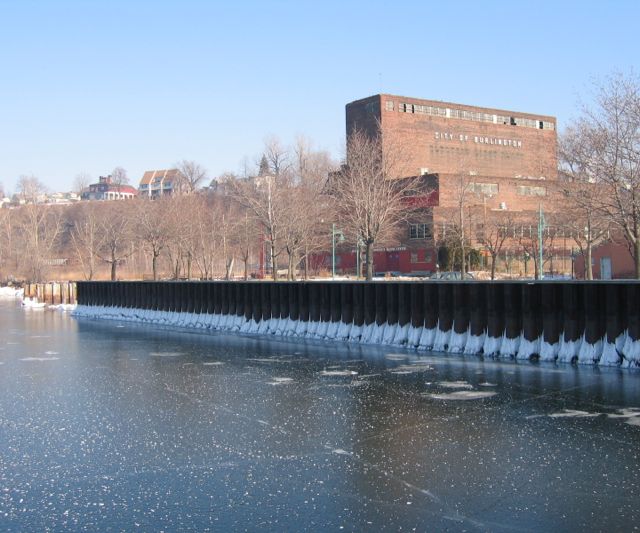
Commercial uses like a brewery and circus were also discussed. Pecor briefly considered using the site to build a baseball stadium. But ECHO ultimately opted for the former Naval Reserve site near the Boathouse, while the other projects proved impractical or hard to finance.
After the YMCA plan was dropped and Bob Kiss succeeded Clavelle, a renovation plan was finally accepted by local voters in 2008. The state legislature approved public financing in September 2009.
The administration subsequently spent $750,000 to prepare the site, and loaned the project another half million in city funds. In September 2010, however, the Lake Champlain Maritime Museum withdrew from the project citing financial concerns about the “ability to raise sufficient funds to participate in the project and the long-term financially sustainability of a future Moran maritime museum site.” A children’s museum also pulled out. Kiss insisted that the departures were due to the non-profits’ financial capacity, not the nature of the project.
On the bright side, the city announced that a $3 million stimulus grant from the U.S. Transportation Department would free up TIF money for Moran. “That’s an absolute game changer,” said David White, the project’s financial advisor, “It took the project from one that was very dependent on the tenants in the financing, to one that no longer requires any specific tenants to participate in this project.”
Kurt Wright questioned an administration decision not to make the tenants’ financials available. City officials replied that under its new financING structure tenant contributions were irrelevant. With enough time, argued Kiss, the city would find a third, financially strong company that would blend with the other tenants.
In Burlington’s 2011 annual report, Kiss claimed that progress was being made. “The project received a local zoning permit, preconstruction services were hired and work began on construction documents,” he wrote. “Environmental remediation work continueS on the site. Development agreements with tenants Ice Factor and the Lake Champlain Community Sailing Center are in process.”
A dispute over TIF
In early June, only weeks before Weinberger’s Moran announcement, state Auditor Tom Salmon released an audit of Burlington’s waterfront TIF district. The city had not always administered it in line with statutory requirements, he charged. State law allows communities to keep up to 75 percent of the incremental increase in state education property taxes generated by new development. Salmon charged that Burlington had held on to more than a million dollars that should have been repaid to the education fund.
Of $8.3 million in incremental property tax revenue used by Burlington, Salmon’s audit concluded that approximately $1.2 million was allocated for ineligible purposes – specifically to pay refinanced debt associated with the Urban Reserve. The city has argued in response that refinancing the Urban Reserve debt is a legitimate TIF district transaction.
TIFs are authorized to fund expenditures like property acquisition that stimulate development or redevelopment within a district, according to the attorney general’s office. If an investment has already occurred, however, the creation of a TIF district does not serve the purpose of motivating the investment.
Salmon concluded that Burlington’s problem started when the city refinanced the Urban Reserve purchase, assuming that the property could be incorporated into the Waterfront TIF. The Reserve was purchased from Central Vermont Railway to create Waterfront Park in 1991. The waterfront TIF was established in 1996.
The audit recommends that the city stop using incremental property tax revenue for payment of the debt related to the purchase of the Urban Reserve and work with the state to resolve the city’s shortfall in payments to the state education fund.
Whether the state will actually attempt to collect the money is unknown. State law mentions no penalties for improper TIF administration.
In any case Weinberger disputes the audit’s conclusion, charging that Salmon has made a “subjective objection to a refinancing transaction that occurred 13 years ago.” While saying he will work with the state to make sure that future TIF funds are handled appropriately, the mayor says that he sees nothing in the audit to prevent the use of TIF for investments around Moran, elsewhere on the waterfront, or within a separate downtown TIF district.
Before key elements of his new five-point plan can be implemented, however, Weinberger will have to convince the City Council, not to mention the public, that using $5 million in TIF funding for bike path and other waterfront infrastructure improvements will attract a Moran site investor with a plan they like, and also one that generates enough economic growth to justify the price.
