

Editor’s note: Telly Halkias is an award-winning freelance journalist. This piece first appeared in the Bennington Banner.
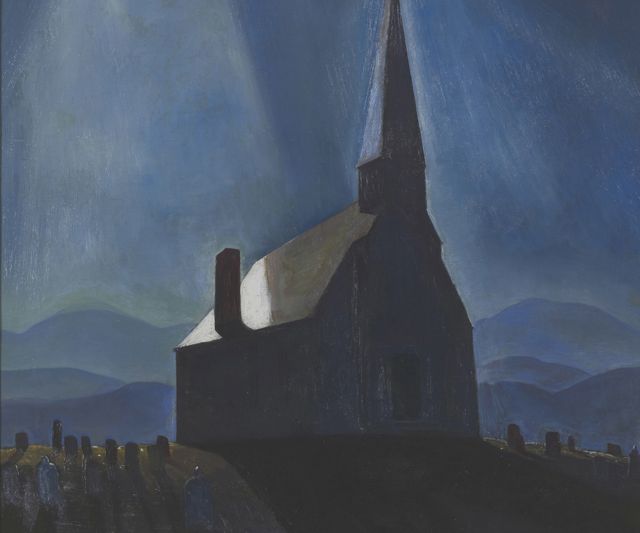
There are certain hollows on Red Mountain in Arlington with views to the Valley of Vermont that seem more like an idyllic postcard than reality. In one such locale, a 200-acre farm dubbed “Egypt,” American painter Rockwell Kent (1882-1971) lived for six years, producing work that would set the tone for the rest of his legendary career.
To honor that period in Kent’s life, the Bennington Museum has opened a major summer exhibition, “Rockwell Kent’s ‘Egypt’: Shadow and Light in Vermont.”
Edie Sawitsky, the museum’s interim director, said the show and its accompanying catalog are the first comprehensive documentation of this period of Kent’s life, despite the significant scholarly attention Kent has received during the past 15 years.
“Our curator of collections, Jamie Franklin, has spent more than five years researching the life of Kent and the paintings and drawings he created right here in Vermont,” Sawitsky said. “Those works reveal, sometimes simultaneously, the shadowy recesses and light-filled aspects of humanity. The Green Mountains as his sublime backdrop from his home on ‘Egypt’ allowed Kent to create a series of powerful paintings, such as ‘Autumn’ and ‘Nirvana.’”
Sawitsky said these works, along with over 50 others by Kent, including many rarely seen paintings, prints and drawings created in Vermont, will be on view through Oct. 30.
Finding Egypt
From the 1920s to the 1960s, celebrated author Dorothy Canfield Fisher was the central force in establishing Arlington as a cultural center. She fostered the town’s creative development not only through her work as a best-selling writer, but also through her generosity and support of artists.
According to exhibition curator Jamie Franklin, during the 1920s and ’30s she would go out of her way, both personally and then as a member of the Vermont Commission on Country Life and through the Vermont Publicity Bureau, to attract to Vermont, and Arlington in particular, “those men and women teaching in schools, colleges and universities; those who are doctors, lawyers, musicians, writers, artists — in a word those who earn their living by a professionally trained use of their brains.”
“Of course, Rockwell Kent fit this description perfectly,” Franklin said. “Canfield was instrumental in helping him find and purchase ‘Egypt,’ a typical Vermont hill farm on the slopes of Red Mountain.”
The house and barn on the property were dilapidated and the farm cost $2,300 — more than Kent had to spend. But he wasn’t intimidated by its condition, since he had studied architecture and built or renovated many structures over the years.
Franklin said Fisher offered to lend Kent the money needed to buy “Egypt.” Kent went about fixing up the saggy old house, living with his family in a place provided by Fisher during the summer of 1919 until their farmhouse was habitable.
Productive period
Since his student years in New York City, Kent had been developing a reputation as one of the leading artists in America. Studying under Robert Henri at the New York School of Art during the first decade of the 20th century, Kent was well-versed in his teacher’s mantra that art and life are inseparable: “… the goal is not making art. It is living a life. Those who live their lives will leave the stuff that is really art.”
This principle found its way into Kent’s work in Vermont, which was heavily influenced by his physical surroundings.
“In a series of powerful paintings, including ‘Autumn’ and ‘Nirvana,’ Kent made use of this sublime view as a sort of theatrical backdrop,” Franklin said. “While conveying heady universal themes the figures and the scene they inhabit remain believable and avoid cliché. The messages Kent sought to convey — of joy and sorrow, life and death — are neither ethereal, nor separate from us. Rather, we live them all simultaneously, as he did, day to day, and they make us who we are.”
Despite the fact that this period was pivotal in Kent’s career, the beginning of a rise to fame that made him almost a household name in America from the mid-1920s through the mid-1940s, the artist’s time in Vermont has been largely overlooked.
When the Kents purchased the Arlington property, it came with a name of epic proportions, “Egypt,” in accord with the artist’s own larger than life personality. Franklin said it is within this framework that Kent’s life and work in Vermont is best understood.
“The paintings, drawings, and prints that he created during this period reveal sometimes simultaneously, both the shadowy recesses and light-filled aspects of humanity,” he said. “At ‘Egypt,’ the artist was able to harvest a body of work that conveyed the full spectrum of human emotion, from anguish to ecstasy. It was here that Kent found much inspiration in both the awe-inspiring physical landscape that surrounded him and in his own internal musings on life, death, and man’s place in the world.”
“Rockwell Kent’s ‘Egypt’: Shadow in Light in Vermont” runs through Oct. 30 at the Bennington Museum. Info: 802-447-1571 or visit benningtonmuseum.org
