

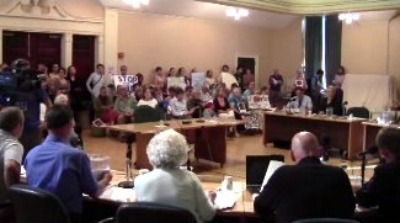
On Monday, two days before the deadline for submitting public comments on an environmental impact statement, members of the Burlington and Winooski city councils voted to ask for more information about the impact of basing F-35 fighter jets at the Burlington International Airport.
In Burlington, where more than 40 people expressed their opinions in a public forum, three resolutions were debated for almost two hours.
One resolution expressed support for the argument, voiced last week by Maj. Gen. Michael Dubie, that the Vermont Air National Guard and the regional economy will experience “likely negative economic consequences” if 18 to 24 of the aircraft are not based in Vermont.
A second resolution opposed basing the F-35s in Vermont with environmental, economic and moral arguments and urged Vermont’s congressional delegation to “pursue more sensible alternatives … that do not destroy homes and communities.”
The third resolution, which passed unanimously after the first two failed, incorporated arguments from both sides, listed a series of unanswered questions and requested that the Air Force bring an F-35 to the airport so that residents can experience the actual noise level.”
Whether that will happen, or is even possible, is another unanswered question. About a third of all F-35 test flights to date have required major maintenance afterwards to make aircraft safe for future use. At this point only about two dozen of the aircraft have been built and some lack monitoring systems to detect in-flight problems.
Meanwhile, at the Fort Worth, Texas, plant where the F-35 is being built, 3,300 union workers have been on strike since April 23 over health benefits and Lockheed Martin’s plan to stop offering a traditional pension to new employees. Last Friday the corporation announced the hiring of the first 300 temporary workers to replace strikers.
Turning out for final comments
Winooski also voted unanimously on Monday to request more information. But its resolution added that if the F-35s are significantly louder than the F-16s they would replace the City Council will not support basing them in Vermont.
In South Burlington, where both the City Council and school board have previously voted to oppose the selection of the Burlington area, the issue was not on Monday’s agenda. But it was discussed anyway when F-35 supporter Gary Farrell, an influential local hotel owner, requested reconsideration and presented a petition with more than 1,600 signature that will also be submitted to the Air Force.

Three F-35 supporters also spoke in Burlington, including developer Ernie Pomerleau and Frank Cioffi, president of the Greater Burlington Industrial Corp. Pomerleau, citing the often-mentioned estimate that the presence of the Air Guard contributes more than $50 million in payroll to the regional economy, argued that the “economics speak for themselves.”
On June 10, Cioffi, Pomerleau, Farrell and more than 100 others, including prominent business leaders like Angelo Pizzagalli, Pat Robins and former Republican U.S. Senate candidate Richard Tarrant, signed an ad in the Burlington Free Press arguing for the importance of the F-35 to the local economy.
On Monday, however, the supporters were vastly outnumbered in Burlington by a standing room-only audience that included 37 residents who offered critical testimony. Speaking for the Stop the-F35 group, Eileen Andreoli submitted a petition signed by 300 residents who oppose basing the plane at the airport.
Some suspect, as a WPTZ report on the debate suggested, that “neither the cities nor their residents have much more than a symbolic say in the matter. That decision is still up to the Air Force.”
One question not on Burlington’s list was whether the local comments, either pro or con, will have any influence on the decision. Some suspect, as a WPTZ report on the debate suggested, that “neither the cities nor their residents have much more than a symbolic say in the matter. That decision is still up to the Air Force.”
The successful Burlington resolution, drafted by City Council President Joan Shannon, assumes that there is still time to get at least some additional questions answered. Several members of the council said that in spite of all the information already available, in the environmental impact statement (EIS) and from both backers and critics, they remain uncertain about the true costs and benefits.
The deadline for public responses is June 20, which was extended after a public hearing was requested in Maine. Comments must be postmarked by midnight Wednesday and mailed to the Air Force at HQ ACC/A7PS, 129 Andrews Street, Suite 337, Langley Air Force Base, Virginia 23665-2769, ATTN: Mr. Nick Germanos.
Production problems
Lockheed Martin began developing the F-35 in 2001. It has since become the Pentagon’s most expensive weapons program, with costs increasing at least 70 percent over the last decade. In 2011 Defense Secretary Robert Gates said the Pentagon was frustrated with the skyrocketing price.
The first 63 jets will cost $1 billion more than estimated. In a review released on June 14, the Government Accountability Office reported that $12.7 billion a year will be needed for the aircraft through 2037, an increase from the $9.1 billion requested for next year.

The strike of employees at Lockheed Martin’s Texas plant further complicates the picture. Speaking for the International Association of Machinists and Aerospace Workers, Bob Wood points out that unionized workers receive extensive training while temps are put on the line after only a day or two. “That’s like saying somebody built a Cessna and now they’re going to walk in and build the F-35,” he argued.
According to Frank Kendall, under secretary for acquisition at the Department of Defense, testing has also been a problem. “Putting the F-35 into production years before the first flight test was acquisition malpractice,” he said in an industry presentation Feb. 6. As a result the program’s optimistic predictions “were good enough at modeling and simulation that we would not find problems in flight test. That was wrong, and now we are paying the price.”
Resolutions: Yes, no or maybe
At the Burlington council meeting, Shannon’s resolution posed a series of questions: Will homebuyers in areas affected by increased noise be able to get federally guaranteed loans? Will any residents be in an “accident potential zone?” Will the planes put some people at risk of hearing impairment? And will the Vermont Air Guard “continue to exist” if the F-35s are not based at the airport?
Shannon incorporated arguments from both sides of the debate. On the one hand, her resolution mentioned the value of emergency services provided by the Air Guard, the importance of the airport to the regional economy and the need to protect both. But it also noted that noise levels “incompatible with residential use” will increase and that “there is a large body of evidence demonstrating that real estate values decline as a result of increased noise levels.”
It did not include some of the points mentioned in the resolution introduced by Republicans Vince Dober and Paul Decelles. Their proposal said that the Air Guard “has demonstrated a willingness to mitigate neighbors’ fears” and may create a community relations committee “under the auspices of the Airport Commission” to address local concerns.
Nor did Shannon’s compromise incorporate some of the more pointed arguments made in the resolution introduced by Progressives Vince Brennan and Rachel Siegel. They argued that habitability will be destroyed for large swaths of several communities, including much of Winooski and South Burlington.
That resolution pointed to a total cost of $1.45 trillion for production and operation of the aircraft, making the case that spending on education, infrastructure and health care would create twice as many jobs. It also included the more ideological argument that “supporting our soldiers is one thing and dropping bombs and firing missiles at other countries is another.”
In defending his resolution, Brennan suggested that Burlington’s decision “could have an impact of whether our neighbor (Winooski) will prosper” after investing about $500 million in revitalization of its downtown in the last decade.
Democrat Bram Kranichfeld was swayed to join those voting against the F-35s by the potential impact on housing. “If you make most of Winooski less desirable, prices will go up in Burlington,” he said. Voting no would be good for Burlington, he added, “and we’d be being a good neighbor.”
Defending his resolution, Dober, a retired member of the Air Guard, argued that it was important for the state’s largest city to support the National Guard. He also said that Vermont has “no option except the F-35 for this base.”
Decelles suggested that the severity of the noise impact depends on the “definition of loud.” While acknowledging that the world might be better off without such an aircraft, armed with 15,000 pounds of bombs and missiles, he concluded, “We don’t live in a perfect world.”
Siegel responded with a question of her own. “If we don’t take a stand, where will change start?”
Mixed reactions … and a middle way
Ward 4 Democrat Bryan Aubin said that he sensed a “not-in-my-backyard” mentality in the debate, with intense opposition in communities that would be affected, but little concern in areas not expected to experience noise or other impacts.
The calls and emails received by council members in the run-up to the vote revealed a related pattern. Siegel, who represents a lower-income area in the center of Burlington, said 95 percent of those who contacted her were opposed to basing the planes in South Burlington. But Ward 5 Democrat Chip Mason, an F-35 supporter representing a more affluent area in the city’s South End, said he had heard nothing from constituents.
The calls and emails received by council members in the run-up to the vote revealed a related pattern. Siegel, who represents a lower-income area in the center of Burlington, said 95 percent of those who contacted her were opposed to basing the planes in South Burlington. But Ward 5 Democrat Chip Mason, an F-35 supporter representing a more affluent area in the city’s South End, said he had heard nothing from constituents.
Karen Paul, an independent from Ward 6, which is also part of the South End, reported that she had received 10 comments and suggested that some people in favor of the planes “are not prepared to speak publicly.” Describing herself as “a huge supporter of jobs,” she nevertheless agreed that not enough is known. Paul also questioned why “no one from the Guard spoke tonight.”
In arguing for a path that stresses common ground, Shannon acknowledged that opponents of the plane vastly outnumbered supporters at City Hall on Monday. But she questioned whether they represented the sentiments of most residents and, in her resolution pressing for answers to some questions, suggested that some of the opinions expressed “are not necessarily informed.”
Shannon added that her own viewpoint was influenced by a meeting with local realtors where questions were raised about the future availability of federal home loans for houses in high-noise areas. “It’s easy for people outside the affected area to say they are in favor,” she noted.
As usual, the public forum period began at 7:30. But it was almost 11 p.m. before the council finally voted on the three resolutions. Democrats Mason and Norm Blais joined Republicans Dober and Decelles in support of basing the planes at the Burlington airport. After a “friendly amendment” removed the most political language in the anti-basing resolution, independent Sharon Bushor voted with the three council Progressives and Kranichfeld.
Both resolutions failed, however, due primarily to the middle way preference of Paul and three Democrats — Shannon, Aubin and Ed Adrian.
