


On Video: Staying Competitive at UVM
At a University of Vermont meeting last weekend the Board of Trustees covered everything from sustainable models to market share. This video includes fact-filled highlights from May 17 sessions with a warning about remaining competitive from Interim President John Bramley, Provost Jane Knodell discussing strategic initiatives, a three-minute financial aid dialogue, and finishing up with lightning-quick adoption of new tuition and fees. (9.59)
“I probably shouldn’t make the analogy,” mused Interim President John Bramley at one point during his report to the University of Vermont’s Board of Trustees last Friday — but he went ahead anyway: “You can see the analogy with the banking industry.”
Bramley lamented that large institutions have economic advantages over small colleges and that a university education could again “become the preserve of the wealthy and the privileged.”
Bramley, who was temporarily promoted last August after the tumultuous departure of former UVM President Daniel Fogel, made the points forcefully during his final remarks as CEO before the arrival of UVM’s new president. Lawyer and former University of Minnesota Provost Thomas Sullivan is scheduled to begin work July 15. His name, and decisions that await his review, were mentioned frequently during a two-day trustee meeting.
Bramley pointed out that Harvard and MIT are already investing $60 million in online education.
“They’re not doing that altruistically,” he said, “but because they see a huge global education opportunity. Some institutions with huge resources will see themselves as the providers of education to an increasing proportion of the world’s students.”
A longtime member of the UVM faculty, Bramley has been chair of the Animal Sciences department, dean of the College of Agriculture and Life Sciences, and provost and senior vice president of the university. He first served as acting president during Fogel’s illness in 2006. Since then and until 2011, he was president and CEO of the Windham Foundation.
Bramley’s prescription for competitiveness and sustainability for UVM, the largest post-secondary school in Vermont, is “a distinct identity, a demonstrated value and a competitive edge to prosper in the new educational world.” He told the trustees they must exploit the university’s location and experiential learning models and embrace technology in cost effective ways.
The tone of the discussion was guardedly optimistic at the end of what Board Chair Robert Cioffi called “a very good year” for the university.
It didn’t start out that way. Cioffi said after a “time of uncertainty and angst” that some “scars” from the media scrutiny surrounding Fogel’s departure last year remain.
Since then, he said, relations with state government have been “revitalized,” and UVM is back in a “position of strength.” In a reference to incoming president Sullivan, he said, “I have a pretty good feeling about this one.”
On Sunday Bramley conferred 2,552 undergraduate degrees on behalf of the school, plus 429 masters, 94 doctoral and 114 M.D. degrees to recipients from 39 states and 22 countries.
Suggestions for restructuring
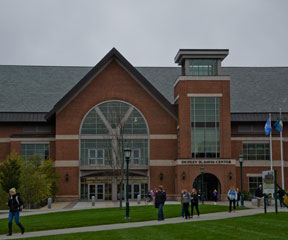
Befitting the governing body of the state’s largest educational entity, trustees convened in committees and as a Committee of the Whole for more than a dozen hours at the top the Dudley Davis Center, a stately facility overlooking downtown Burlington.
Several dozen members of the university community – administrators, senior staff, plus a few faculty members and students – sat in on the deliberations. In the cavernous ballrooms they heard about proposed resolutions and listened to assorted reports, including Provost Jane Knodell’s less-than-rosy forecast that neither traditional demographics nor public funding trends, particularly for research, look that promising.
Still, UVM must become “more affordable for families and still deliver a high quality education,” Knodell explained, “and we’ve reached our full capacity in undergraduate enrollment with both housing and the ability to deliver courses. We won’t be able to grow our way out of the problem.”
The projected operations budget for next year will rise by 2.4 percent. This includes a $299 million general fund, plus other income and $170 million in restricted funds, for an impressive total of $614 million. The State of Vermont will contribute $40.7 million.
By comparison, the total revenue for the City of Burlington last year, including all government services, the schools, Burlington Electric Department, Burlington Telecom and the airport was $261 million.
Tuition will rise 3.5 percent, the lowest increase in several years. For resident Vermonters the cost will be $13,344, while out-of-state students will pay $33,672. The online tuition rate will be between $556 and $1,403 per credit hour. Spending in support of financial aid will increase 6.5 percent. Salary spending for all personnel will rise by 2 percent.
Bramley started with the positive. He called the planned tuition increases modest, listed numerous academic achievements, and touted a record first year for the University of Vermont Foundation, which was launched in January to handle future “fundraising, campaign planning, alumni relations, stewardship, operations, and staff development.”
“We are in excellent shape,” he concluded just before pivoting, “however, I am anxious about the future of higher education and our ability to adapt to the challenges.”
The trouble is that higher education costs have grown faster than health care, he said, exceeding families’ ability to pay. Jobs are harder to come by, and he said, “the wisdom of investing in a college education is increasingly in question.”

“Sadly, higher education is often presented or discussed now as a private benefit rather than a public good,” Bramley said. “We must convince others that we are a public good, worthy of public investment and essential for the future success of the nation.”
Echoing the rhetoric of recent protests against economic inequality Bramley issued a warning: “If we fail, a college education may once again become the preserve of the wealthy and the privileged, very much just the thing Justin Morrill was trying to lead the nation away from.” Morrill, a Vermont founder of the Republican Party and a U.S. senator, was instrumental in the development of federal funding for public colleges and universities.
This year, Bramley noted, he has received many emails and phone calls from parents seeking additional financial aid after decisions are made. He also mentioned what he views as a pattern of families – especially Vermonters – choosing to have their children begin in a community college, perhaps live at home or take courses online, and perhaps transfer in later. “The models are changing,” he stressed.
Among the prescriptions are “relying on content from others in some areas, and focusing our content on areas where we have a competitive advantage, and in turn making that available to others.” Bramley predicts that the university won’t be able to depend on “the 18- to 24-year-old model” for much longer.
Combining economic logic with populist sentiments, he called for change in “our way of doing business.” He said the university, as the only academic research facility in the state, is expected to partner with business and economic development efforts in the private sector. This means using Vermont’s edge to compete, he said, or else continuing to lose “market share.”
Bramley concluded that UVM can overcome socioeconomic challenges by adapting to new technology, employing distance learning and maintaining a quality on-campus experience. He envisions the university as “the center of an innovation hub with spokes statewide that link our students, faculty and entrepreneurs in an innovative learning and delivery system.”
Compensation and benefits
Executive pay has been a focus of attention at recent gatherings of the trustees. But a report on compensation for university officers other than the president attracted limited attention over the weekend.
In 2011 the 45 highest paid UVM employees made between $105,000 and $468,924, a broad range described in the document as an average of just 1 percent above the market median, based on a survey of college and university professionals.
This group of administrators includes vice presidents, deans, associate vice presidents, associate deans and other senior level officials. Those who report directly to top management – not including deans — make between 82 and 138 percent of the market median. Salaries for vice presidents reporting to the president or provost range from 92 to 117 percent of the market median. Officers reporting to the provost and deans range from 74 to 124 percent. The rest range from 66 to 155 percent, an average of 5 percent above the market median for equivalent jobs.
The practice of awarding signing and performance bonuses and deferred compensation agreements has almost ended, the report states. The remaining non-compensation benefits include a vehicle allowance and other items in the new president package, and Burlington Country Club memberships for two deans and the vice president for Student and Campus Life.
Last year UVM faced considerable criticism for the generous severance package provided to Fogel. In February the trustees hired Sullivan for more than $440,000 annually over the next three years. Sullivan will initially receive $417,000, plus $30,000 of deferred compensation during his first three years. Following that he will receive $40,000 in deferred compensation.
Board Chair Robert Cioffi has argued that Sullivan’s $347,600 base salary as provost in Minnesota, plus deferred compensation there, was similar to what UVM offered.

On the same day in February when Sullivan was officially chosen, a report to the Board of Trustees featured faculty concerns about executive compensation and “corporatization” of the university. Staff Council President Ida Russin reported that staff members were unhappy with “unreasonable perks,” and felt that “Vermont has different cultural values and standards than the rest of the United States when it comes to executive pay.”
Asked about the report at the time Sullivan told VTDigger that he had not yet seen it. Board President Robert Cioffi later explained that “it was necessary to offer a competitive salary based on market realities.”
In his new summary of the issue, Bramley argues that UVM’s compensation policies are “sound and adequate,” “legally compliant,” and in line with best practices. He acknowledges “frustration and anger amongst some members of the community,” but attributes that primarily to procedures and policies that have not been sufficiently transparent.
Under a new recommended policy for administrative compensation, a person’s supervisor would be allowed to offer a base salary of no more than 10 percent above the national average – that is, without the approval of a supervisor. If the president is the one doing the hiring the decision would go to the Executive Committee of the trustees.
Russin did not mention compensation issues in her May written report. She focused instead on post-retirement medical benefits for staff. While praising the process and acknowledging that a “line needed to be drawn” on who is eligible, she said that many staff members with 25 years or more of UVM employment are ending up on the losing side of the line.
“Employees impacted by this change have expressed feelings of anger, frustration, and an inability to trust promises made by the administration,” Russin wrote. They feel “undervalued and unappreciated for all they have contributed to UVM throughout their careers.”
Getting strategic
Provost Jane Knodell said the university has developed a multi-year Strategic Initiative Project to combine “strategic investments” with a sustainable, financial model. The new initiatives include diversity and internationalization and trans-disciplinary research.
Knodell’s presentation on the university’s strategic planning process was a balance of cautionary arguments and pragmatic prescriptions.
“We know that we are facing a situation of declining demographics in the primary area of the country where we recruit students,” she said. “We know that public funding will be at best constant, likely to decline particularly for research.
“We know there is a need for us to become more affordable for families and still delivery a high quality education. And we’ve reached our full capacity in undergraduate enrollment with housing and just the ability to deliver courses,” she said. “We won’t be able to grow our way out of the problem now.”
Pointed questions and comments brought up the economic dangers of “structural encrustations,” the real prospects for long-term survival and whether the strategies being outlined were just “changing deck chairs.” Bramley countered that “these things don’t usually work top down. But they don’t usually work bottom up either.” His advice was a mixture of “leadership and engagement.”
Knodell promised that creative changes in “how we deliver courses” will emerge from the Strategic Initiative Project , which is expected to marshal investments and human resources through an elaborate, collaborative process. Described as roadmap, the Strategic Initiative Project could lead to initiatives like new graduate programs, replacement of public funding with new institutional research grants, intensified recruitment of New American, Abenaki and international students, and an improved focus on special areas like writing and career development.
The central idea, Knodell suggests, is to make UVM one of “the nation’s premier small research universities,” preeminent in its commitment to “liberal education, environment, health and public service.”
Plans so far include a new master of sciences degree in food systems and a smart grid program, already in motion with cooperation and financial support from Sandia laboratories and the Department of Energy. Some proposals await review by UVM’s new president. Others are under way or, like a pilot writing program, scheduled for launch within the next year or two.
Reaching all the objectives, and others that may emerge along the way, will require the success of an eight-year, estimated $597 million fundraising campaign that will be coordinated through the new UVM Foundation. The idea is to match sources of money with promising programs, faculty research projects, facilities improvements, and student support.
