

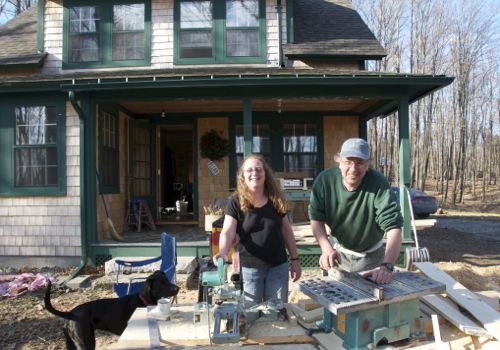
The idea hit Sarah and Steve Gallagher eight years ago during a sabbatical, a grand trip by van with their younger son to Mexico. They had driven from their home in Calais to the Southwest, then down Mexico’s Baja Peninsula; and eventually they meandered east to the central highlands, where they stopped in a small town, Cuitzeo in the state of Michoacan.
The family found an apartment for $72 a month, and liked the area so much they returned year after year, and in 2007, for $22,000, they bought a stone and adobe shack on a lot behind a 16th-century cathedral.
In Cuitzeo, the Gallaghers hike in the mountains, attend rodeos, watch parades and religious festivals, steam tamales over a camp stove and buy papayas and other fresh fruit at street markets. They and their son Isaac, who was age 11 on the first trip, are proficient in Spanish.
“The whole experience has been life-changing,” says Sarah. “It made us realize just how much we value our time.”
And that idea? Continue working full-time in Vermont, save money, downsize, and retire early so they can travel more and live life on their own terms. In retirement they plan to sell raspberries from their berry patch and garlic and mushrooms from their garden. Steve will do occasional freelance carpentry.
The Gallaghers have stuck to script. The family home in the hamlet of Maple Corner, inhabited over the decades by five generations of Gallaghers, is now on the market. The couple recently moved into a 1,100-square-foot, cedar-sided cottage that Steve built on nearby Curtis Pond.
“We decided we don’t need lots of stuff to be comfortable,” says Sarah, 53, who directs training programs for social workers. “Stuff gets in the way of freedom, and we have many interests, and don’t want to get old and miss out.”
Part of a larger trend
Not every baby boomer has the desire or wherewithal to trade traditional family home for a pond-side cottage, or, for that matter, a hut 3,500 miles distant. But many empty nesters, like the Gallaghers, are “downsizing” and finding more affordable living arrangements.
The 72 million Americans born between 1946 and 1964, who once boosted profits at Gerber, put Wham-O Inc. on the map, bought Mustangs and “Bugs” and then homes and strollers and SUVs, are now poised to jigger a key segment of the economy: housing.
“Nobody knows exactly what the baby boomers will do,” says Art Woolf, a University of Vermont professor of economics. “They have wreaked havoc in every decade they have gone through, and what kind of havoc they will wreak in the housing market is anyone’s guess.
“But, yes, real estate is on every (aging boomer’s) mind, and for several reasons, the main one being that their homes are often their largest asset,” says Woolf. “Many wonder how they might use money from the asset that, say, they bought years ago for $40,000 and that is now worth $200,000. They may downsize, and once they do that, they have equity they can use for all kinds of lifestyle options.”
Real estate agents in Vermont say they already are hearing the “D” word from boomers. They are seeing more boomer homes, especially those in the high-end range, going on the market, even though the prices for these homes are down.
Some homeowners are pressed to sell because they have lost or are worried about losing their jobs. Others, concerned about the future of their pension or Social Security, believe a smaller house will help them save to rebuild their retirement portfolio while there’s still time.
Fortunately, those selling bigger homes in Vermont are not finding it difficult to buy smaller houses in lower price ranges, real estate agents say. But to some extent that’s because younger buyers, with few assets for big down payments, can’t get mortgages.
Banks have money and rates are extremely low. The average rate for 15 and 30-year mortgages, are 3.16 percent and 3.92 percent respectively, almost at their lowest points since the 1950s. Rates have been below 4 percent for more than three months. But Vermont’s lending institutions, as those around the country, have adopted tougher loan standards since the housing debacle.
Lori Pinard, a broker at Century 21 Jack Associates in Montpelier, says that older boomers, born in the late ‘40s and early ‘50s, are most prone to reconsider their living arrangements. Those younger, born in the late ’50s and early ’60s, are still at the height of their earning power and may still have children at home.
“The older baby boomers seem more likely to base their decisions on their finances or what they perceive will be their financial situation in the years ahead,” Pinard says.
“Some are downsizing, but a lot are also just changing their residences to Florida or other states, for perceived tax benefits.” (Florida has no state income tax.)
She believes some Vermonters who wish to leave may still want a home in Vermont but one with a smaller profile. “They want something they can feel more at ease with in leaving empty or renting out as they travel or stay in the South.”
She’s seeing fewer out-of-state retirees moving to Vermont to enjoy the state’s natural beauty or partake in outdoor recreational opportunities.
“That (lifestyle) trend was very noticeable years back, but right now that is not prevalent,” she says. “People are just not moving around as much.”
Meg Handler, an agent at Coldwell Banker Hickok & Boardman Realty in Burlington, says boomers have a much greater awareness of energy issues, and small houses generally are cheaper to heat.
Handler sees older boomers moving from remote areas in the state to cities or more populated towns to reduce commuting costs and to increase opportunities for social contact. “Living in a place where you have a community, I think, is becoming more important to older people,” she says. “They are looking to ‘walkable’ communities, towns where it’s easy and natural to make contact with other people.”
She also believes older, financially cautious boomers are more likely to buy a smaller existing house than to build. “It’s now more difficult for people to build, because if you build, unless you are in a subdivision, you have to pay for the land, which itself is expensive, and then you have to pay for a driveway, and septic, and then you need to bring in power,” Handler said. “It’s hard, for example, to build a house in (populous) Chittenden County for less than $500,000.”
Boomers have buying power, says Walt Molony, a spokesman for the National Association of Realtors, but “there’s really a roadblock with first-time buyers, many of whom are being thwarted by credit issues.”
Coldwell Banker Real Estate reports that most of its agents nationwide believe that any current hesitation on the part of boomers to sell is still largely the result of the uncertain national economy. And that can change quickly.
“The baby boomer generation has driven the U.S. economy for years, and like many Americans they may be anxious about their next real estate decision,” said Jim Gillespie, CEO of Coldwell Banker Real Estate, in a press release. “I know baby boomers are a very diverse group and cannot be described in generalities, but our survey indicates that boomers who are financially secure are actively seeking to buy their retirement home, or a second home, and that they are taking advantage of the opportunities and value available in today market.”
Vacation homebuying in Green Mountains softens
In Vermont, there’s apparently no rush to buy second homes.
Wenda Bird, owner of Century 21 Bird Real Estate in Bomoseen, says the second-home market is stagnant, if not declining. Only five homes on Lake Bomoseen sold over the past year, compared with more than a dozen in a good year. “It’s scary,” she says.
Older Vermonters are selling their family homes in Rutland or other cities and then remodeling the summer shoreline home for year-round use. They appear to be “much more careful” in buying second homes, she added. “They are educated, using the Internet, and they know what property is going for.”
Dick Montague, owner of Vermont Country Properties, with offices in several ski towns across the state, confirms that the value of recreational holdings, condos and second homes is in decline, and he makes the demographic connection.
“Everyone is re-evaluating his or her real estate holdings, but I think baby boomers are at the top of the list as they are making their (latest) transition in life,” Montague says. “I also think a lot more baby boomers are looking to get out of real estate than to get in. … I am very confident in saying that the cost of caring for these (recreational) properties has gone up, with taxes and energy costs.”
While many boomers are downsizing out of financial necessity, the Gallaghers are doing so by choice.
“We have both been working full time since we were teenagers, and Steve and I have raised three kids, with the oldest and youngest being 10 years apart, so we have essentially been parenting most of our adult lives,” says Sarah.
“We are frugal, and we have simple tastes; we grow vegetables and raise chickens, and we don’t need a lot of money to be comfortable,” she says. The couple will be well positioned to stay for a month or two at their third cottage, on Prince Edward Island in Canada, and then travel to Mexico for the winter.
“The absolute key for this to work is to not carry lots of debt,” Sarah stresses. “That was our strategy: spend money on the new house only as we earned it.”
Editor’s note: The following article first appeared in Vermont Property Owners Report, a Montpelier-based newsletter that explores issues relating to Vermont real estate. The article has been updated for VTDigger.org. Dirk Van Susteren is a Calais, Vt., freelance writer and editor.

