

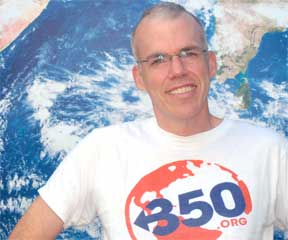
In hastily arranged testimony, Vermont-based climate-change activist Bill McKibben spoke at the Statehouse with the House Natural Resources Committee Tuesday morning. McKibben, founder and chief spokesperson for the organization 350.org, told the committee that today’s climate is deteriorating faster than scientists had imagined possible when he first wrote on the issue 23 years ago, and that waiting to act only makes the problem exponentially worse.
That was apparently the message that committee chair Tony Klein (D-East Montpelier) was looking for. Klein opened the committee meeting by saying that he sought McKibben’s help. “I’m very concerned that we have created legislation and policy over the last 10 to 15 years that is meant to move us to a cleaner environment with less greenhouse emissions, and now that the policy is moving towards reality, we hear the cries, ‘I didn’t know it was going to be like that.’ A green community that has walked together, hopefully to a better world, now is fracturing, because I think we are losing sight of the big target. I asked you here to help us regroup and reground ourselves.”
Speaking without notes, and using few numbers, McKibben gave the committee a lucid, 20-minute overview of what’s known about global warming, how that is translating into both droughts and deluges today, what is needed to prevent runaway climate change, and why the need for action is more urgent than for other important issues like health care reform. He rooted some of the testimony in Vermont’s experiences with Tropical Storm Irene, as well as his town of Ripton’s catastrophic floods in 2008.
From the beginning to the end of his testimony, McKibben voiced his frustration with the lack of action out of Washington D.C., capital of the country that historically has contributed one third of the greenhouse gases now in the atmosphere. Because of national-level inaction in the U.S., it’s up to states like Vermont to lead in converting to renewable energy.
McKibben referred at the beginning of his testimony to his 1989 book “The End of Nature,” the first book-length popular treatment of climate change. We’ve known the basic science of what he now calls climate deterioration for decades — but that the consequences have exceeded climate scientists’ expectations. “The story of the last 20 years, and really of the last three or four years, is that it’s pinching much harder and faster than even the most dire predictions would have had it. Everything frozen on earth is melting, so Arctic Sea ice is reduced 40 percent from what it was when NASA was taking those first pictures. The chemistry of sea water is changing very rapidly.
“Most remarkable, and certainly for Vermont most dangerous, are changes in hydrology. Warm air holds more water vapor than cold. What that means is that with this one-degree increase in temperature [that has occurred so far], the atmosphere is about 4 percent wetter than it was 40 years ago. That is a staggeringly large change in a basic physical parameter, one that we assume has held basically steady for ten thousand years. What it does is load the dice for two things: drought and flood. We get more evaporation in arid areas. The flip side of this is that once that water vapor has evaporated into the atmosphere, it’s going to come down. This means that we load the dice again for deluge and downpour and flood, and we have seen it all over the world.”
McKibben, who commented afterwards that he works in 191 countries, reeled off lists of droughts, fires, and floods in recent years: the current drought in Mexico; the 2010 drought and fires in Russia that caused the world’s third-largest grain exporter to cancel exports; the Texas and Oklahoma droughts and firestorms in 2010; the Khyber Pass rainstorm that dumped 12 feet of rain in a week and flooded a quarter of Pakistan; 2011 floods in Queensland, along the Mississippi and Missouri Rivers, in Lake Champlain, and from Tropical Storm Irene.
The litany included human consequences of these natural disasters: Russia’s 2010 crop failures and subsequent crop failures around the world have jacked up corn and wheat prices by 60 percent and added a couple hundred million people to rolls of the malnourished and severely hungry; half a billion trees died in the Texas drought; and 20 million people were flooded out of their homes in Pakistan. A few weeks after Vermont’s Irene experience, flooding washed out so many roads and bridges in El Salvador, Honduras and Nicaragua that the president of Honduras said the event wiped out 20 years of development progress.
Knowing the Legislature was looking for action to take, McKibben told them what to do: “Make as rapid a transition as possible off of fossil fuel and on to something else. There is no Plan B. Or the occasional Plan Bs that people try to describe are so crazy that we don’t even want to think about them. Filling the atmosphere with sulfur in an effort to block out incoming solar radiation and compensate for the greenhouse effect. These kinds of mad scientist chemistry experiments are not anything we want to undertake.”
Specifically, McKibben recommended taxing fossil fuels heavily and then distributing the revenues equally to everyone in the population. He said afterwards that such an approach would make 80 percent of people better off. Owners of Learjets would pay more, but that’s a good thing, he said. However, McKibben acknowledged that people in small states with heavy taxes on fossil fuels would purchase more in neighboring states, so this “tax and dividend” approach is more practicable on a national scale.
As legislators elsewhere in the Statehouse grappled with the next steps in creating a single-payer health care system, McKibben contrasted the urgency of a transition to renewable energy with the urgency of health care reform. “It’s almost unique among issues in that waiting is not really one of the options. It’s not like a problem like health insurance, where if you wait a decade, a lot of people have suffered in the meantime, but it hasn’t become exponentially harder to deal with than it was when you began. There’s a certain point past which if you don’t deal with climate change, then there’s no use in even trying, because you will have put enough carbon in the atmosphere and raised the temperature high enough that these changes begin to feed on themselves.”
McKibben dismissed the state’s size as an argument for not taking the lead in the transition to renewables. “Vermont obviously by itself cannot make this happen. By the same token, that argument is true of every single jurisdiction considering this stuff as well. If everyone takes that excuse, then nothing will happen. If some places are wise enough to take a leadership position, not only will they be setting themselves up more wisely for the century now dawning, they’ll also at least be running the possibility of providing the example to others.”
Vermont’s diminutive size is an advantage. “Thank heavens that at least in Vermont the discussion can go on with some kind of level playing field, where the fossil fuel industry doesn’t so dominate every discussion that it doesn’t get off the ground. If there’s any justification for small states and citizen government, this is one of those moments when we really need them to rise to the fore.”
Legislators asked a few questions, mostly about policy options, but mostly they listened quietly to McKibben’s sobering testimony. When Klein thanked McKibben for sharing what he joked was “everything I didn’t want to hear,” McKibben laughed and termed himself a “professional bummer outer.”
The committee is in the final stages of preparing a renewable portfolio standard, which would significantly ramp up the state’s amount of renewably generated electricity over the next decade and half.
