

Editor’s note: In This State is a new weekly column by Andrew Nemethy, Bryan Pfeiffer and Dirk Van Susteren about Vermont’s characters and innovators, its unique ideas and quirky places. The three authors, who will take turns writing the column, formerly worked as reporters and editors for the The Times Argus and Rutland Herald and have contributed to other publications in Vermont and around the country.
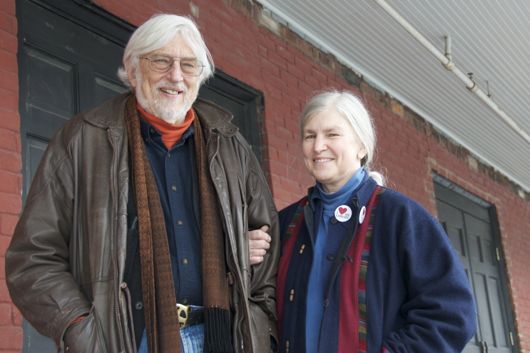
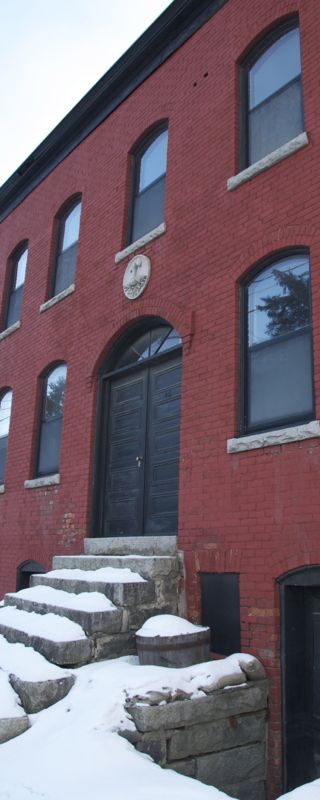
If ghosts wander the upstairs hallways and rooms of the old Socialist Labor Party Hall on Granite Street in Barre, they keep to themselves. Karen Lane has heard none of the odd rattles, moans or scratches one might associate with anxious spirits. Yet, when by herself in this 112-year old brick building, she senses companionship.
“You never feel alone here,” she says. “I walk into this building, and I get a palpable sense of history.”
What she and others experience in the Labor Hall is a sense of the Italian immigrants who a century ago worked in the area’s 60-some granite quarries, and in the sheds, where rock is carved into statuary, and who struggled to make a living in their adopted country.
The labor hall was built in 1900 for $7,000, says Lane, a local historian and director of Barre’s Aldrich Public Library. It was used as a center for union activity and social events. Dances, masquerade balls, concerts, boxing matches operatic performances and lessons in how to speak and write in English were held there.
Primo Maggio, May 1, the Italian Labor Day, was celebrated in grand style at the hall.
It also was the place to air economic grievances and radical political philosophies, which helped establish Barre’s past reputation as a small-town center for American radicalism.
Consider that at one time or another these leftist luminaries delivered fiery speeches in the city: Eugene Debs, who ran for president three times as a socialist; Mother Jones, once labeled “the most dangerous woman in America” for her efforts organizing mine workers; Emma Goldman, the anarchist philosopher and lecturer; and Big Bill Haywood, a founder of the combative Industrial Workers of the World (Wobblies).
Throw in Samuel Gompers, founder of the American Federation of Labor, who was tamer than the others, and you had quite the team.
But it was the Labor Hall where most of the political action occurred, says Lane, who with her husband Chet Briggs have done as much or more than anyone to save the hall and help keep the city’s colorful labor history alive.
“There is just something special about this building,” she said during a recent visit at the hall, which, though preserved, and now a National Historic Landmark, still bears the scars of neglect.
The Labor Hall was the place where Barre’s socialists and anarchists squared off in a debate on an autumn night in 1903, one that turned violent, with the shooting death of a talented and beloved carver, Elia Corti. His likeness was carved in stone by friends and now rests elegantly above his grave in the city’s Hope Cemetery.
It’s where Italian families gathered in 1912 to raise money for workers in Lawrence, Mass., during one of New England’s bitterest textile mill strikes. And it’s where 35 sons and daughters of these strikers later posed for a photograph, having been temporarily sent to Barre by train for safety and square meals.
It’s where Barre unions in 1933 coordinated their own difficult strike against the granite industry, one in which the governor, Stanley Wilson, called out the National Guard.
Karen Lane says her and Briggs’ interest in the building probably reflects their political and social values. They were formed largely during the 1960s at the University of Texas in Austin during era of the civil rights and peace movements. Both were involved in university political activities, with Briggs having founded the campus Student Peace Union, which, among other things, counseled students on how to avoid the Vietnam War.
“I do think our interest in the Labor Hall may come out of all that,” says Lane. “We were children of the ‘60s.”
The couple were in Georgia — Lane working for the Georgia Folklore Society — when the two were offered jobs in Vermont, Briggs as director of Head Start, and Lane as director of Barre’s Ethnic Studies Project.
The ethnic studies project naturally led Lane to Barre’s Italian community and its political and cultural heritage.
Organizing to build a community is important to the two. It’s what seems to have impressed them most about early activities at the Labor Hall. The quarry workers not only raised money for the building – 50 families chipped in $23.08 apiece – but many helped with construction while still cutting rock six and a half days a week.
The member families established a food cooperative in the Labor Hall’s basement. They opened a bottling plant, a bakery and a depot, from which firewood and coal were distributed.
The commissary at the hall provided food to striking workers in 1915, 1922 and 1933.
“For awhile they even experimented with their own currency,” Briggs reports.
The building continued as a Labor Hall for 36 years, when in the depths of the Great Depression, short on funds, it was sold first to one fruit company, then another; and for much of the next half century, it served as a cold-storage center for produce.
In 1994, the Granite Savings Bank assumed ownership in a bankruptcy after the building had been abandoned for several years. Lane, Briggs and other interested citizens and public officials rallied to save the hall when they learned, to their horror, that historic papers and documents shedding light on early labor history, had been carted off to the landfill.
Through grants and loans and donations the Barre Historical Society bought what was by then a wreck of a building for $95,000.
Now, as a result of money-raising efforts, notably a $300,000 federal grant, the spacious main hall glistens; new toilet facilities are in operation, a kitchen has been opened and an elevator is operating. Five other rooms remain in much need of repair.
Floods have hampered work: Three times in the past decade the Stevens Branch of the Winooski has overflowed and sent water into the Labor Hall’s basement. “We now just assume we will have a flood every few years,” shrugs Briggs.
The good news is that the building is structurally sound and has been open to the public for various events, including reunions, weddings, birthday parties, concerts, film showings, funeral receptions, lectures, book signings, you name it.
“A total of 110 organizations use the hall in one way or another, including three unions, and even Republican groups,” says Briggs.
No partisan stigma attached to building? After all, if spooks inhabit the Labor Hall, they would be left of center.
“Apparently not,” says Briggs. “We asked the Republicans why they wanted it, and they said: ‘When the meeting is to be political and is to be in Central Vermont, it HAS to beheld at the old Labor Hall.’”
Some consider the building a shrine to righteous, if not sacred, causes.
Every Primo Maggio morning a man drives up to the Labor Hall and leaves two roses on the front concrete steps.
Briggs says an Argentine immigrant leaves the flowers to honor his grandfather and grandmother, socialists, who had fought the dictatorship of Juan Peron.
Dirk Van Susteren is a Calais freelance writer and editor.
