

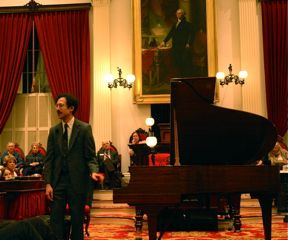
- Pianist Michael Arnowitt prepares to play Gershwin classics on a Steinway grand piano that was rescued from the defunct Vermont State Hospital. VTD/Andrew Nemethy
Months after the disaster named Irene, at least there’s been one happy outcome.
Three standing ovations by a packed crowd in the resplendent, high-ceilinged hall of the House chamber provided loud testimony to that truth Wednesday night.
The applause came for Montpelier concert pianist Michael Arnowitt, who delivered a remarkable program, “An Evening with George Gershwin,” sponsored by the Vermont Humanities Council and Kellogg-Hubbard Library as part of the First Wednesdays lectures, and presented as one of the Farmer’s Night Statehouse events. But Arnowitt could not have held the crowd spellbound in the fascinating rhythms of Gershwin without his not-so-silent partner, a 1923 Steinway baby grand that for years had collected mostly dust at a most unlikely place: the Vermont State Hospital.
And this is where a bit of luck and a small slice of irony get mixed up with the Aug. 28 storm that created so much misery in Vermont – and at least now, one happy moment.
The piano, said assistant Statehouse curator Tracy Martin, had been donated to the state hospital sometime in the 1960s – unfortunately, a search for the donor’s name has come up empty so far. When Irene flooded the Waterbury office complex and the hospital, the piano was safely on the second floor.
“It was high and dry in the library,” she said. But it was also mostly forgotten about, except for the state hospital employees who knew there was a piano in the former library, which had been converted to use as meeting rooms.
With the buildings vacated and any renovations not expected to be completed for a couple of years, the piano was, in essence, marooned by the storm like many Vermonters, with no one to play it, a sad thing for an instrument with the exalted pedigree of a Steinway.
“There was nobody there to use it or enjoy it,” said Martin.
Coincidentally, however, Arnowitt needed a piano for his lecture and performance Wednesday night. And so a piano that needed a home came to find a new one at the Vermont Statehouse, in the well of the House Chamber, its ivory keys submitting to Arnowitt’s masterful hands.
But not before some tuning and tinkering, and some moving magic. Wednesday morning bright and early, well-known piano tuner and technician Tom McNeil of Barre worked with movers to get the Steinway out of the state hospital and deliver it to the Statehouse. A grand is anything but light and this is an elaborate process that includes taking off the legs and bundling up the body on a dolly.
At the Statehouse, the piano was brought up in an elevator and readied to be put in well of the House chamber on the second floor. But first, there was the small matter of a debate that was taking place on reapportionment in the chamber, delaying the evening transition to concert hall.
Arnowitt, who played “Rhapsody in Blue,” “An American in Paris” and a wonderful rendition of “I’ve Got Rhythm” along with regaling the chamber with stories about the era and the immense musicality and genius of Gershwin brothers George and Ira, tried the piano for the first time at 5 p.m., admitting he was a bit nervous about it.
“I begged to get access to it to see if there was anything wrong with it,” he said.
Before sitting down to play, Arnowitt told the crowd the Steinway was not only built around the same time that the Gershwin’s star was rising, but that 1923 was the year when he wrote “Rhapsody in Blue.”
Some things are just meant to be, perhaps.
By this morning, the night’s magic will have evaporated and the piano will be in its new temporary home in the Statehouse, said Martin.
“It’s going to live in the Cedar Creek Room,” she said. The room often hosts receptions and press conferences and now could offer the chance for legislative themed songs (“Ain’t Misbehavin?” and “Reapportionment Blues?”).
The idea of Farmer’s Night began in the early 1900s as a way for legislators stuck in town to entertain themselves and included some legendary performances, the most notable by circus impresario and Manchester legislator Reid Lefevre, who in 1947 brought an elephant into the well of the House. Today the mid-week events run the gamut from brass bands to gospel music, the Vermont Symphony Orchestra, re-enactments of historic figures, and bringing in a piano for a concert.
As Martin joked, “This was way easier than an elephant.”
There’s one final irony: A chamber that resonated with the sounds of a piano rescued from the closed state hospital is scheduled today to take up debate on … the state’s plan to replace the state hospital.

