

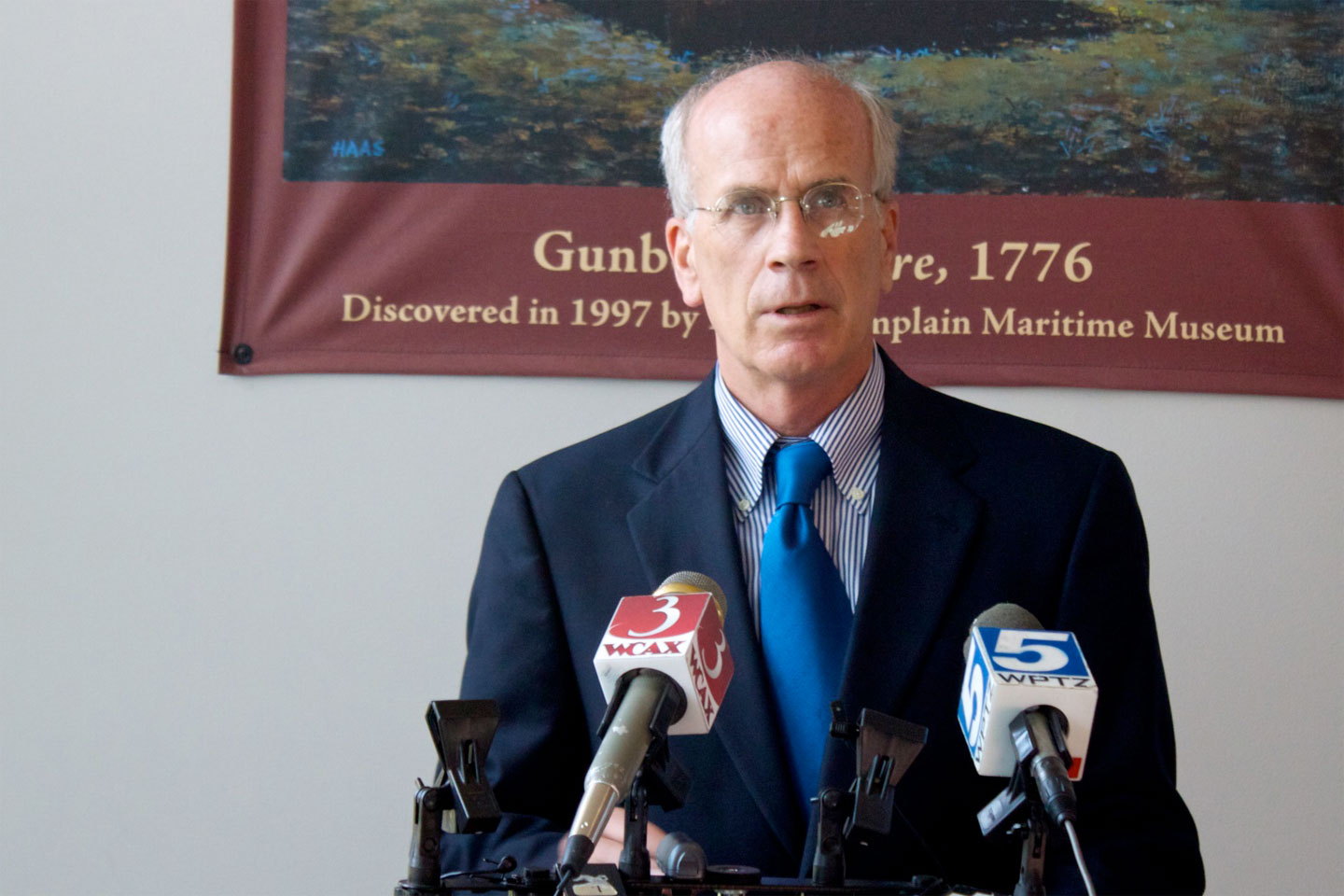
U.S. Rep. Peter Welch understands that getting anything done in Congress during a presidential election year won’t be easy. “There’s been a lot of dysfunction,” he admitted at the start of remarks on Monday to the Rotary Club of Burlington.
But even in a polarized political environment, Welch argued “there are some common sense priorities where there is common ground between Republicans and Democrats. Energy efficiency and infrastructure are two very obvious ones.”
Welch’s basic message to club members, a lunch and regular business meeting at the Hilton Hotel, is that election-year politicking “cannot be an excuse for not directly facing the challenges.” But since he is also running for re-election, Welch stressed that he would be able to work effectively across the aisle on a practical to-do list that puts Vermonters to work and sends a positive signal to business.
This approach can give business interests “a little more confidence that this institution [Congress], which has to function on their behalf, can,” Welch said.
Welch’s office contacted the Rotary Club just last week to provide a legislative briefing for 2012 during a visit to the area. He also wanted a little feedback from local business leaders. Among the responses he received was a suggestion that not only homeowner interest rates but also student loan rates should be lowered. “I think it’s a great idea,” he replied.
One member questioned, somewhat skeptically, the timeline for introduction of a federal budget, and suggested that cutting it modestly, but across the board, might do more to restore trust in government and send an optimistic message.
“That’s essentially what the sequester does,” Welch replied. He provided a brief review of the legislative compromise that last year gave a Congressional Super Committee the chance to come up with $1.2 billion in debt reduction. “A combination of revenues and cuts is always the better way to go,” he argued. “The deal was that if the Super Committee failed – as it did – then there would be automatic cuts, more or less across the board, about half from Pentagon and half from domestic discretionary.”
“If we can’t find an alternative,” Welch said, he thinks the sequester “has to go into effect.” But he warned that Republicans, as well as some Democrats, are currently attempting “to carve out an exemption for the Pentagon cuts. That would send the wrong signal to the financial markets.”
On budget procrastination, he sees good reason for public skepticism. “When we don’t pass a budget it’s an indication that Congress is not functioning,” Welch admitted. Ideological divisions over taxes and spending are real, he noted, but that doesn’t excuse “having a debate where the central premise is having the country default on its bills.”
“That’s outrageous. You owe money, you pay your bills. I say that as someone who wasn’t in favor of some of the spending, for example on the Iraq War. But you pay your bills. That’s the big challenge for Congress. We have to get back to practical problem solving.”
During the talk, Welch forecast that infrastructure and energy efficiency can be two legislative priorities where partisanship gives way to common interests. “Whether you are in a Republican or a Democratic district, you’ve got roads and bridges that need attention,” Welch said. “And the longer we delay in maintaining and rebuilding our infrastructure the tougher it’s going to be on job creation for our businesses.”
He also sees promise in working with Republicans to pass legislation, stalled in the last Congress, “that would give incentives to homeowners and to commercial landlords to be able to retrofit their homes and buildings to save on energy.” The proposal would create 176,000 jobs and save businesses $10 billion on energy bills over a 10-year period, he claimed.
“So you’re putting people to work on jobs that are going to save homeowners and businesses money,” Welch said. “You are able to cut through a lot of the debate about what’s the best source of energy, the debate about climate change.” He calls the latter issue “a real challenge, but I don’t want to get stalled on that debate in such a way that we can’t even do together the things that are right there before us to do.”
On Monday, Welch wrote to President Obama as leader of a bipartisan congressional coalition on another energy issue, full funding for the Low Income Home Energy Assistance Program in the FY2013 budget. LIHEAP funding was cut by 24 percent last year to $3.47 billion. Vermont has seen $19.5 million in funding so far in the current fiscal year, down from $26 million. Welch is working with Republicans like Reps. Peter King and Michael Grimm of New York on the problem.
“With a tough economy and rising fuel costs, even keeping the funding level stable represents a cut to Vermonters struggling to hang on. As we work to rein in the federal debt, we should not do so on the backs of those who can least afford it,” Welch wrote to Obama. He called LIHEAP “a critical lifeline for Vermonters in need.”
His third priority is the most challenging — to make progress on the debt. “We have two major problems in this country economically,” explained Vermont’s lone congressman. “One is that the middle class is getting squeezed. Our businesses are struggling and we’ve got to put people back to work. Things like infrastructure and energy efficiency will help.
“But we also have a long-term fiscal imbalance,” he added. “The debt is more than we can sustain.”
A balanced approach would include revenues, he argued. “That always beats across-the-board cuts. But if we are going to carve out from the pain that is required to address this one segment of spending, the Pentagon, that would be a step backward in my view.”
He continues to hold out some hope for the “common sense conclusion that working together, all of us being involved, all of us sharing the burden, that is really the only way to make a significant contribution on bringing the debt down.“
Welch also thinks that would help to restore public confidence. “We can’t do it all at once,” he said. “We can’t pull the plug on the economy. We’ve got to do it in a balanced way. But if folks see that we are moving with a plan and toward reducing our deficit and debt in a significant way, I think that would give some significant confidence to folks who make economic decisions.”
Real improvement will also require action on the tax code. “It has distorted economic decisions,” he charged. “You have some companies that are doing really well and not paying taxes, or actually get a rebate. This includes some of our major multinational companies. And then you have a hardware store that is working hard and providing good jobs to local people, and they are paying a higher tax rate than multinational companies. That’s obviously not fair.“
Last week, during a House Oversight and Government Reform Committee hearing, Welch questioned Consumer Financial Protection Bureau Director Richard Cordray about how the new bureau will help Vermonters who are being treated unfairly by financial institutions.
The coming months will feature a rough-and-tumble political battle, he told the Rotarians. “But once any of us get elected, we have to shift from competition to cooperation.”
Welch said he remains optimistic about the prospects, at least in part because of what he saw during the handling of Hurricane Irene. “Vermont had one representative in Congress in the minority party, not on a committee of jurisdiction,” he recalled. “And we had, on a per capita basis, the worst damage that was done by Irene in any state.
“What I did was what any Vermonter would do. We identified the members of Congress whose districts had been impacted by Irene. There were about 55. As it turned out there were about 30 Democrats and 25 Republicans, and we created the Irene Coalition.”
He said that using a cooperative and bipartisan approach made it possible to approach the GOP leadership with some Republican allies. “We focused on the common job that we had – to help the people that we represent get the help through FEMA,” he explained.
The state “got all the federal assistance that the law allowed it to get to help business get back on their feet, to help homeowners get help, and of course to get the several hundred million dollars it will take to rebuild our roads and bridges.”
The lesson, Welch added with a smile, was “that if the federal government had just 10 percent of the good will that Vermont has and 10 percent of the efficiency, this country would be a lot better off.”
