


The ice is frozen, good and thick. A growing village of small, wooden shanties has popped up on the frozen waters of Lake Bomoseen. All-terrain vehicles, four-wheel-drive trucks and snowmobiles come and go across the wind-driven snow.
Smoke billows up from the plywood shanties, where venison stew and perch fillets are cooked up in big black skillets. In the background, a slate-gray sky threatens even more snow.
The people of the ice are dressed in thick layers of wool and Thinsulate. They brave the cold while waiting for the red flags of tip-ups to announce the coming of fish, down deep, below the ice. Other anglers jig with small rods, trying to entice fat perch to nip at the maggots at the end of their lines.
Out here, men, women and children would prefer to catch fish — or simply try their best to — than worry about the effects of light deprivation and cabin fever.
Ice fishermen are clearly tougher than the summer variety, but the sport has evolved to such a degree that you can catch fish and still stay warm, relaxed, eat and drink well and enjoy the company of friends, if you know how to do it the right way.
Heated ice shanties, cooking stoves, portable heaters, card games, ice skating, longtime friends and entire families can turn a day out on the ice into long and fond memories of the outdoors. Some shanties are homes away from home. Propane heaters and small wood stoves keep the feet and hands warm, while propane and gas-fueled stoves keep the coffee fresh and fish filets going. In the ice shanties, benches and tables fold out for the inevitable card games that are played when the fish aren’t biting. You can even fish inside these shacks. Most anglers have several trap doors — in the flooring — for those bitter cold days when jigging inside makes a heck of a lot more sense than jigging outside in 20 mph winds and temperatures in the single digits.
But you can fish out here on a budget, as well.
Lone wolf anglers, willing to brave the cold that sweeps along the frozen surface, can make a successful day of it. All you need is a large plastic bucket (it serves as a seat and a place to store your fish), along with a jigging pole, a few simple accessories like an auger (used to drill a hole down into the ice), a skimmer (to skim ice out of a fishing hole) and a small container of spikes, small maggots that serve as bait.
Cold-weather fishermen in the Green Mountain State don’t have to travel far to find quality ice fishing. Prime lakes and large ponds, offering fish large and small, are scattered throughout the state.
Ice fishermen come in all shapes and sizes. They dress in snowmobile jumpsuits and thick, deer-hunting wool.
Early ice fishing clearly favors those who jig for fish. Jigging is simply dropping a weighed jig, baited with a maggot, to the bottom, then lifting it six inches or so from the bottom and “jigging” it up and down to attract fish. The most successful jig fishermen score well with fat yellow perch throughout the ice-fishing season. These are schooling fish, so an angler must be ready when a big school comes by. The action can be furious, sometimes for as long as 15 or 20 minutes, then suddenly go as cold as bare fingers in February.
Many ice fishermen prefer to drill six to eight holes in the ice, then set out their tip-ups, a wooden or plastic device that sets on the ice with a spool of line. They bait the line with minnows of various sizes, depending on what fish is being pursued. A red or orange flag attached to the line will spring up when a fish hits, alerting the angler, in ice fishing terms, to “fish on.”
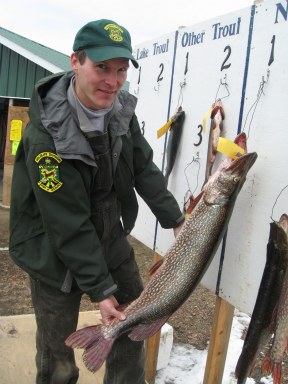
Men and women can also fish competitively during the winter months, if that is their cup of iced tea. In January and February, a series of ice fishing derbies are held around the state. The two oldest and most-fished derbies are the Lake Bomoseen Ice Fishing Derby and the Great Benson Fishing Derby, both held in February. Anywhere from 500 to 700 anglers from around New England converge on these two derbies, with headquarters at Crystal Beach in Castleton, to try their luck at bringing in trophy fish.
On Sunday, the final day of both derbies, onlookers and anglers come by to derby headquarters to get a glimpse at the impressive collection of fish — huge northern pike, trout and bass — displayed on the “fish board.”
On one particular derby a few years back, I got a firsthand glimpse at the challenges of ice fishing — particularly during harsh, frigid conditions. As my six companions set up their tip-ups and drilled more holes for jigging, I fired up the cook stove. That two-burner stove would be the only heat source for a weekend of record cold. We had our first tip-up baited and set just after the 6 a.m. start of the Lake Bomoseen Ice Fishing Derby. It was just above 20 degrees and a whipping wind made it feel close to zero. Later that morning my good friend Bob Walker, who fishes like a man possessed, wore a glaze of ice on his mustache and beard. A glob of venison chili that he had consumed earlier was blended with the ice on his face, giving us all a big laugh.
Ice fishing is about waiting, often a great deal of waiting — waiting for the red flag announcing a tip-up, waiting for a school of perch to pass by as you lift your jig for the 300th time, waiting for the sun to come up and warm the morning. Of course, some anglers will stay in their shanties, while the bolder ones step out and take the cold. I stayed in the shanty, most of the day, under the pretense that “someone” had to do the cooking for seven men.
But no one was complaining. The chili, which had simmered for five hours a day earlier, was hot and spicy — and gone in less than 30 minutes.
We didn’t catch many fish that day. The word from passing fishermen was that the bite was really slow, but no one complained. We had a day out on the ice, the company of great friends and, above all, we were fishing — fishing the deep freeze.
