

Vermont’s economic recovery from the Great Recession has hit the pause button. Over the next 18 months, the economy will stall and the state will see a slight dip in tax receipts, according to two economists who advise the Shumlin administration and the Legislature.
Though the economy will continue to improve slowly, housing sales will be soft and employers will remain cagey about hiring in the coming year, according to Jeffrey Carr, an economist who advises the Shumlin administration, and Tom Kavet the consulting economist for the Legislature.
Meanwhile state budget-writers will need to sharpen their pencils again to make up for the estimated decline in projected revenues for the General Fund. Tax receipts will continue to improve, but lag by 0.2 percent, or $1.8 million, over the next six months, and then drop about 0.7 percent, or $9.3 million, in fiscal year 2013, from the previous projections. The state will need to find about $12 million to cover the shortfalls. Overall, total tax income is expected to grow by $68 million in 2013 over fiscal year 2012 revenues.
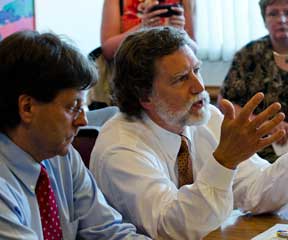
Jeffrey Carr, the consulting economist for the Shumlin administration, and Tom Kavet the consulting economist for the Legislature, gave the Emergency Board the news on Wednesday in the governor’s ceremonial office.
Carr and Kavet said the uncertainty that has clouded the 2012 and 2013 fiscal forecasts comes on top of a very volatile 2011 in which the global economy contended with high energy prices, the tsunami in Japan that disrupted auto manufacturing and other markets, the debt ceiling fight in Congress and now the European debt, currency and banking crises.
So far it looks like the plateau in economic growth is not going to lead to another cliff, or double dip, instead they said the recovery would be flat for the next 18 months as the nation’s economy slowly returns to normal growth patterns.
“When we consider how far and how long we were down, it’s really been a tepid recovery,” Carr told Gov. Peter Shumlin and the chairs of Senate Finance, Senate Appropriations, House Ways and Means and House Appropriations.
“Last year when we were sitting here at this time, things were looking much more encouraging, then along came things like rising energy prices, then along came things like the tragedy in Japan,” Carr said. “There was the tsunmai which interrupted the supply chain for automobile manufacturers, then we had a surge in food prices and then along came the manufactured debt ceiling crisis, which really eviscerated confidence on the part of a lot of businesses and on the part of a lot of households.”
Though Carr said he saw a “brightened tone” in the last quarter of the 2011, he is very concerned about a potential drop in tax revenues for corporate profits and capital gains in April. Good business profitability could counteract that trend and lead to higher business and personal tax revenues.
“When you take all those things into account, we feel comfortable with the forecast, but certainly April this year is going to be much more uncertain than other Aprils than we’ve seen in the recession in the last couple of years,” Carr said.
Kavet cautioned that corporate tax refunds could go up in 2012, putting a dent in state revenues.
“When you look at corporate taxes, it’s one of the most difficult ones to forecast because it’s the most volatile,” Kavet said.
Compared with other states, Vermont is doing “relatively well,” according to Kavet. The unemployment rate is fifth lowest in the nation, and Vermont homes have retained their value better than the rest of the region. Prices have declined by 4 percent since the housing bubble peaked in 2006. Nevada and Arizona have seen 54 percent and 44 percent drops in values over the same period.
“We’ve been able to avoid that self-reinforcing cycle where you have a foreclosure and then forced liquidation sale,” Carr said. “If you want to lose value in your house, just have your neighbors sell their houses at 30 percent and 35 percent discounts.”
Home sales in Vermont, however, will remain soft through the next two to three quarters, Kavet said. “We’re not going to get a lot of growth there.”
Construction starts have remained weak, particularly new home building, though the state saw bumps in construction activity as a result of recent VELCO transmission line projects and the Kingdom Community Wind Project in Lowell.
Though the state has lost 33 percent of its manufacturing jobs since 2000, the productivity of the 30,800 workers who remain in the sector has skyrocketed. Kavet estimates that manufacturing output in Vermont has gone up by 25 percent.
“The companies that have survived this downturn are incredibly productive, especially in manufacturing, and they’re very competitive,” Kavet said.
Carr agreed. “The fact is the U.S. economy is growing and we’re doing it with 6 million fewer jobs than we had at the last peak,” he said.
When will the recession end? Carr and Kavet say a robust turnaround is hard to predict because of the globally integrated nature of the economy and the crisis in Europe.
“I still fundamentally believe in the animal spirits of business people,” Carr said. “When they finally get to the point where they realize the only way to improve their corporate profitability is to stop cutting costs by maybe adding capacity to meet the demand that’s out there. As soon as they feel comfortable to do that I truly believe we will get back to a more normal correction.”
One business person in the room on Wednesday maintained an optimistic view of the state’s economy and the impact slowed growth will have on the General Fund.
Gov. Peter Shumlin emphasized that the dip in tax receipts amounts to seven-tenths of 1 percent. Overall, revenues have improved, he said.
“We have a $1.3 billion General Fund budget,” Shumlin said. “We are talking about having revenues down by about $9 million over what might have been projected, but we’re up $68.5 million over last year, so this is a good news story. We’re on track in a very fragile recovery and if we can keep passing legislation in this building that balances the budget without raising taxes on struggling Vermonters, we’re going to see, I believe, a steady continuous recovery in Vermont that’s going to grow jobs and economic opportunities.”
Shumlin said the state is well positioned to absorb the $9 million in reduced revenues — he suggested that budget-writers tap reserve funds that were set aside for federal budget cuts.
