


It’s hard to ignore the rumblings of an imminent political upheaval in Burlington. With the next mayoral election set for March 6 in Vermont’s largest city, a $33 million Burlington Telecom lawsuit that accuses the city of fraud and breach of contract, and Progressive Mayor Bob Kiss facing widespread criticism – some it from within his own base — the atmosphere is as volatile as it’s been in decades.
Four candidates to replace Kiss have already announced, and at least three more are considering it. The official list currently includes three Democrats – Airport Commissioner Miro Weinberger, state Rep. Jason Lorber and City Councilor Bram Kranichfeld, along with Republican Kurt Wright, a council member who came close to beating Kiss three years ago. All are hammering the mayor about BT finances and other examples of what they consider the administration’s mismanagement.
The possible contenders also include Sen. Tim Ashe, once a City Council Progressive, now perhaps that party’s best hope for a functional alliance with Democrats; Assistant Housing Director Brian Pine, a former Progressive councilor said to be seeking both Progressive and Democratic support; and Ward 3 Councilor Emma Mulvaney-Stanak, a Progressive Party stalwart who has so far resisted suggestions that she jump in.
Kiss has been mum about his plans, even at a recent caucus of the local Progressive Party. But the push for others to challenge him, along with an increase in local activism on issues like his recent attempt to forge a climate change partnership with Lockheed Martin, point to a tumultuous political season. No matter what the weather conditions, party caucuses in January are sure to be hot and well-attended.
At the same time, questions are being raised about the election process itself, specifically whether candidates should continue running with party labels. Last week, the City Council narrowly rejected a resolution to look at changing the city charter to prohibit party designations for both mayoral and City Council contests, but only after a debate intense enough for Board President Bill Keogh to hammer his gavel and angrily call a halt to the squabbling.
The discussion highlighted the unique nature of Burlington’s political landscape, three well-organized and determined political parties uneasily sharing legislative power, and an executive branch run by Progressives for all but two of the last 30 years. It all began in March 1981 when independent Bernie Sanders unseated long-term incumbent Democrat Gordon Paquette by just 10 votes.
Debating party politics
Backers of the recent “Party Designation in Local Elections” resolution included Ward 4 Democrat David Hartnett, who argued that “party politics” has played an unproductive role in local affairs, and Wright, also from Ward 4 in the city’s relatively suburban New North End. Wright was more equivocal, but suggested that the current approach has discouraged, or even prevented, some people from running.
After his 2009 loss to Kiss, due in part to instant runoff voting, Wright successfully pushed for a return to Burlington’s traditional voting system. As a result, next March the mayoral candidate with the most votes will be the automatic winner, as long as he or she receives at least 40 percent of the total. If not, a runoff election will be held.
Kranichfeld wasn’t persuaded by the arguments against party-based elections made by Wright or his fellow Democrat. “You don’t have to check your brain at the door when you join a party,” he said. “If the issue is partisanship, the solution is to use your judgment.”
The resolution noted that that “Burlington is one of the only municipalities (and perhaps the only one) that allows party designation in Vermont” for local elections, and that a 1990s city charter change removed party designations from school board elections.
Mulvaney-Stanak adamantly opposed a move away from party-based voting. “Parties provide useful information,” she said, and their caucuses provide a process for active participation. Parties also “represent a set of principles,” she added, and “help to weed people out or help people get into the process.” She warned that without parties there could be “multiple candidates in every election.”
Most of the Democrats on the council also disliked the idea. Ed Adrian said that party structure provides him with needed support, while Joan Shannon argued instead for a “city manager style government,” an approach championed by former Mayor Peter Clavelle.
When Hartnett urged his colleagues not to fear trying “something new,” suggesting that not even the board’s two Independent members can avoid responsibility, Independent Karen Paul shot back, “I’m not running away from anything, and I’m not part of a problem.”
Wright argued that dropping party designations would allow more people to run, referring to the Hatch Act, which prohibits any public employee whose salary includes federal funds from participating in partisan campaigns. The act, which has twice been upheld by the U.S. Supreme Court despite free- speech concerns, is usually the subject of liberal attacks and conservative backing.
The vote on party politics was ultimately 8-6, with Independents Paul and Sharon Bushor joining Hartnett and the council’s three Republicans in support of studying a non- or post-partisan system. Six Democrats and the council’s two Progressives voted no.
The current field
Despite agreement with Progressives on many issues, local Democrats see the chance of recapturing the city’s most powerful job for the first time in years. The critique is that Burlington’s finances have become a mess, and that Mayor Kiss is a poor communicator who isn’t accountable and transparent enough. On Sept. 16, that analysis received a boost when Moody’s Investors Service warned that the city’s financial troubles could lead to a further downgrade in the city’s credit rating.
At Weinberger’s campaign announcement on Sept. 13, held next door to City Hall in the former firehouse managed by Burlington City Arts, he charged that Kiss has put the city in “an exceptionally poor negotiating position,” while an apparent reluctance to discuss the details of Burlington Telecom finances “have left a mood of anger and anxiety about our future.” The 41-year-old airport commissioner, a housing developer, also pointed to the city’s failure to secure funding before starting on a $14 million airport parking-lot expansion.
Lorber, the first candidate to announce, makes a similar critique. Weighing in recently on the Burlington Telecom lawsuit, the state legislator, who works as a standup comedian, said BT’s trouble was an example of the need for change and called for “more financial oversight, communication and transparency.” Although promising not to assign blame, he nevertheless accused Kiss of failing to be sufficiently open about city affairs. Local residents “don’t want decisions being made behind closed doors,” he charged.
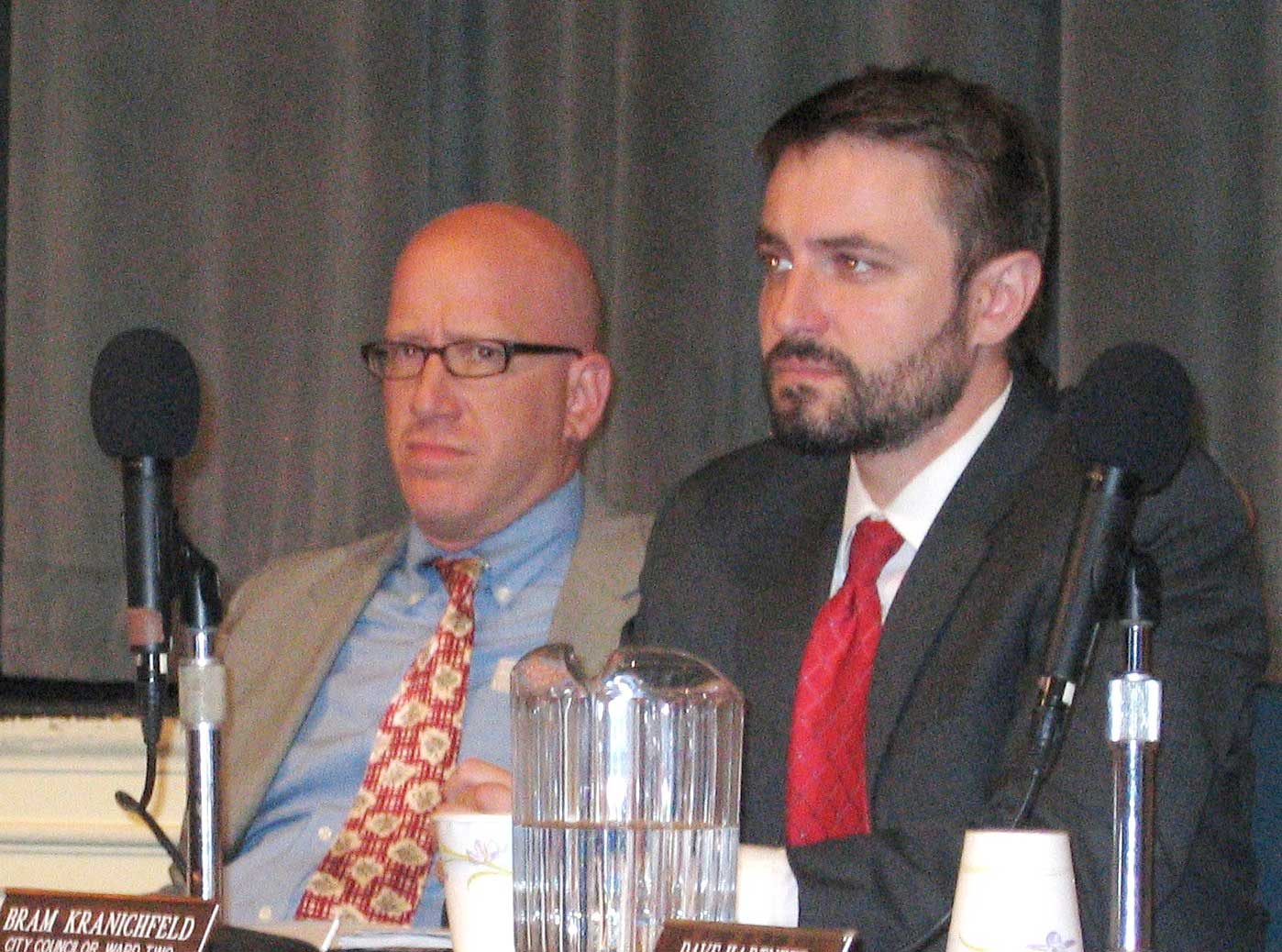
On his campaign website, Kranichfeld, a criminal prosecutor at the Chittenden County State’s Attorney’s Office, defines himself as “the people’s choice” and says he wants to “restore trust, accountability and fiscal responsibility to City Hall.” At 31, he is the youngest announced candidate to date, and counts among his backers former Democratic mayoral candidate Paul Lafayette. Although he opposed the recent move to drop party designations, he frequently talks about a “non-partisan approach.”
Wright, a councilor and state legislator who managed Kerry’s Kwik Stop in Burlington for many years, made his official announcement on Sept. 18 during appearances on a morning TV news program and a local radio talk show. Promising to restore trust and credibility, he said “job No. 1 for me will be to restore fiscal responsibility to the city and restore our credit rating.” As a Republican who has run before, Wright knows that the less voters think about party allegiances the better chance he has with what has become over the years a relatively liberal local electorate.
Politics by the numbers
When progressive Peter Clavelle decided to retire in 2006 after 15 years as mayor, he and others didn’t think that another Progressive candidate could be elected, or even that the local party would survive. Thus, many progressives decided to endorse Hinda Miller, the Democrat running to succeed him.
The leaders of Burlington’s Progressive Party weren’t willing to accept that diagnosis, however, and turned to Kiss, a veteran human services bureaucrat. He ended up beating Miller by about 9 percent and became the first Burlington mayor elected using instant runoff voting (IRV). Rumors circulated that some GOP supporters had been advised privately to give Kiss their second place vote rather than support the Democrat. In any case, the conclusion that the city’s progressive era was over proved to be premature.
Kiss continued along a pragmatic yet somewhat progressive path – lean budgets, “modest growth” and innovations like Burlington Telecom, a municipal cable television operation. Business Week called Burlington one of the best places “to raise your kids,” and the Centers for Disease Control crowned it the nation’s “healthiest city.”
In the 2009 race, despite various political affiliations, the five mayoral candidates embraced the same mixture of progressive rhetoric and pragmatic practice that first emerged during the Sanders era. Wright talked about leadership, and Democrat Andy Montroll argued that Burlington was “coasting along.” But neither questioned how the city was being run.
At one campaign debate, Montroll said that the best course was to focus on “what we have,” while Independent challenger Dan Smith stressed the need to “reinvent ourselves” in a “post-partisan” era. The only substantive criticism of Kiss revolved around his handling of accounting and personnel matters.
In the end, 8,980 people voted in March 2009 – about 1,000 less than had three years earlier – and Kiss was re-elected. In the initial count, however, Wright received 2,951 votes, beating Kiss by almost 400. In the second round of the instant runoff, the votes of independent Dan Smith and Green Party candidate James Simpson were redistributed to the remaining three. Wright was still ahead, with 3,294 votes to 2,981 for Kiss.
But when Andy Montroll’s votes were redistributed for a third round, Kiss finally pulled ahead with 4,313, beating Wright’s 4,061. Wright’s supporters weren’t pleased and mounted a campaign to repeal IRV, which they succeeded in doing by 52 to 48 percent the following year.
In 2012, the race will be decided the old way. If turnout remains about the same, it should take at least 3,600 votes to win.
The big question at the moment is whether Kiss will even seek a third term. He’s considerably less popular than he was just two years ago. But even if he opts out, the Progressive Party faces an uphill battle with almost any candidate. That’s why politicians like Ashe, with ties to both Progressives and Democrats, are being solicited, and why Pine talks about reaching out beyond the Progressive base.
At its height, this “third party,” which evolved slowly from an informal coalition years after Sanders became mayor and today is part of a statewide organization, had almost half the seats on the City Council. There are currently two Progressives, both representing Ward 3, heart of the inner city and once a Democratic stronghold.
Mayor Kiss is meanwhile beleaguered from both the right and left by criticisms about openness, finances and the handling of Burlington Telecom, a major progressive initiative at risk of failing. Thirty years after Bernie Sanders became mayor, Democrats dominate the City Council again, and both they and Republicans can envision a return to executive power.
As Sanders put it back in 1981, “It’s time for a change, real change.”
CORRECTIONS: In our original post, we incorrectly reported that Kurt Wright is employed by Kerry’s Kwik Mart. Wright no longer works for the company. We also used the name David Hartwell instead of David Hartnett in several places in the story.
