

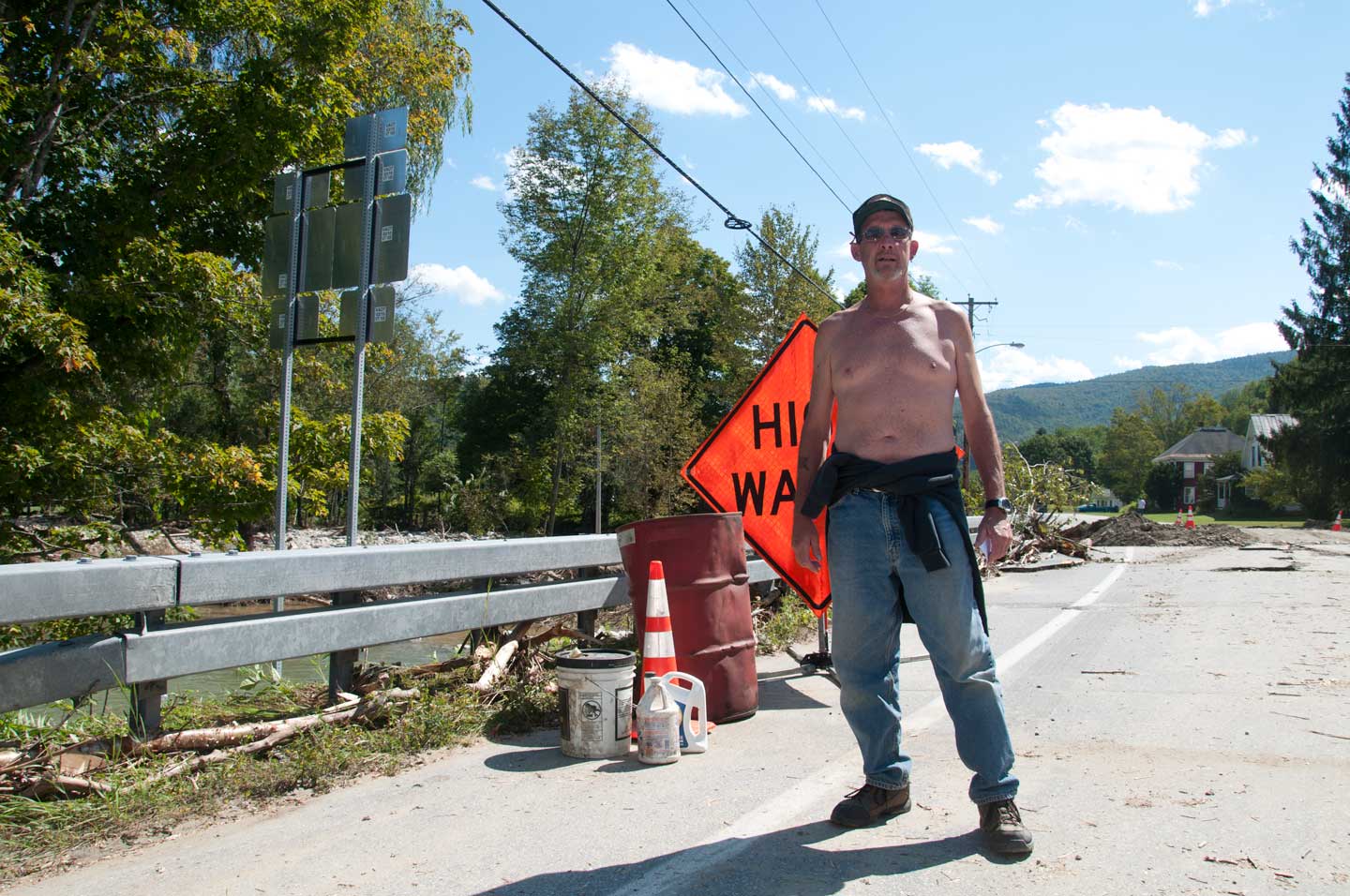
Jon Margolis is a news analyst for VTDigger.org.
It was a terrible natural disaster, but the response by officials and ordinary citizens alike was remarkable, perhaps heart-warming.
Even the secretary of Homeland Security was impressed by the “spirit of community engagement” and “can-do attitude” which was “really unsurpassed.”
“I’ve been in a number of communities,” said Janet Napolitano, but this place “has something special going for it.”
Big deal. This has become Vermont’s motto of the month. The floods caused by Tropical Storm Irene were terrible, but the state’s response was extraordinary – neighbor helping neighbor, volunteers heading into rather than out of the danger zones, strangers welcoming strangers into their homes.
In fact, Vermont’s “something special” quality has been a constant theme of Gov. Peter Shumlin as he travels the state consoling and encouraging flood victims.
“Vermonters more than anyone in any other place in the country will unconditionally give love and help to both friends and strangers that are in trouble,” the governor said in an interview, citing the state’s “sense of community, our sense of acceptance of each other.”
But hold on a second here. Napolitano wasn’t talking about Vermont. She was in Joplin, Mo., praising that city for how it responded to the May 22 tornado. There, too, some residents risked (and a few lost) their lives to save others. Those whose homes were spared opened them to those whose homes had been blown away. Rescuers and doctors worked through the night to save the stranded and injured. Altruism and humanitarianism, it seems, are not confined to the land and people between the Connecticut River and the Lake Champlain basin.
Where selfishness, greed and crime are not entirely absent. Amidst all the self-congratulations, came word that some Vermonters responded to the disaster by stealing from their neighbors instead of helping them. Copper plumbing from abandoned houses seemed to be the preferred booty, but anything else left behind was good enough for some.
Still, on balance, it’s hard not to give Vermonters a good grade for their post-flood behavior. On the other hand, the same could probably be said of New Jerseyans, and – difficult though it may be for Vermonters to swallow – New Hampshirities. But there doesn’t seem to have been quite as much “aren’t-we-special” talk coming from those states.
Raising an interesting question: Is there anything “special” about Vermont and Vermonters that would explain their (generally) admirable conduct over the last month? Obviously, just being born in – or having moved to – Vermont does not render one inherently superior to a Nebraskan or Alabamian. But there could be something about Vermont that engenders a greater attachment to community than is likely to be engendered elsewhere. Is there any real evidence, though, that this is the case?
Yes, at least according to two scholars who have spent years keeping tabs on Vermont’s attitudes and ethos.
But some of that evidence makes them a bit uncomfortable.
The scholars are St. Michael’s College professors Vince Bolduc (sociology) and Herb Kessel (economics) who, via St. Mike’s Social Science Research Center, run the “Pulse of Vermont” surveys sponsored by the Vermont Business Roundtable.
Those surveys, Kessel said, do indicate that Vermonters have “more social cohesiveness” than residents of most other states. “We tend to trust our neighbors more than people in other states,” he said. “Our latest Pulse of Vermont Study reported that when people were asked whether they feel like they can trust other Vermonters, 63 percent feel they can, double the rate that one gets from national polls.”
I truly believe Vermonters uphold a spirit of decency and devotion to one another that is different than any other place.”
– Gov. Peter Shumlin
None of this should be a surprise, Kessel said. Vermonters are better educated than the average American, the crime and poverty rates are low, and so is economic inequality compared to the rest of the country (though it’s creeping up). All these factors are usually associated with greater mutual trust and more social cohesion.
So is small town and rural life, said Bolduc (the two were interviewed separately). There is “less anonymity” in small towns, he said, and “rural people have traditionally had to depend on each other in times of need, helping each other get the hay in and things like that.”
Somewhat reluctantly, each with his own euphemism, both men acknowledged another possible reason for Vermont’s above-average social solidarity. Bolduc’s euphemism was “ethnic homogeneity.” Kissel’s was “less diversity.”
What they mean is that almost all Vermonters are white.
This does not mean that Vermonters are racist (well, except for the respondents who tell the “Pulse of Vermont” telephone callers that they moved to the state to get away from black and/or Hispanic neighbors). It does mean, Bolduc said, that all people “identify more strongly” with those who look and sound like they do.
“We like people who are like us,” he said. “It’s one less barrier we have to cross over.”
The governor would have none of that.
“I really don’t think that’s a factor,” he said. “I truly believe Vermonters uphold a spirit of decency and devotion to one another that is different than any other place. I don’t think our lack of diversity plays a part.”
There is no doubt that Vermont is very white, and that the non-Anglo, non-white minorities are disproportionately in Chittenden County, which was barely touched by Irene. In flood-ravaged Windham and Rutland Counties, the minority population is miniscule.
Bolduc suggested one more reason Vermonters might be more public-spirited than most Americans: because they know they’re supposed to be. It’s something of a “self-fulfilling prophecy,” he said.
This image of Vermonters as more community-minded than most didn’t start last month. It’s been around for years, perhaps because – as the “Pulse of Vermont” reports indicate – it seems true. Then people begin to believe the reports about themselves, and act accordingly.
“What’s wrong with that?” Bolduc said. “We become as we are treated, and conform to other people’s impressions of us.” That’s just how people are, he said, and in this case, it’s beneficial.
Shumlin said he finds all this “over-analyzing.” He insists that the way Vermonters have been acting this past month is “just who they are.”
The Vermont spirit and attitudes, he said, are “infectious, even for those who move here,” the result of centuries of “farming rocky land and living in a rugged climate.”
No governor has ever lost a vote by telling his constituents how wonderful they are. This governor, though, seems genuinely enthusiastic when he describes the “thousands and thousands of examples of selflessness, generosity and goodness” he has seen in the last month.
Who knows? Maybe it does have to do with the rocky land and rugged climate. Or maybe it’s just that the generous, selfless folks elsewhere aren’t as impressed with themselves.
