

Editor’s note: Dennis Jensen is the outdoor editor of The Rutland Herald and Barre-Montpelier Times Argus and a member of the board of directors of the New England Outdoor Writers Association.
The little brook is shallow and harmless at dead-low tide. But I was anxious to get to my fishing spot — a sweet sandbar that juts out into Saco Bay — a good three hours before that low-tide mark and, at that time, the brook’s waters are nearly chest-deep and the current swift.
With sunrise still 10 minutes away, I stepped into the cold waters, barefoot and in shorts. With a heavy backpack filled with the day’s fishing gear, two 10-foot surf rods in one hand and a small cooler of bait in the other and a lawn chair draped around my neck, I considered what would have to go first (the backpack) if the waters proved too strong to make passage and I was swept away with the current.
About halfway across the brook, the current is strong and I struggled to keep my balance. As I staggered up the steep, soft, sandy bank of the creek on the other side, I dropped my gear and caught my breath.
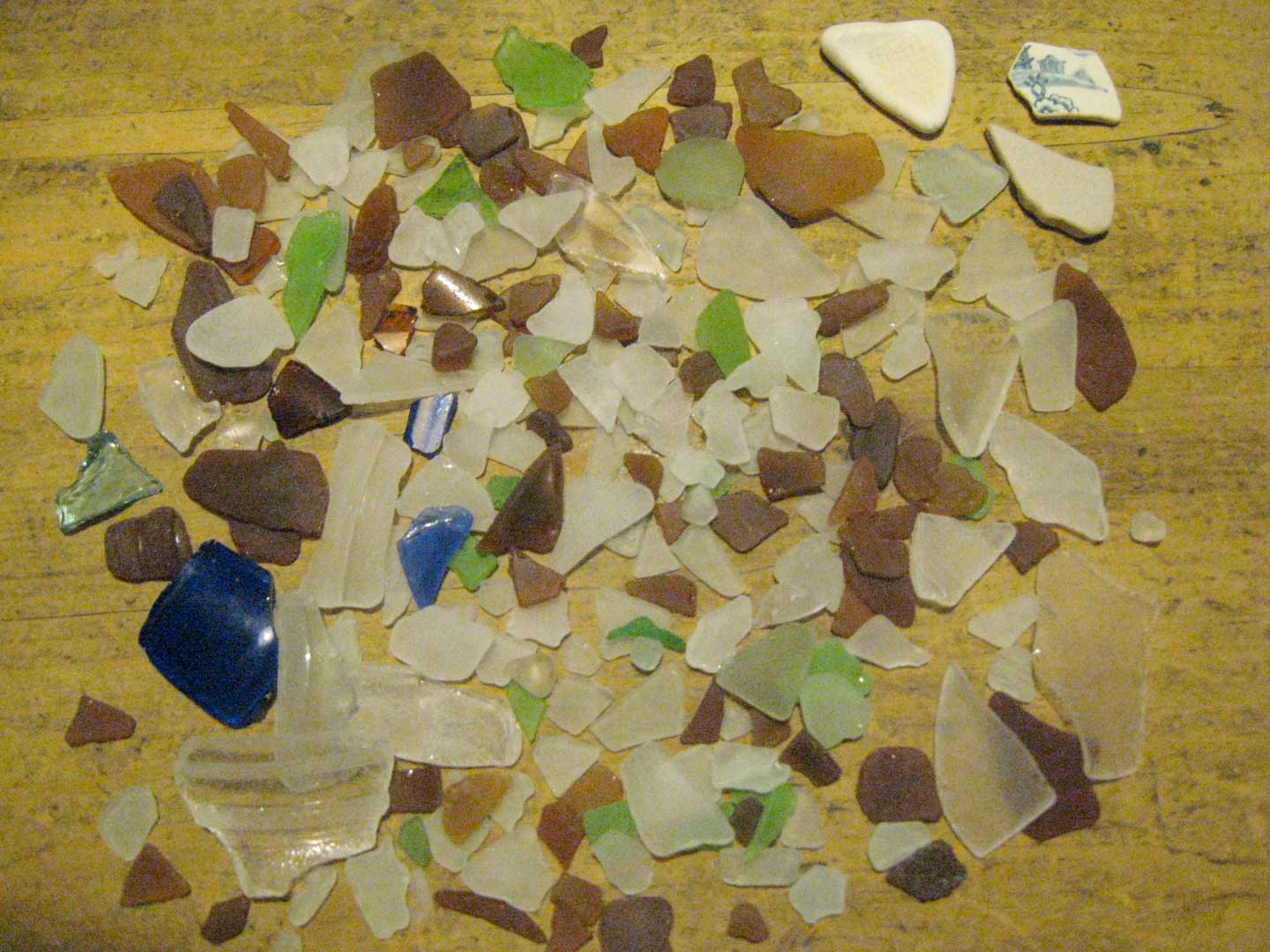
Then I glanced down. There, in the wet sand where the waters had run its course not a half-hour earlier, was a big, dull, blue chunk of sea glass.
I soon found that sea glass was littered all over the place.
In the next half-hour or so, after I baited, cast and secured my surf rods, I hit into a bonanza. At one point, as I scanned the sand, I was struck by what appeared to be a broken shell. But something made me pick it up and turn it over.
It was a ceramic shard, marked by a soft blue painted scene that included an image of an oriental home, arguably the finest piece I have ever found along the coast of Maine.
By the time I got back to our beach house, I had some 55 pieces of sea glass and two ceramic shards, undoubtedly my best outing ever. This, despite the fact that the great bulk of that morning was spent focused on fishing.
The passion for collecting sea glass happened, as I suppose it does with most people, by accident. Some two decades ago, we found one piece, were struck by the sheer beauty of it and have collected it ever since. On some outings, particularly a few hours before low tide, our only focus is sea glass, and we crisscross along recently exposed sand and along the shoreline, looking down, always looking down.
There is a wonder to sea glass and to the mystery of its origin. These are the little jewels of the sea, cast off by shipwrecks, by old dump sites near the ocean front, by ballasts dumped in ports long ago.
Sea glass, according to a sweet, little book by C.S. Lambert (“Sea Glass Hunter’s Handbook”), “is fragments of indeterminate glass and ceramic objects that have been in oceans and rivers for incalculable amounts of time, have taken on the scars of their untold voyages, and have washed up on beaches everywhere. Some collectors consider it more precious than gemstones.”
But the real truth to sea glass is that, well, it’s just plain fun to find and collect. And anyone, children included, can take part.
Where we, that is my wife and myself, hunt for glass, high tide is a waste of time. In fact, along this one long, nearby stretch of beach, sea glass is all but non-existent for more than a mile, even at low tide.
But, headed back the other way, just a little further north, sea glass can be found almost with certainty, along another stretch of beach. It must have something to do with the way the water kisses the sand and the structure of the beach.
We find almost all of our glass from a few hours before low tide to just before low tide. I look for those stretches of sand where small pebbles and shells have been trapped by small, outgoing waves.
Many successful sea glass hunters, according to Lambert, find their glass where a “wrack line — a horizontal line of pebbles and other debris — traps sea glass.”
You can spot these wrack lines quite easily, as they are short stretches of pebbles and broken shells, standing out against long stretches of pure sand.
We have become quite competitive about how much glass each of us has collected on a given day. But I have a clear advantage, thanks to my drive to fish for striped bass along the coast of Maine. Often, I have the beach to myself as the orange-red ball of a sun first emerges. If the tide is right and the fishing is slow, I’ll walk away from my two fishing rods, constantly looking back, of course, in the event of a sudden jolt of a pole.
And if the sea glass conditions are really good, as they were that morning last week, I’ll put an even greater priority on the hunt for sea glass, leaving my fishing rods virtually unattended.
While the competition still goes on between us, I have a long way to go to top my wife, Kathleen. Three or four summers ago, during one of our highly-competitive sea glass outings, she found a striking, black arrow head in the sand. How many hundreds or thousands of years ago the hands of some Native American hunter fashioned that arrow head is anyone’s guess.
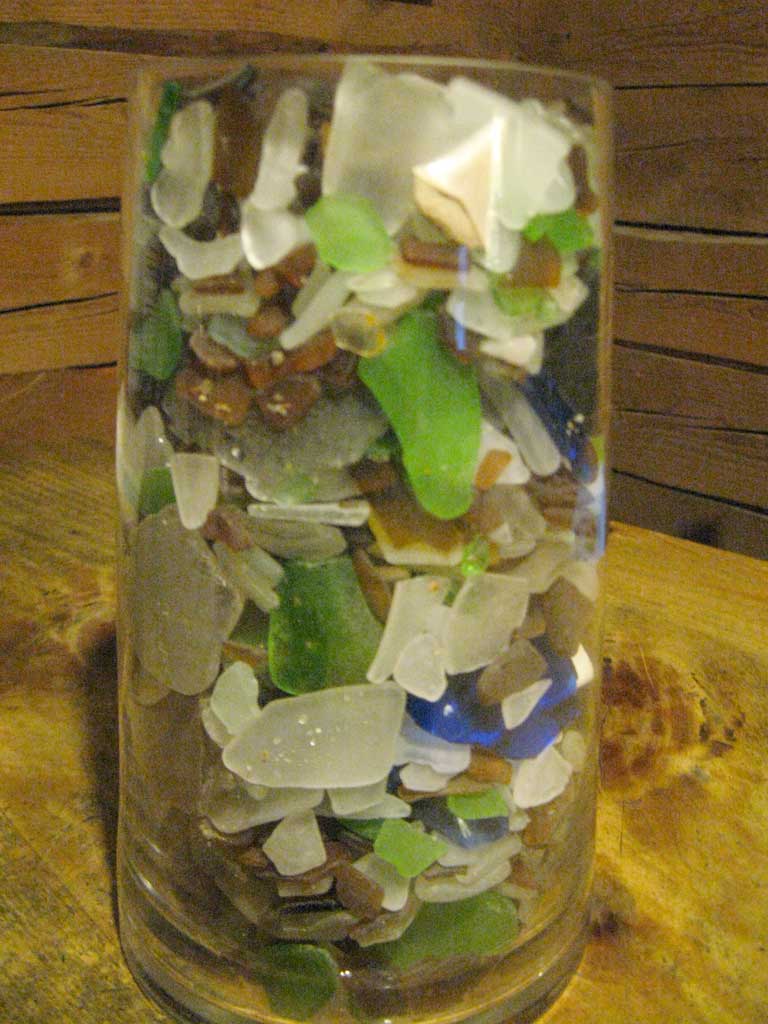
We have a great big glass vase that sits on the kitchen table, each summer, which displays our glass. It is filled now and another vase must be found. Most of the sea glass is a muted white or brown. Some are green. Then there is the red and blue glass; those are the rarest of them all.
But all sea glass is precious, in my eyes. And I will pocket even the smallest piece as these worn shards have an unknown history. Conjecture about where it came from and how it got here — and the sheer beauty of it — makes sea glass a gem of the imagination.
