

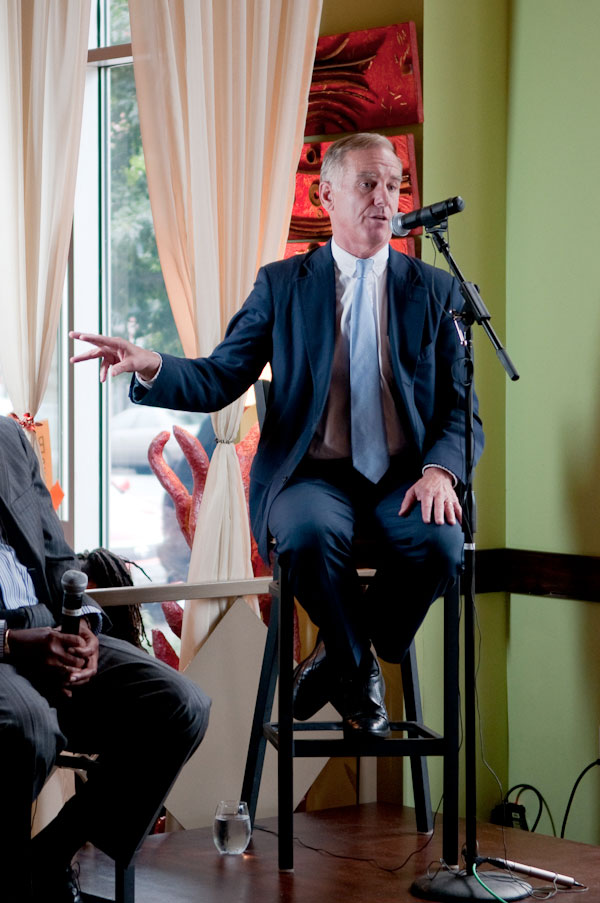
Former Gov. Howard Dean told VTDigger.org on Saturday that he supports Green Mountain Power’s “hostile takeover” bid for Central Vermont Public Service.
“I am supportive of it,” Dean said. “The reason I’m supportive of it is because does some important things for the ratepayers.”
He pointed to three “sweeteners” that he says make the Green Mountain deal more advantageous than the May 30, Fortis, Inc., offer for the state’s largest utility. (Fortis is a holding company based in St. John’s, Newfoundland; Green Mountain is owned by Montreal-based Gaz Metro. Each of the bids by the vying Canadian companies give stockholders a roughly $10 increase in share values; Green Mountain’s offer is 15 cents higher than Fortis’.)
No. 1 on Dean’s list? Green Mountain Power’s promise to set aside its 30 percent share of VELCO, the company’s share of the state’s transmission utility, in a public trust. (CVPS owns 40 percent of VELCO; Green Mountain owns 30 percent. The VELCO compromise is widely regarded as a way to allay fears about majority Gaz Metro ownership should the deal go through.)
No. 2. Dean says the annual $1 million fund derived from the public trust that will be used to help poor Vermonters power their houses will be “critical at time when the federal government is going to cut back.”
Doesn’t he worry about one company, a Canadian corporation at that, providing electric service to 70 percent of Vermont households? Not really. Dean says Gaz Metro, which has owned Green Mountain since 2007 and Vermont Natural Gas since 1986, has a good track record in Vermont.
That’s point No. 3. Generally speaking, Dean said, the state hasn’t had “a lot of luck with out-of-state takeovers of Vermont entities.” With one exception: Gaz Metro.
“If we’re going to be owned by Canadian company, it’s better to go with a company we know than a company we don’t,” Dean said in a telephone interview.
No matter which company buys CVPS, however, Dean says a subtext of the deal will be the build out of a new transmission corridor from Canada to the urban areas points south of Vermont. The corridor is “the real game of Hydro-Quebec,” he said. Hydro-Quebec owns a massive dam system in northern Quebec that will be providing about 30 percent of Vermont’s power over the next several decades.
“We’re a nice market,” Dean said. “But the south is a great market. I don’t have any doubt we’re going to end up with a (new) transmission corridor.”
Apportionment Board’s math-in-public problem
Oops! The Apportionment Board miscounted. As it finalized plans for redrawing Senate voting district areas, the board neglected to notice that it inadvertently created 31 Senate seats instead of the 30 permitted under the Vermont Constitution.
Much of the board’s time was spent reworking Chittenden County districts late on Thursday afternoon; it’s possible that the addition may have occurred while working in that area.
Board Chair Tom Little and staffers from the Vermont Secretary of State’s Office realized the math was faulty on Friday morning, a day after what was supposed to be the board’s final meeting. Little apologized; the board will reconvene next week to complete the Senate proposal.
Board member Steve Hingtgen thinks the mistake likely happened when the board was recalculating the Chittenden and Franklin county Senate districts.
“It’s on us, but thank goodness we’re ahead of schedule,” Hingtgen said.
The board has not set a date for its next meeting but will re-convene sometime next week to finalize the senate plan before its July 1 deadline.
~Eli Sherman
Redistricting as fundraising tool
Meanwhile, the “nonpartisan” redistricting process has fueled new fundraising efforts by the Progressive Party and the Vermont Democratic Party.
Jesse Bragg, the new executive director of the Vermont Democratic Party, sent out an email blast Friday asserting that the GOP and the Progressive Party are joining forces and are “threatening to reshape the entire landscape of the state in order to score electoral gains in 2012.”
The email, titled “Redistricting Tactics Threaten Healthcare Reform” seemed an attempt to unnerve Democratic voters about maintaining the party’s supermajority in the House and the Senate. The fear tactic was designed to help supporters find a reason to pry open their wallets and give the Vermont Democratic Party a monetary boost. The party is trying to raise $2,012 in the next week to “close out with a strong quarter.”
The Progressives counterattacked on Saturday with their own fundraising salvo. In an email titled, “Partisanship Threatens Redistricting (but is good for fundraising),” executive director of the Progressive Party, Morgan Daybell, alleges that the Democrats are a bunch of hypocrites.
Daybell maintains that it’s the Progressives who have been fighting for single-payer health care all along.
So what is the nefarious Progressive plan for killing healthcare? Apparently we will kill it by giving Vermonters greater access to their elected representatives! The two Progressives on the Legislative Apportionment Board (LAB) have been pushing for house and senate redistricting plans that put good democracy over protecting incumbents.
Daybell also points to a bill proposed by now-House Speaker Rep. Shap Smith, a Democrat, during the last redistricting fight that would have “favored” more single-seat districts. Smith was not immediately available for comment.
What a difference a few years make. With the Dems in the Governor’s office, and holding huge House and Senate majorities, the plan has changed to: discredit the LAB’s (Legislative Apportionment Board) work, accuse others of partisanship to hide your own, fundraise like hell, and pass a plan in the interest of your colleagues, not the voters.
Daybell then proceeds to make his own fundraising pitch – urging Progressives to donate $31 a month “the same (unconstitutional) number of Senators in the plan pushed out of the LAB”; $20 a month, which represents $1 “for each year that Vermont Progressives have been serving in the house and fighting for single payer health care”; or giving a one-time contribution of $150, or $1 for every “House district needed to ensure that all Vermonters enjoy equal access to their representative government.”
Who said redistricting was arcane and boring?
No upgrades to campaign finance reporting system anytime soon
The July 15 deadline for campaign finance reports from candidates seeking legislative seats or statewide office is looming. Once and for all, we’ll know at that juncture just how much Gov. Peter Shumlin has raised for his 2012 re-election bid. We’ll also probably get a good gander at who on the GOP side has finally declared their intentions to run against the new governor. (I’m placing bets on Brian Dubie.)
What we won’t see, however, is a new and improved system for reviewing the donations. Alas, the oft-promised searchable database system for campaign contribution information is a long way off.
The newly elected Vermont Secretary of State Jim Condos expects to find out in a week or so what his office can do to improve the current arcane system, which is only one step above your local library’s card catalog system.
Without more money from the Legislature, however, a searchable database system for campaign contributions is a long way off. Condos said a system that encompasses information from years past would cost between $600,000 and $1 million.
So what about a system that only includes new data? Condos said he’ll get back to me on that.
You may recall, yours truly analyzed the campaign contributions of all the major candidates for statewide office last year during the intense 2010 election cycle. The information ran to hundreds of pages (only available in unsearchable PDF format) with dozens of single spaced entries per page. Suffice it to say, it took days to create spreadsheets that enabled me to analyze patterns of giving.
With a searchable database in place, this task would have taken a matter of minutes for any member of the public to complete, as opposed to days of masochistic number and name crunching.
“Right now there is no money for a searchable database,” Condos said. “We have to do work within the budget the Legislature approves for us.”
The Secretary of State says it will, however, be easier this year for candidates to provide information. Politicians and their helpers can fill out a campaign finance form online, which can then be printed and signed, Condos said.
“We’re taking some steps to make it easier,” Condos said. “We’re going to work on it and continue to try to work on it until get full funding.”
The searchable database is part of the “disclosure piece,” as Condos put it.

