

Editor’s note: This article first appeared in The Commons.
The curtain went up Wednesday night on three days of meetings, public comment and an injunction hearing for the Entergy v. Vermont lawsuit.
It all began with the U.S. Nuclear Regulatory Commission’s presentation of Vermont Yankee’s safety findings for 2010 before nearly 200 people at the Brattleboro Union High School auditorium.
Foes and supporters both voiced their concerns for the health and safety of Entergy’s Vermont Yankee 600-megawatt nuclear plant in Vernon.
Members of the International Brotherhood of Electrical Workers, the largest union at Vermont Yankee, grumbled in the back row while anti-nuclear activist Gary Sachs paced the auditorium heckling officials.
The intent of the meeting was to provide a brief discussion of Vermont Yankee’s 2010 safety performance. NRC representatives also spoke about the commission’s evaluations of nuclear plants in the United States in response to events at the Fukushima-Daiichi plant in Japan.
At the recommendation of the Brattleboro Police Department, the NRC had followed increased public safety measures and maintained a security check point in response to a recent heated and verbally abusive public meeting in New York state on the future of the Indian Point plant.
The NRC’s presentation lasted about 20 minutes. Public comments took up the remainder of the evening.
According to David Spindler, the NRC’s Senior Resident Inspector at Vermont Yankee, the plant “operated in a manner that preserved public health and safety and met all cornerstone objectives.”
In its Annual Assessment Letter, the NRC wrote that all inspection findings at the plant received a “very low (i.e., green) safety significance (rating).” Inspections also indicated that “your performance was within the the normal, expected range.”
The NRC gave Vermont Yankee the same rating in 2009. According to Vermont Yankee spokesperson Larry Smith, the plant has received this green significance rating for multiple years.
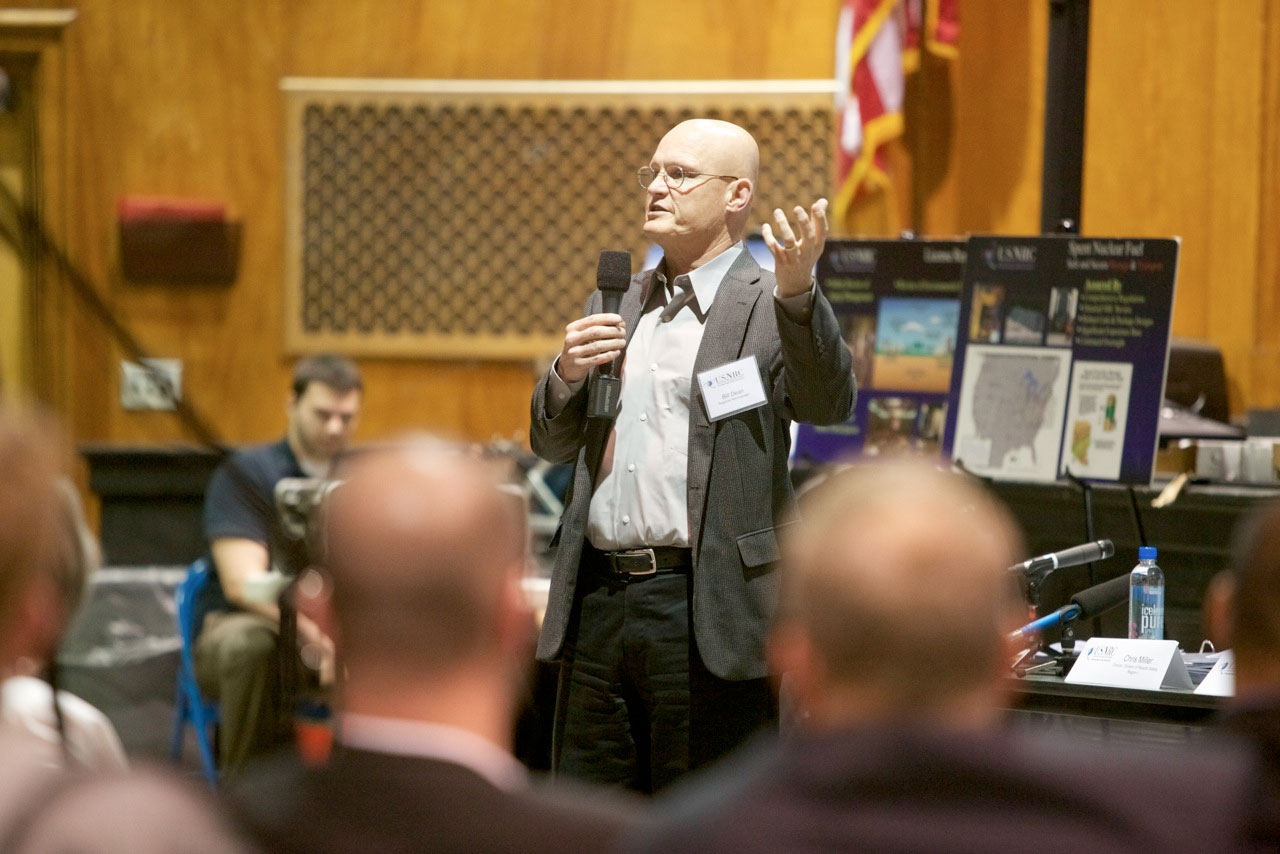
According to Bill Dean, NRC Region 1 administrator, the commission is still conducting extra inspections related to the 2010 tritium leaks through a Demand for Information letter.
The first portion of the letter addressed inaccurate statements made by Entergy employees to the state over the existence of underground piping. Dean said the NRC wanted to ensure the same employees had not made any erroneous statements to the commission.
He said that Entergy has satisfied the first part of the Demand For Information.
The second portion involved increased inspections related to the remediation of the 2010 tritium leaks. Dean said the NRC is waiting on a hydrogeological site mapping but expects the final reports in a few weeks.
No good information
NRC officials called for a moment of silence for the people affected by the earthquake and tsunami in Japan.
Wayne Schmidt, NRC Senior Reactor Administrator, Division of Reactor Safety, said, the NRC still did not have “good information” to assess what happened at Fukushima-Daiichi but is focused on health and the environment.
“That’s our sole job,” he said, adding that the NRC believes that U.S. plants were not compromised by events in Japan.
Plants on the Atlantic Seaboard would not be subject to the same environmental conditions as Japan, or be affected by aftershocks or a tsunami, he said.
The NRC was concerned about West Coast plants, such as those in Washington state.
Schmidt also said despite the fact that Fukushima-Daiichi and Vermont Yankee reactors are the same design, he assured the audience that Vermont Yankee is a different animal.
For example, said Schmidt, Vermont Yankee has a diesel generator to help charge back up batteries in the event of a blackout. The plant also has nitrogen in the containment around the reactor to limit the level of oxygen in the event of a hydrogen explosion similar to Fukushima-Daiichi’s.
Finally, Vermont Yankee is “one circuit breaker away” from the Vernon hydroelectric dam.
The NRC is investigating “what we can do to enhance safety,” in the long-term as part of a “lessons learned” process after events are Fukushima-Daiichi, said Dean.
Dean said there were thee key concepts he wanted to share with the audience. The first was that given what the NRC knows about Fukushima- Daiichi, it believes U.S. nuclear plants are safe to operate.
Second, the commission is taking a systematic look at procedures and changing the requirements accordingly.
Finally, he said, despite Vermont Yankee being an “unsettled situation” the NRC is committed to the public and “we’re going to do what ever needs to be done” to keep the public safe.
Public comment
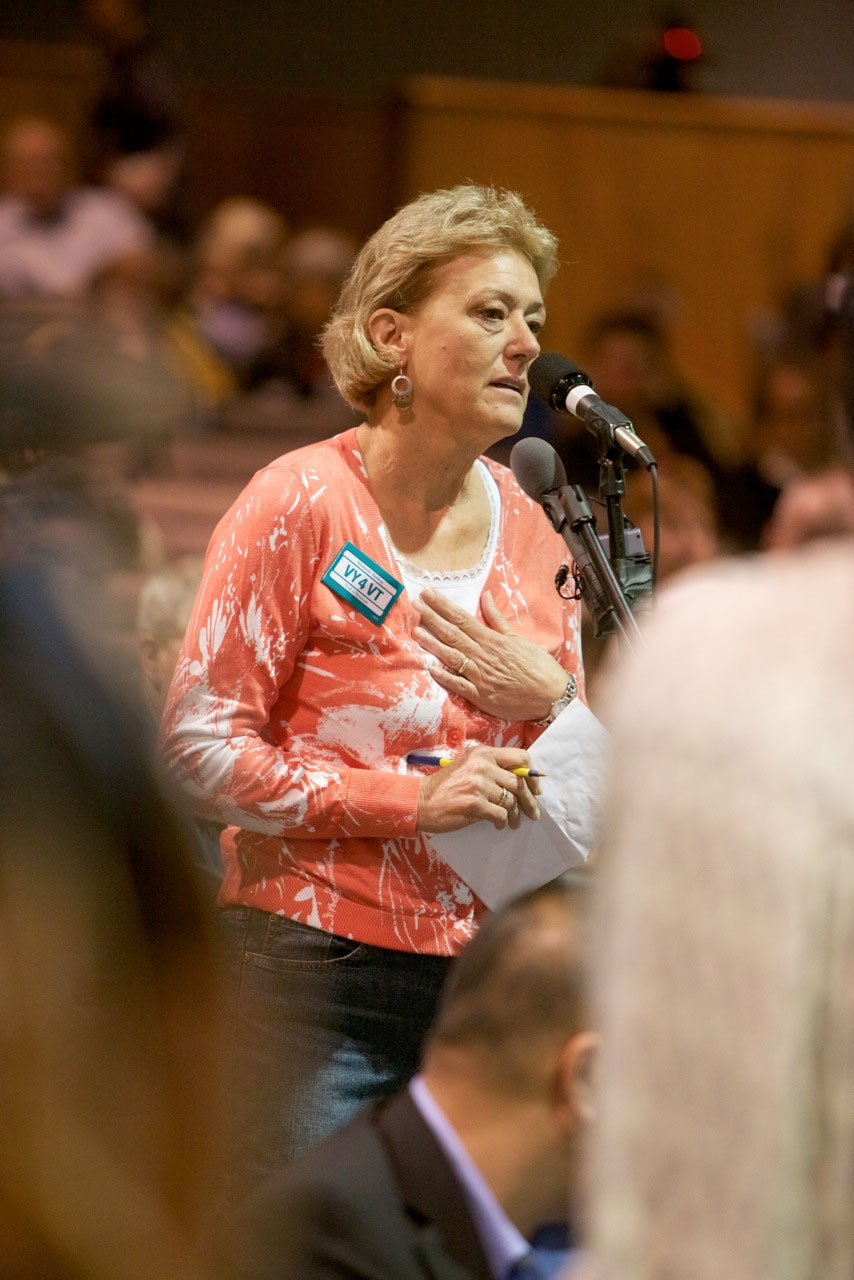
During the question and answer session, 44 out of the estimated 170 audience members asked to speak. Speakers had three minutes to comment. Not all kept to that time frame.
Audience members raised concerns about the plant’s safety. Others about the loss of jobs. Many expressed a distrust of the NRC.
“The stuff [spent fuel] is a disaster out there waiting to happen,” said Walter Klinger of Pownal, a member of the Bennington County Regional Planning Commission.
Officials told him that spent fuel pool and dry cask storage is relatively safe. Of the two, dry cask is safer because the passive storage system relied on circulating air. The casks are stored on-site above the max projected flood level but can also survive submersion.
Raymond Shadis, technical adviser for the New England Coalition, took the NRC to task for thinking plants were “Scot free” because they couldn’t be hit by a tsunami and earthquake simultaneously.
He pointed out that a tsunami hit Newfoundland with 90-foot waves in 1924 after an underwater landslide.
“We’re concerned about the quality of information and research at the NRC,” he said.
Jared Cobb called for Vermont Yankee’s closure in 2012. The NRC is “too often a lap dog not a watch dog,” he said.
Cobb also pressed the officials about the commission’s alleged vote to request the U.S. Department of Justice intervene in the Energy v. Vermont court case on Entergy’s behalf.
Dean refuted the lapdogs charge, and said that he has no knowledge of a vote taken by the commission. He added that the NRC had no intention to get involved in the case as long as there’s “no transgression.”
After the meeting, Dean said, in light of the pending injunction hearing, if Vermont Yankee temporarily shut down it could restart later, provided the plant met any new NRC regulations. Other plants, such as Millstone in Connecticut and Indian Point, have done so.
Pitting neighbor against neighbor
Community members said the Vermont Yankee issue has pitted neighbor against neighbor.
Vernon Selectboard member Patty O’Donnell said to a round of shouts of disagreement, “There are thousands and thousands of Vermonters that support Vermont Yankee.” O’Donnell served 12 years as state representative for Vernon and Guilford before she retired last year.
O’Donnell said she understood how controversial Vermont Yankee is, but she said the plant is safe. In the aftermath of the Sept. 11, 2001, terror attacks, O’Donnell said she spent the night at the plant and witnessed how the employees responded.
“We know the people at Vermont Yankee,” she said. “Never would the employees jeopardize their families for the sake of a paycheck.”
She also chided the state for buying nuclear power from a New Hampshire plant with a lower safety rating and apologized to the NRC representatives for the audience’s “rudeness.”
“Real, true Vermonters respect the fact that we’re all different,” O’Donnell said.
Andrew Davis, a Brattleboro Town Meeting representative from District 3, said the good people at Vermont Yankee are as good as Fukushima-Daiichi operators, and as Chernobyl, and as at Three-Mile Island.
“It’s a little unfair to pit neighbor against neighbor,” he said.
Davis challenged the NRC’s lax oversight of the nuclear industry. He cited an article in The New York Times that reported plant officials in Japan ignored issues with the plant prior to the March earthquake.
“Could any of you stop the events at Fukushima-Daiichi?” asked Sachs.
He said the NRC “is out of their league” and it’s time to let the industry die.
“It’s these hands here that check the equipment you speak so passionately about,” said Vedrana Greatorex, to the anti-nuclear supporters.
Greatorex works at Vermont Yankee, but she said she spoke as a private citizen. She accused the anti-nuclear activists of ignoring safety issues in the interest of shutting the plant down.
“If you ever have questions, reach out to us,” she said. “We’re not biased. We want our kids to be safe.”
“[Many] spoke but nobody heard a thing,” said Claire Chang of Gill, Mass., after the meeting.
