

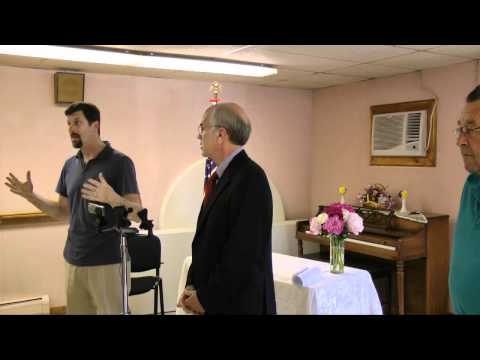
Congressman Peter Welch, D-Vt., appeared at the Barre Senior Center Monday to outline a bipartisan bill designed to reduce prescription drug costs for seniors and reduce the federal deficit.
To be introduced in Congress, the bill would cut drug costs through Part D of Medicare, while saving up to $156 billion over the next 10 years, savings that could be applied toward the U.S. deficit.
The bill would require the Secretary of Health and Human Services to negotiate prescription drug prices under the congressman’s Medicare Prescription Drug Price Negotiation Act of 2011. Medicare has been unable to negotiate the price of drugs with pharmaceutical companies since 2004.
Part D of the Medicare program helps senior citizens pay a portion of the cost for prescription drugs. The remainder is paid for by the individual. Each individual pays a certain percentage of the cost based on the person’s income, but the cost of the drug is determined by the pharmaceutical companies, not Medicare.
“We have 110,000 Vermonters who are on Medicare and depend on it for health care,” Welch said. “What is so wrong about the Part D program is that even though the taxpayer is the biggest purchaser of prescription drugs, as a large purchaser it can’t negotiate bulk-price discounts.”
When Part D of Medicare narrowly passed Congress in 2003 as a part of the Medicare Prescription Drug, Improvement, and Modernization Act, the law prohibited the government from negotiating bulk price discounts, which kept drug costs artificially high.
After that bill passed, some of the bill’s supporters left Congress to work for pharmaceutical companies, including Billy Tauzin, a former Republican congressman from Arizona. Tauzin helped pass the bill while in Congress, then left in 2005 to become president and CEO of Pharmaceutical Research and Manufacturers of America (PhRMA) lobbying for pharmaceutical companies. Welch said “Medicare Part D was really a corrupt bargain” due to Medicare being forced to pay a price determined by pharmaceutical companies.
Welch said that if the bill succeeds, it would save taxpayers, along with the Medicare program, up to $156 billion over 10 years.
“We all know that there are enormous budget pressures in Washington, and my view is that it’s irresponsible for us to not save money where we can, particularly when doing so makes Medicare stronger, not weaker,” Welch said.
The Department of Veterans Affairs, which administers the nation’s largest health care system, is allowed to negotiate drug prices. According to a Families USA report, the top five Medicare Part D insurers charged 58 percent more than Veterans Affairs.
Welch originally attempted to get this same plan passed as part of the Health Care Reform legislation. The provision was stripped from the law in the Senate after passing the House last year, but Welch said he is optimistic about its chances this time around.
“Both Republicans and Democrats are working hard to try and get on a long-term fiscal plan that will restore balance,” Welch said. “You just can’t afford to be giving away money for nothing. So I think there is more willingness on the part of some of my Republican colleagues to find savings through price negotiation; this is real money making a dent in the deficit.”
Greg Marchildon, state director of the American Association of Retired Persons, said that if the drugs that people need the most can get into the hands of Vermont seniors at an affordable price quickly, then they will “live much longer and live much happier.”
Taking the lead on the bipartisan bill with Welch this time around is Rep. JoAnn Emerson, R-MO. Welch describes Emerson as a “bipartisan type of person and an excellent member of Congress.” Welch, who is a big supporter of bipartisan legislation, said it’s Vermont’s style.
“It’s the way we do it in Vermont,” Welch said. “In Vermont we’re about solving practical problems, not having big ideological battles. So that works, and it’s the approach I’m taking, and I find that if I work with people in a practical, concrete way, we can find common ground.”
