


A national advocacy group, Families USA, has given the Vermont Public Interest Research Group $25,000 for its health care “education” efforts in Vermont. VPIRG is the largest nonprofit consumer and environmental advocacy organization in Vermont.
Families USA supports Vermont’s plan to push ahead with a controversial universal health care system. The Washington, D.C.-based nonprofit, however, opposes a proposed Senate amendment to the Affordable Care Act that would enable Vermont to obtain a waiver to the law in 2014.
When H.202, the single-payer plan, passed the Legislature, Families USA issued a press release that equated Vermont’s reform act with the Affordable Care Act.
“Vermont’s new law and the Green Mountain Care roadmap for implementing the Affordable Care Act is a significant success story,” Ron Pollack, executive director of Families USA, said in the release. “We hope that other states across the country take inspiration from Vermont to implement their own unique pathways to improving health coverage, costs, and quality of care.”
Kathleen D. Stoll, deputy executive director of health policy for Families USA, was in Central Vermont last week to talk with single-payer supporters, Democratic leaders and members of the Shumlin administration about her organization’s views on how Vermont’s push for waivers could undermine the Affordable Care Act. Stoll said the new national health care reform law is vulnerable to the whims of Tea Party activists who were elected on a wave of anti-government sentiment that crested with the November congressional election.
Families USA’s stance on waivers runs counter to the wishes of Vermont’s political leadership.
Vermont’s congressional delegation and Gov. Peter Shumlin have pushed for the Brown-Wyden waiver amendment because they have said the Affordable Care Act complicates implementation of Vermont’s plans for a single-payer system. The Affordable Care Act requires the state to implement health insurance exchanges by 2013. Shumlin has said wants to move ahead with a single-payer system that bypasses insurers and moves toward a unified, government run payment system by 2014.
The exchanges create a mechanism for consumers to evaluate insurance plans based on actuarial value. The system will enable consumers to more readily understand the costs and benefits of health insurance programs that include a dizzying array of co-pays, co-insurance, deductibles and benefit limits. The program also comes with money – Vermont stands to receive several hundred million dollars in federal supports to ease implementation of the exchanges. Shumlin’s administration would use the money from the exchange to help fund the transition to single payer.
Stoll said the Brown-Wyden amendment, which would give states waivers to opt-out of the exchanges in 2014, could undercut the Affordable Care Act and open the door for states like Georgia to bypass requirements to offer adequate insurance.
Given the current political climate in Washington, she said, the waiver could “wipe out” the exchanges and result in “a completely unregulated market.”
“We want Vermont covered, but not at the expense of other states,” Stoll said.
Under current law, 2017 is the earliest date waivers can be obtained. Sen. Bernie Sanders, I-Vt., has been a vocal supporter of the Brown-Wyden amendment, which he says would make it easier for Vermont to shift to a single-payer system in 2014.
Last winter, Sanders, an independent, Sen. Patrick Leahy, D-Vt., and Rep. Peter Welch, D-Vt., held a press conference in the governor’s ceremonial office to support Gov. Peter Shumlin’s single-payer reform plan and to announce their push for a waiver from the federal government to bypass the
Affordable Care Act’s mandatory insurance exchanges.
At the presser, the congressional delegation emphasized that the amendment gives states more flexibility under the Affordable Care Act and that was the key to selling the waiver to conservatives in Congress.
In November, Sanders told political columnist Ezra Klein of the Washington Post that he wanted to make sure Vermont could move ahead with single payer under the Affordable Care Act. “We think what we have an opportunity to do is reach out to our conservative friends and say, hey, Vermont wants to go forward with a single-payer system, and Mississippi and Alabama don’t, but maybe they have other ideas,” Sanders told Klein. “Now, we’re conscious of the need to make sure that the health-care reform bill’s standards aren’t diminished. So everyone needs to provide the same quality of health care as the bill provides and at the same, or lower, price. But if they can do that, then they should be able to go for it.”
Whether the Brown-Wyden amendment has merit may be a moot point. Passage in Congress isn’t looking likely at the moment.
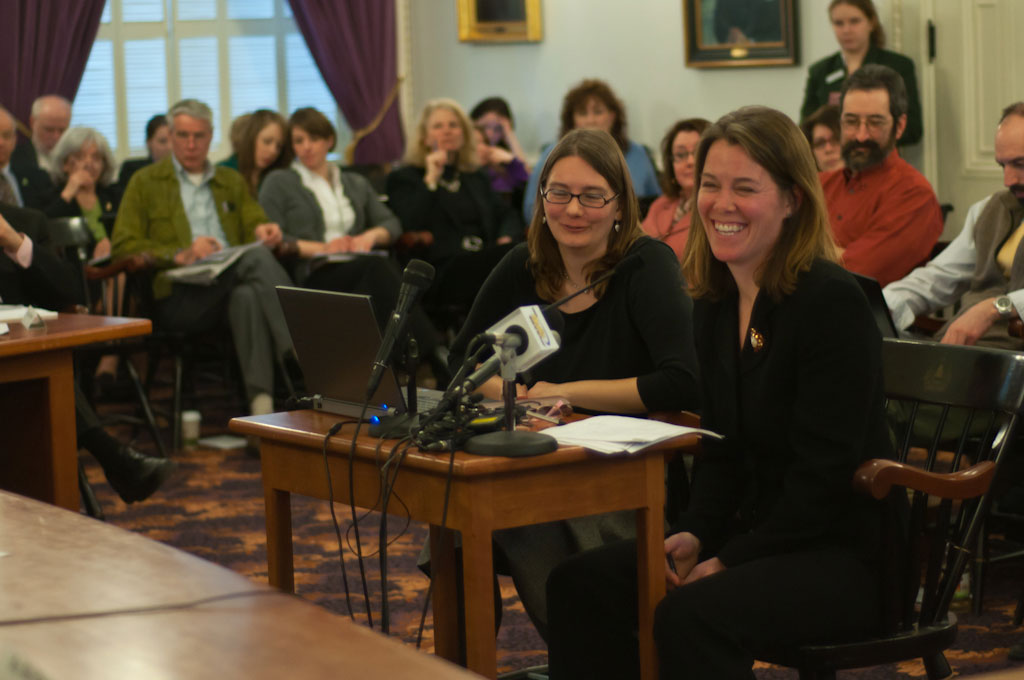
Anya Rader Wallack, who is leading Shumlin’s health care reform effort, said the amendment faces an uphill battle in Congress.
“We’re hopeful, but I think it’s going to take hard work to get that passed,” Wallack said.
Wallack defended the Shumlin administration’s position on waivers. Families USA, she said, understood “what we’re proposing builds on the Affordable Care Act and it embraces the exchanges as the first step.”
Wallack said the waivers that would be available in 2017 or 2014 would hold states to high standards. If states wanted to lower the bar, they wouldn’t have access to a waiver.
“We’ve laid a plan for how to take a step along the way, so it’s not essential,” Wallack said. “It would help if we wanted to move to single-payer sooner, and it would make some difference in our planning –
it would simplify things. We would like to be able to plan for an end point sooner, but it’s not essential.”
Stoll said it’s very important for the Vermont media to put a positive spin on the Affordable Care Act, especially the insurance exchanges, in order to protect the Obama administration’s health care reform law from right-wing attacks in other states.
She said it’s possible Vermont could get the flexibility it needs to pursue single-payer health care under the current law through the Department of Health and Human Services.
Cassandra Gekas, a health care advocate with VPIRG, said Families USA has not asked VPIRG to advocate for a particular point of view. VPIRG plans to use the money for public forums about H.202, the Shumlin’s plan for a universal health care system. The events are co-sponsored by Vermont Health Care for All and Vermont Businesses for Social Responsibility.
Gekas interpreted Stoll’s remarks as an endorsement of Vermont’s attempts to obtain other federal waivers for Medicaid and Medicare that would help to build a larger pool of potential patients in the single-payer system. “Families USA is excited by what Vermont is doing; they want to help us get the waivers it needs,” Gekas said.
The Brown-Wyden amendment, she said, is broad and could open up other states to a more free market approach in which there is less regulation. “Other states don’t share Vermont’s values,” Gekas said.
“They don’t want to be forced to expand coverage to people. They (Families USA) wants to make
sure people in those states are OK. They’re walking that balancing act. They’re enthusiastic about everything we’re trying to do.”
Families USA is less enthusiastic, however, about the Brown-Wyden amendment because it could enable a Republican president to lower the bar for health insurance coverage in 2017. “From their perspective, they feel there is a lot of flexibility in the system.
Without the federal money that comes with the exchanges, Stoll said, Vermont would not be able to afford to move ahead with single-payer. The Affordable Care Act, she said, includes enough flexibility for the state to move ahead with single payer.
