

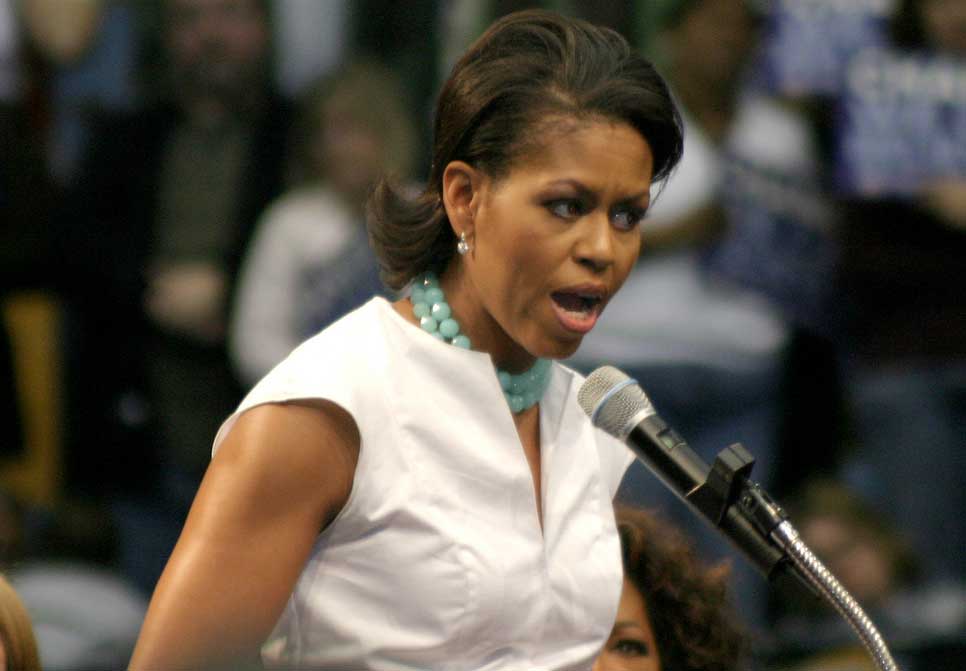
Obama looks to fill hat in Vermont
You are cordially invited … to give the Obama Victory Fund 2012 $5,000.
President Barack Obama announced his re-election campaign two months ago, and First Lady Michelle Obama will make the first pitch for Vermont donations on his behalf when she comes to Burlington for two fund-raisers — an afternoon reception and a private dinner on June 30. At the invitation of Sen. Patrick Leahy, D-Vt., the first lady will also be visiting with the families of Vermont National Guard troops that day.
Tickets to the reception are $100, $250 and $500 per person. The $5,000-a-plate dinner will be held at the ECHO Leahy Center on Lake Champlain. Couples get in for $10,000 (no discount for duos), and the meal comes with a complimentary photo reception. Co-chairs have the option of donating $35,800 — $5,000 to Obama’s campaign and $30,800 to the Democratic National Committee (both amounts represent the maximum that may be contributed to the candidate and the party by law).
During Obama’s first bid in 2008, Vermonters contributed $1.59 million to his campaign, according to opensecrets.org. John McCain, his Republican rival, raised $173,000. Despite its small population size relative to Maine and New Hampshire, Vermont’s donations to Obama were on par with those two northern New England states. Contributors from Massachusetts outstripped donors in neighboring New England states combined; they gave $20.8 million to Obama’s campaign in the last presidential election cycle.
The bill that got away
In a recent column about Gov. Peter Shumlin’s bill signings, we quoted Sue Allen, special assistant to the governor, who said Shumlin didn’t receive a request for a public signing ceremony for the controversial
miscellaneous tax bill, which among other things raises cigarette taxes by 38 cents per pack and increases taxes on health care providers and insurers.
It turns out, the governor did receive a signing request for H.436, but it was one he apparently chose to ignore.
The nature of the request might have had something to do with it. Rep. Oliver Olsen, R-Jamaica, who serves on the House Ways and Means Committee, suggested in a sardonic missive that it would only be fitting for the governor to mark the enactment of the tax bill because it raises property taxes by one penny. Here’s what Olsen wrote:
Dear Governor Shumlin,
It looks like you have a busy couple of weeks ahead of you with a number of bill signings. I appreciate the notifications that I have received from your staff about the bill signing ceremonies around the state. I have not, however, seen anything about when or where you might be signing the Miscellaneous Tax Bill into law.
If this has not yet been scheduled, I would like to invite you to sign the Miscellaneous Tax Bill into law at a ceremony at the Daniel Webster Monument on the Kelly Stand Road in Stratton. After all, this bill
represents a few historic milestones, headlined by the first increase in the statewide property tax rate since the passage of Act 68. A bill of such historic proportions calls for a ceremony!Let me know if we can make this work; I’ll work with your team to make it happen.
Cordially yours,
Rep. Oliver Olsen
Borders may go bust in Burlington
Borders, a national bookstore chain, may close its franchise in Burlington. Borders is in bankruptcy proceedings and has shuttered 220 stores across the country, according to The Wall Street Journal. The
Church Street store is on a list of 51 retail outlets the giant book seller is seeking permission to close in order to comply with the terms of its bankruptcy financing.
American Flatbread fires up in Tribeca
Vermont’s own American Flatbread, one of the first popular purveyors of wood-fired pizza, is opening a retail franchise in Tribeca. The Manhattan beachhead is the Waitsfield-based company’s first foray into New York City, according to a blog post on the Village Voice website. American Flatbread’s newest restaurant will serve liquor into the wee hours on the southwest corner of Hudson and Canal.
American Flatbread has six restaurants, five of which are franchises, including two in Virginia and one in Portland, Ore. The franchises, however, are more than dine-and-dash venues. Each restaurant features
“local, regional, and organic ingredients raised and harvested by farmers we personally know.”
The company sells frozen pizza in more than 30 states and the Virgin and Cayman islands and at mainstream grocery stores like Hannaford’s, Shaw’s and Shop ‘n Save.
FCC issues sobering report on journalism
You know things are bad when the government gets in on the act.
News and nonprofit organizations like the Columbia Journalism Review, the Poynter Institute and the Knight Foundation have been sounding the alarm bells for years about the demise of in-depth news coverage, and now comes the Federal Communications Commission.
The message? Journalism as we once knew it is in steep decline.
The commission determined that all of the data-gathering and prognostication journalism research institutions have engaged in over the last few years is fully justified.
The 475-page report released last week details the decline of newspapering and broadcast journalism as we know it — despite the advent of the Internet and the proliferation of information through vehicles like Facebook, Twitter, Google and even email.
The authors of “The Information Needs of Communities: The Changing Media Landscape in a Broadband Age” assert that journalism is crucial to a healthy democracy. The authors of the report go so far as to quote the Founding Fathers on the subject.
Thomas Jefferson famously said, “Were it left to me to decide whether we should have a government without newspapers or newspapers without a government, I should not hesitate to prefer the latter.” If the vibrancy of our democracy is dependent on the latter, the United States is in trouble.
The key question for news organizations these days is: Got reporters? Not so much anymore. In the last four years, 13,400 newspaper journalists nationwide have gone the way of the dodo. Revenues from newspaper advertising, according to the report, declined 47 percent from 2005 to 2009. Spending on editorial content fell by 25 percent, or $1.6 billion, over that same period. Newspapers across the country have lost a quarter of their editorial staffs since 2006. Newsrooms haven’t been this sparsely staffed since the pre-Watergate era, according to the report.
Consequently, fewer articles are published and more of those stories are based on press releases and press conferences.
The report states that there is less in-depth reporting on topics with social impacts like health care, education and local government. As independent watchdog reporters disappear, government officials are emboldened to push promotional stories and even engage in corruption without fear of discovery or repercussions.
When journalists go missing in action, the kind of independent reporting that provides citizens with information, investigations, analysis and news context that citizens need to make good decisions also disappears, the FCC authors wrote.
The report concluded that without reporters keeping an eye on venality and other abuses of power, America is much more susceptible to the corrosiveness of corruption.
“It is a confusing time,” the authors write. “Breathtaking media abundance lives side-by-side with serious shortages in reporting.… We find ourselves in an unusual moment when ignoring the ailments of local media will mean that serious harm may be done to our communities — but paying attention to them will enable Americans to develop, literally, the best media system the nation has ever had.”
