



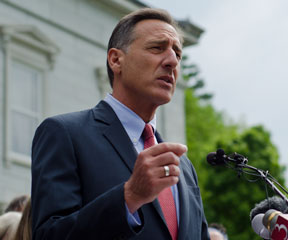
Gov. Peter Shumlin told reporters at the VTrans garage in Berlin that “it’s too soon to tell” whether federal assistance will be available for some of the local businesses damaged in the flood.
“Is there more of this (weather) ahead?” Shumlin asked. “I expect the answer is yes.”
Flood estimates are in flux as state and local officials continue to survey the ongoing damage to public infrastructure, but Scott Rogers, the director of the operations division at the Vermont transportation agency, said preliminary reports show that the state has sustained $15 million to $16 million dollars worth of damage to roads, bridges, culverts and other public infrastructure.
The Federal Emergency Management Agency, which covers cost of local infrastructure damages, estimated roughly $5 million of damages prior to last week’s heavy rainfall – an additional $3 million has been estimated since, according to Rogers.
The state is waiting for an emergency declaration from President Barack Obama for assistance. If the request is granted, the federal government will pay for 75 percent of the damages. It is, however, unclear when a response will come from the federal government. Susan Allen, special assistant to the governor, said the disasters occurring all over the country may have an impact on FEMA’s response time.
In the past, the remaining 25 percent of disaster costs has been split between local communities and the state, however with the unprecedented amount of water and damages it is unclear how it will play out.
According to the governor, more than 100 employees from districts six, seven and four have been working non-stop since the state was deluged with 6 inches of rain in six hours.
A variety of private contractors have stepped in to help. As a result, the state’s cost for damages so far has only amounted to $1.6 million. The costs will soar when the private contractors begin billing the state.
“The priority is to make sure all existing roads are reopened,” Shumlin said. “We are almost at the point where we will have everything reopened shortly.”
At the signing ceremony, many state employees who have been working on the ground throughout the recovery stage of the disaster were present. The governor, along with both Mayors Mary Hooper and Thomas Lauzon, were appreciative of the ongoing efforts of volunteers.
“I’m incredibly grateful as governor to all the hardworking employees that are out rebuilding roads, culverts and putting in temporary bridges,” Shumlin said.
George McCool, the general manager of district six, worked through the night Friday on only two hours of sleep was modest about his key role during the flooding saying, “I’m just another guy to get the job done.”
“It’s been a tri-province-state effort,” Shumlin said, who has been in communication with New York’s governor Andrew Cuomo along with Quebec’s premier Jean Charest who, according to Shumlin, are dedicated to work together to serve the people and get assistance to those in need during this “tough situation.”
Mayor Lauzon has been working tirelessly every day (including his birthday which was Monday) to get Barre cleaned up is determined to get the job done.
“When I go home at night I’ve got a warm place to sleep, I’ve got food in my refrigerator and I’ve got a cold beer… I will continue working 20 hours a day until everyone in Central Vermont can make that same statement,” Lauzon said.
