

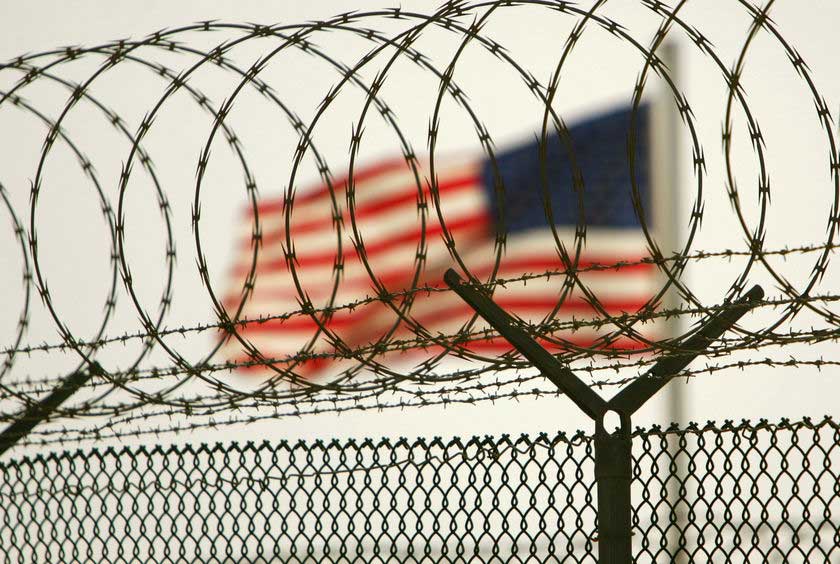
If U.S. forces had captured Osama bin Ladin alive, how would he have been handled? Burlington attorney Bob Rachlin has defended two prisoners held at Guantanamo since September 11, and he has been present at military tribunals there. He spoke Monday on WDEV’s Equal Time Radio. While he cautioned that he could only offer speculation, Rachlin said he believes that Osama would have faced a military tribunal. Fears of attempts to break Osama out of prison, Rachlin said, would have meant that he would have been taken far from U.S. facilities in Pakistan, Afghanistan, or other areas with an active insurgency, probably to the detention facility at Guantanamo Bay.
“I think that if the President had his way,” Rachlin said, “all of the high-value detainees, such as Khalid Shaikh Mohammed, would be tried in our civilian courts, because our own law and our own legal institutions are fully capable of dealing with these people. But the President’s hands have been tied by Congress.” Congress has prohibited spending money to try Sheik Mohammed in a civilian court.
In this case, Rachlin argues, the civilian court might not have been the best solution. “The case of Osama bin Ladin, however, might have been the rare case where it really would have been better to try him before a military tribunal at Guantanamo, because there would likely be much more justified widespread concern about public safety.”
Rachlin pointed out that over 70 people have been tried on terrorism charges in the US since 2001, with the vast majority of the cases resulting in convictions. That shows, he said, that the civilian justice system works for international terrorists.
Maine “food sovereignty” expert comes to Vermont
At their town meetings in March, three coastal Maine communities declared food sovereignty for the purposes of supporting local food production. Regardless of what state or federal law requires, they said, direct sales of food to consumers are exempt from inspection and licensing requirements. Bob St. Peter, one of the organizers behind the ordinances, is coming to Vermont this week. He spoke Monday on WDEV’s Equal Time Radio.
In Vermont, farmers can sell up to 1,000 chickens a year that they have slaughtered outdoors on their farms. St. Peter said the ordinance in the three Maine towns was in response to the state’s refusal to allow a similar exemption. The towns explicitly exempt producers or processors of local food from state and federal requirements when they are selling direct to consumers, for home consumption. St. Peter says that state and federal authorities have not accepted the ordinance.
“The three towns that passed this ordinance, Sedgwick, Penabscot, and Blue Hill, all received letters from the commissioner of the department of agriculture, saying that this ordinance violates the state’s ability to pre-empt local rules that stifle or interfere with state or federal requirements. From what I understand, the Feds are putting pressure on the state to do something about this.”
St. Peters argues that webs of trust and accountability make for a robust, safe local food system. “There’s always friendly competition, there’s always the prospect that if you sell something that is not good or inferior in any way or somehow shouldn’t be sold, then people are going to know about it. So there has been this self-regulating mechanism that happens in small, rural communities. If you are focusing on direct, face-to-face sales, selling it to the people who are going to eat your food, then you’ve got transparency, you’ve got immediate traceability, and you’ve got full accountability. Those are the three legs of the stool of a healthy, safe, robust food system.”
St. Peter will be the keynote speaker at Rural Vermont’s annual meeting in Richmond Wednesday night. He will also speak Thursday evening at Green Mountain College in Poultney.

