


“It wasn’t fair that [other kids] could wake up safe in the morning,” a young man says, recalling his childhood in an abusive family.
“I was constantly in fear, wondering what was going to be my father’s next move,” a young woman says.
“She’s crazy, this is bad, I’m in a bad situation,” another young man remembers realizing about his mother.
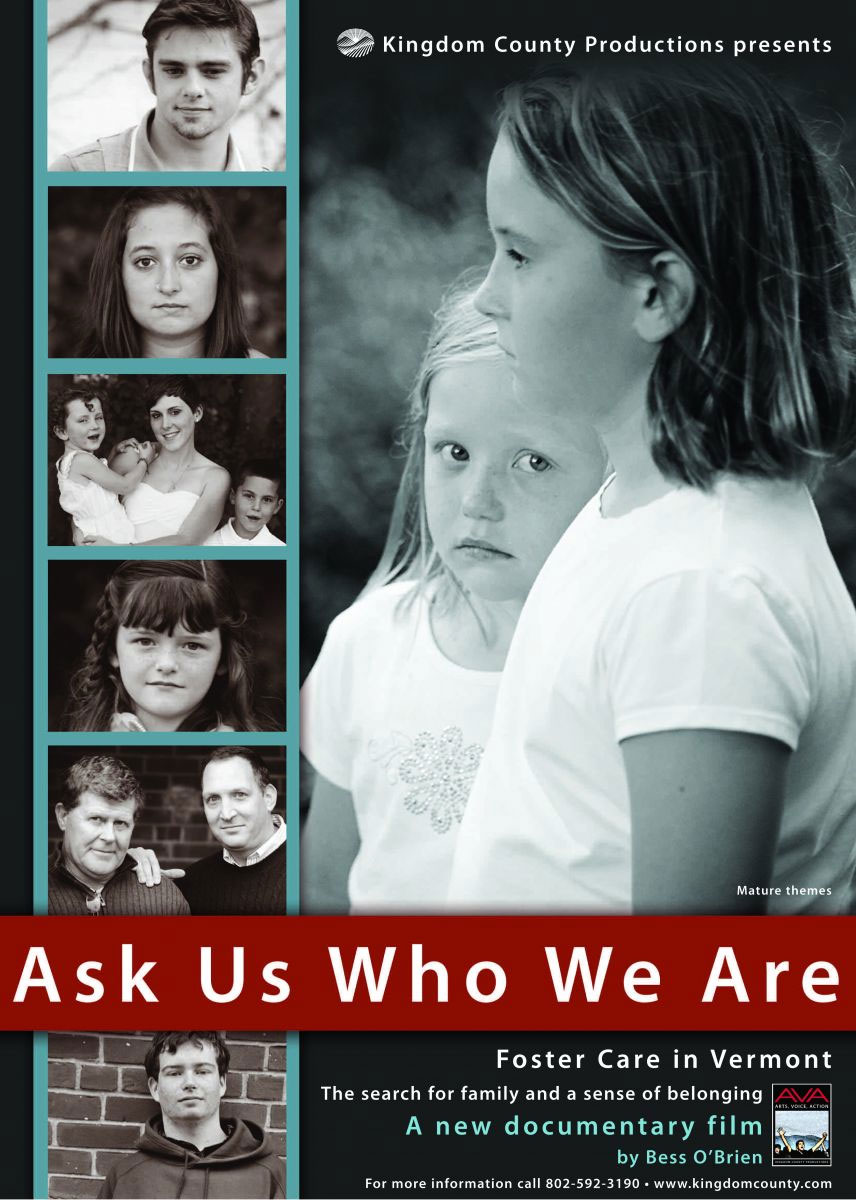
Bess O’Brien’s latest film, “Ask Us Who We Are: Foster Care in Vermont,” begins with a series of teens and young adults recalling their childhoods. They tell harrowing stories of abuse at the hands of fathers and mothers, and heartbreaking tales of families torn apart by alcohol, substance use and mental illness.
But the fear and uncertainty of these unstable homes quickly becomes fear and uncertainty of a different sort, as these youngsters are removed from their homes and placed in foster care.
The fateful day that one unpredictable situation was traded for a situation equally unpredictable is etched in their memories.
“Imagine just getting dropped in a stranger’s house,” one youngster entreats the audience.
“You move in…and hope that they’re nice,” another says. Underlying this uncertainty is an emotion of a different kind, perhaps not obvious to someone who can’t imagine why getting out of a bad situation wouldn’t seem like the best thing in the world.
“It’s the most devastating thing in the world to have your parents reject you,” a young man explains.
“Ask Us Who We Are” weaves together the stories of a dozen young people who were or are in foster care, and 20 adults, including foster parents, non-parental family members caring for related children and parents who gave up their children into foster care. Their stories are skillfully woven into a compelling narrative, highlighting the universal aspects of foster care while maintaining the individuality of each person interviewed.
O’Brien is currently screening the film on a statewide tour through May 20. Early screenings have received positive feedback and some high-profile guests, including Gov. Peter Shumlin and Secretary of the Agency of Human Services Doug Racine.
“People are moved by the stories,” O’Brien said. “The film opens up a world people didn’t know about or thought they knew about.”
O’Brien was prompted to make the film when a young woman who’d seen her previous film, “Shout it Out,” contacted her.
“She said, ‘I was in foster care and no one knows our stories—we’re invisible. Would you make a movie about us?,’” O’Brien recalls. O’Brien met with the woman, Kellie Coakley, who is featured in the film, and then began pre-production, meeting with officials from the Department of Children and Families to gain access to children and families, and with funders to begin raising the $200,000 needed to shoot, edit and produce the film.
“I’m a filmmaker first,” O’Brien states, “but I like to stir things up a little bit. In Vermont, you can tell a story like this and begin a conversation about the issue.”
The film premiered at the Green Mountain Film Festival in Montpelier in March where it showed to an almost-sold out audience, according to Ellen Cheney, president of the board of directors of Focus on Film, the organization that sponsors the festival.
“A lot of people were shocked to hear kids say that being taken away from their family was just as bad as the situation they’d been taken from,” Cheney said.
The film includes interviews with several mothers who chose to give their children into foster care because drug or alcohol addiction made them unable to provide the care they knew their children needed.
“I was relieved,” one mother says of her decision, knowing that her child would be cared for better than she was able to do herself at the time.
The foster parents and kinship caregivers have a voice in the film. Foster parents work hard to build trust with children who’ve learned distrust as a survival skill. The foster parents also negotiate tricky visits with biological parents. Then, often but not always, they send the child back to their biological parent(s).
“Letting her go back…is excruciating,” one foster parent says. “All you can do is pray.”
In addition to introducing the public to the strengths and challenges of the foster care system in Vermont, the people in the film who share their stories connect with a larger narrative.
“I’ve made a lot of films like this and I can say, telling your story is empowering,” O’Brien says. “It’s a surprise to some [subjects] that their stories are honored by strangers; it’s a surprise to some that their stories are universal.”
Several of those interviewed have posted on the Kingdom County Productions Facebook page, thanking O’Brien for telling their stories.
“Some of this stuff never goes away,” O’Brien notes. “Not everybody in the film is doing great. Some are still struggling.”
Currently, 985 children are under the care of the Department of Children and Families, according to Cindy Walcott, Deputy Commissioner of the Department. More than half of those children are placed with foster families; the others are placed with relatives or in other settings. Stipends for foster families, and other line items related to foster care are level-funded in the FY2012 budget, says Walcott.
In between stops on the tour, O’Brien is working with the Department of Education and the Vermont NEA to have the film shown in schools. She’s hopeful that the film’s tour will raise consciousness about foster care in Vermont.
“If we can create empathy, if we change one person’s mind about what foster care is, or get three people to sign up to be foster parents, I’ll be happy,” O’Brien says. “This is an issue about what our communities should look like and how we support each other.”
