


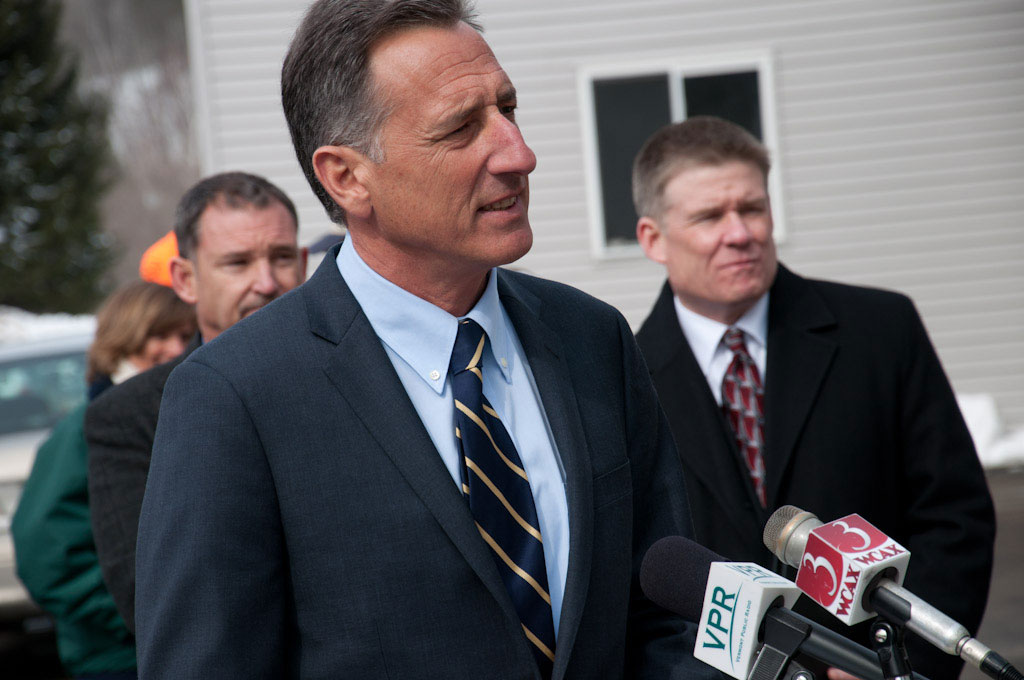
Gov. Peter Shumlin has been spending more time at the Statehouse this week. He even paid a visit to the cafeteria on Wednesday to break bread with House Speaker Shap Smith and others. (The governor has graced the dining hall a handful of times over the course of the session.)
It’s not the governor’s usual breakfast haunt, and so when he walks into the room with his security entourage in tow, Shumlin draws a fair amount of attention.
It was a reminder that the governor has been a presence in the Statehouse this week.
Shumlin has been lobbying senators to drop the cigarette tax.
Shumlin has said from the beginning of the session that he would object to the levy on tobacco, but no one in the building knew just how aggressively he would protect that stance — until this week.
Shumlin has pressed senators to agree with his anti-cigarette position, despite Senate President Pro Tem John Campbell’s objections. The governor was determined to levy a $3.2 million tax on the dentists, which both the House and the Senate have refused to impose in the miscellaneous tax bill.
“The governor was adamantly opposed to a cigarette tax — especially a $1 a pack tax — so he (Shumlin) talked to several members in the Senate,” Campbell said.
That was yesterday. Today it appeared that support in the Senate for the tax, Campbell said, “wasn’t as strong as he wanted it to be,” and so he negotiated with Shumlin to drop the increase to 53 cents and instead bump up the assessment on health insurance claims from 0.65 percent to 0.9 percent.
Shumlin has insisted on a provider tax for dentists; Campbell refused to agree to the proposed assessment.
So, is the governor throwing his weight around more than usual? Campbell says Shumlin’s tactics are typical of any governor. Campbell characterized the meetings with individual senators as the governor’s prerogative, and he said both Gov. Howard Dean and Gov. Jim Douglas pulled lawmakers aside to change their votes on a given issue. “He’s well within his rights to bring members in,” Campbell said. “That happened all the time.”
As for the Statehouse scuttlebutt that Shumlin is attempting to run the Senate from the Fifth Floor, Campbell says: “People are going to say whatever they want…“Anyone who thinks I’m doing Peter Shumlin’s bidding is wrong. I think it’s been clear I’m my own person. My intention is to protect the Senate’s position.”
The resolution of the tax bill revenue sourcing paves the way for passage of the budget bill.
Budget bill cuts state spending by 3.7 percent over fiscal year 2011
The Senate Appropriations Committee voted out the Big Bill 5-0 on Wednesday, and it’s scheduled to hit the floor on Thursday.
The committee’s budget for fiscal year 2012 is largely based on the House bill. The total state budget for fiscal year 2012 is $4.68 billion, and that total represents 3.7 percent less than the previous year’s expenditures, according to the Joint Fiscal Office. Over a three year period, state spending has increased 2.3 percent.
The total General Fund budget spending increased by 7.3 percent in fiscal year 2012. That’s because the state had to replace $158 million in stimulus funding for core programs with General Fund dollars. The overall increase in the General Fund budget from 2009 to 2012, is 2.6 percent, according to the Joint Fiscal Office.
Sen. Jane Kitchel, D-Caledonia, described the budget process as a “daunting task.”
“The reductions are marbled throughout state government,” Kitchel said.
The Senate’s budget deviates from the House version by about $500,000. The governor had recommended more dramatic cuts to human services. Both the House and Senate agreed to soften the reductions in programs for the elderly, the developmentally disabled and the mentally ill. All three areas of the Agency of Human Services budget, however, took significant reductions.
The designated agencies will see a $5.5 million reduction (including Medicaid matching money) in funding for services to Vermonters who are developmentally disabled or mentally ill.
Funding for respite care and personal assistants for elderly Vermonters was not fully restored. The programs could see an $800,000 reduction unless, as expected, the Choices for Care program, which provides supports for seniors who want to stay in their own homes, saves money on nursing home care.
- Shumlin eliminated the substance abuse counselor program for local high schools; lawmakers funded the positions at a 50 percent level.
- The Vermont Employee Ownership Center is zeroed out.
- The Area Agencies on Aging will see a $180,000 cut.
- The budget includes $29 million in the human services caseload reserve. That money is a cushion in the event that demand for services increases again, as they did at the beginning of the recession.
- Kitchel said they didn’t include $4.1 million in payments on interest for Unemployment Insurance from the federal government that were forgiven.
Any revenue above the forecast level would be set aside for the state’s Unemployment Insurance interest payment; another waterfall contingency plan would reserve money for unanticipated federal cuts to programs.
