

Editor’s note: The video footage of this hearing at the end of this post was shot and edited by Catherine Hughes.
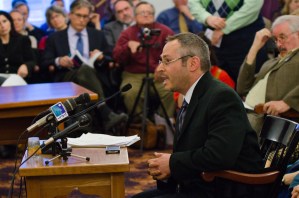
Doctors who testified at a hearing on Thursday were divided on the merits and potential pitfalls of the health care reform bill, H.202, which is now under consideration in the Senate Health and Welfare Committee. The legislation creates a framework for a universal, unified health care system in Vermont.
Physicians said the bill, which is designed to contain health care costs, would have a negative impact on the state’s ability to retain and attract physicians in urology, neurology, obstetrics, orthopedic surgery, oncology, emergency care, and other specialized medical fields. Most of the doctors who testified were from Fletcher Allen Medical Center. A number of hospital administrators also spoke in opposition to the bill.
Most primary care doctors, nurse practitioners and nurses, at the hearing, supported the legislation.
The split between specialists and general physicians reflect an economic divide in medicine.
Surgeons in Vermont, for example, earn $197,000 a year on average in 2009; anesthesiologists bring hone $185,000 annually, according to the Bureau of Labor Statistics. Internists on the other hand received about $137,000 that year; and primary care doctors made $133,000.
The average medical student leaves the University of Vermont with $200,000 in debt, according to several professors who testified at the hearing.
Many of the physicians, who prefaced their remarks by saying they considered themselves to be small business owners, said they supported reforms in theory. The potential reality, however, when the reforms go into effect in 2014, presents “uncertainties” that they find worrisome enough to contemplate leaving the state. They are worried about how the system will be funded, about whether the state will be able to recruit specialists in addition to general practitioners, and whether the cost containment strategies – particularly the effort to reduce administrative costs — will hurt their practices financially.
Dr. Julia Brock, a gynecologist at Fletcher Allen Health Care, said she and her husband, a gynecological oncologist, chose to live in Vermont, even though they could have made considerably more money elsewhere. “What I’m for is careful planning,” Brock said. “I don’t see how I’m going to save money (under the new system). The big take home message is: I don’t want to leave the state.”
Dr. Allan Ramsay, a professor of family medicine at the University of Vermont, said general practitioners have made financial sacrifices to stay in practice. Most are committed to taking Medicare and Medicaid patients for whom reimbursements are much lower than those who are covered under private insurance, he said.
“I have heard reference to physicians leaving Vermont because of this health care reform,” Ramsay said. “I am not surprised about this response because a colleague recently reminded me that we have all become psychologically dependent on the fee for service system. In other words primary care, specialists, administrators, and insurers are all addicted to fee for service. I have treated many patients with addiction in my 30-year career. The way to treat an addiction is by doing an intervention, which you are doing, and then prescribing a recovery program. Family physicians are ready to recover from this dependency. Those who continue to be in denial about their addiction will relapse, and find other places to work the fee for service system. Those of us who do recover will flourish in a system that makes everyone as accountable as family physicians have been for generations in Vermont.”
~Anne Galloway
